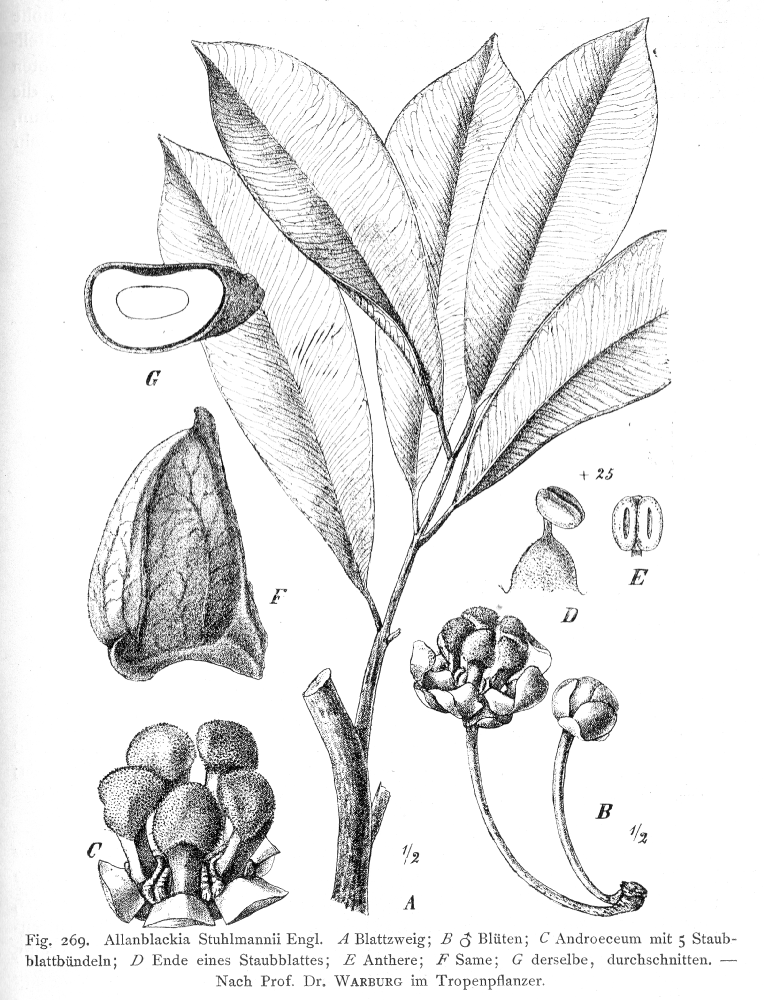
Allanblackia is a genus of evergreen trees in the family Clusiaceae (order Malpighiales), native to the tropical rainforests of sub-Saharan Africa. Molecular phylogenetic analyses indicate that the genus is nested within the dioecious genus Garcinia, though it continues to be treated as a separate group by many authors. GBIF recognises nine species within the genus.
Members of the genus are medium to large canopy and understorey trees, reaching up to 30 metres in height. The bole is typically short, straight, and cylindrical. All species are dioecious and insect-pollinated, meaning separate male and female trees must be present for fruiting. The fruits are exceptionally large — up to 30 cm long and 10 cm in diameter — and contain more than 100 seeds embedded in a translucent mucilage. Under natural conditions trees begin flowering only after approximately 12 years.
The genus is best known economically for the high-quality solid fat extracted from its seeds, commonly called Allanblackia oil or allanblackia fat. The seed kernel constitutes about 60% of the seed by weight and contains roughly 72% fat, composed primarily of stearic acid (45–58%) and oleic acid (40–51%). The fat is solid at ambient temperatures with a melting point around 35 °C, making it a valued natural ingredient in margarines and cocoa-butter substitutes. Commercial cultivation programmes are under way across West and Central Africa.
Species range from Upper Guinea in the west (notably A. parviflora) through the Congo Basin (A. floribunda, A. stuhlmannii) to the Eastern Arc Mountains of Tanzania. The genus name honours Allan Black, a nineteenth-century Scottish botanist.
Etymology
The genus name Allanblackia commemorates Allan Black, a nineteenth-century Scottish botanist. No further explanation of the epithet is given in the primary sources consulted.
Distribution
Allanblackia species are restricted to the moist tropical forests of sub-Saharan Africa. The range extends from Upper Guinea (Ghana westwards) through Nigeria, Gabon, the Congo Basin, and DR Congo, south to Angola, with eastern outliers in the Eastern Arc Mountains of Tanzania (Usambara and Uluguru ranges). Individual species occupy distinct sub-ranges within this overall band.
Ecology
Species of Allanblackia grow as understorey or canopy trees in lowland closed evergreen rainforest, riverine forest, secondary forest, and swamp forest, typically at elevations up to 1,000 m. They favour strongly leached, acidic soils (pH 3.8–4.1) with mean annual rainfall of 1,200–2,400 mm and maximum mean annual temperatures of 24–33 °C. All species are dioecious and insect-pollinated.
Cultural Uses
The seeds of Allanblackia trees yield a solid fat — known locally as beurre de bouandjo in the Congo — used for centuries in local food preparation. Seeds and oil are sold in traditional markets across West and Central Africa. The seed fat has attracted international commercial interest as a natural solid component for margarines and cocoa-butter substitutes, owing to its high stearic and oleic acid content and relatively high melting point. Beyond food, the fruit pulp is used to make jams and jellies, and seeds are eaten during food scarcity. Bark decoctions serve medicinal purposes including treatment of diarrhoea, dysentery, stomach ache, toothache, asthma, bronchitis, and cough.
Cultivation
Allanblackia is grown in wild, semi-cultivated, and cultivated settings. Trees require a moist tropical climate with mean annual rainfall of 1,200–2,400 mm and perform best in a sunny position on well-drained soils. Efforts are under way to establish large-scale commercial plantations, particularly for A. floribunda, A. parviflora, and A. stuhlmannii, driven by demand from the international food industry. Trees grown from seed take approximately 12 years to reach first flowering under natural conditions.
Propagation
Propagation from seed is slow and unreliable: germination takes 6–18 months and success rates are very low. Storing fruits on damp sites covered with banana leaves and scarifying the seedcoat improve germination rates only marginally. Vegetative propagation techniques — cuttings and grafting — are under active development to accelerate commercial production and reduce the time to bearing.










