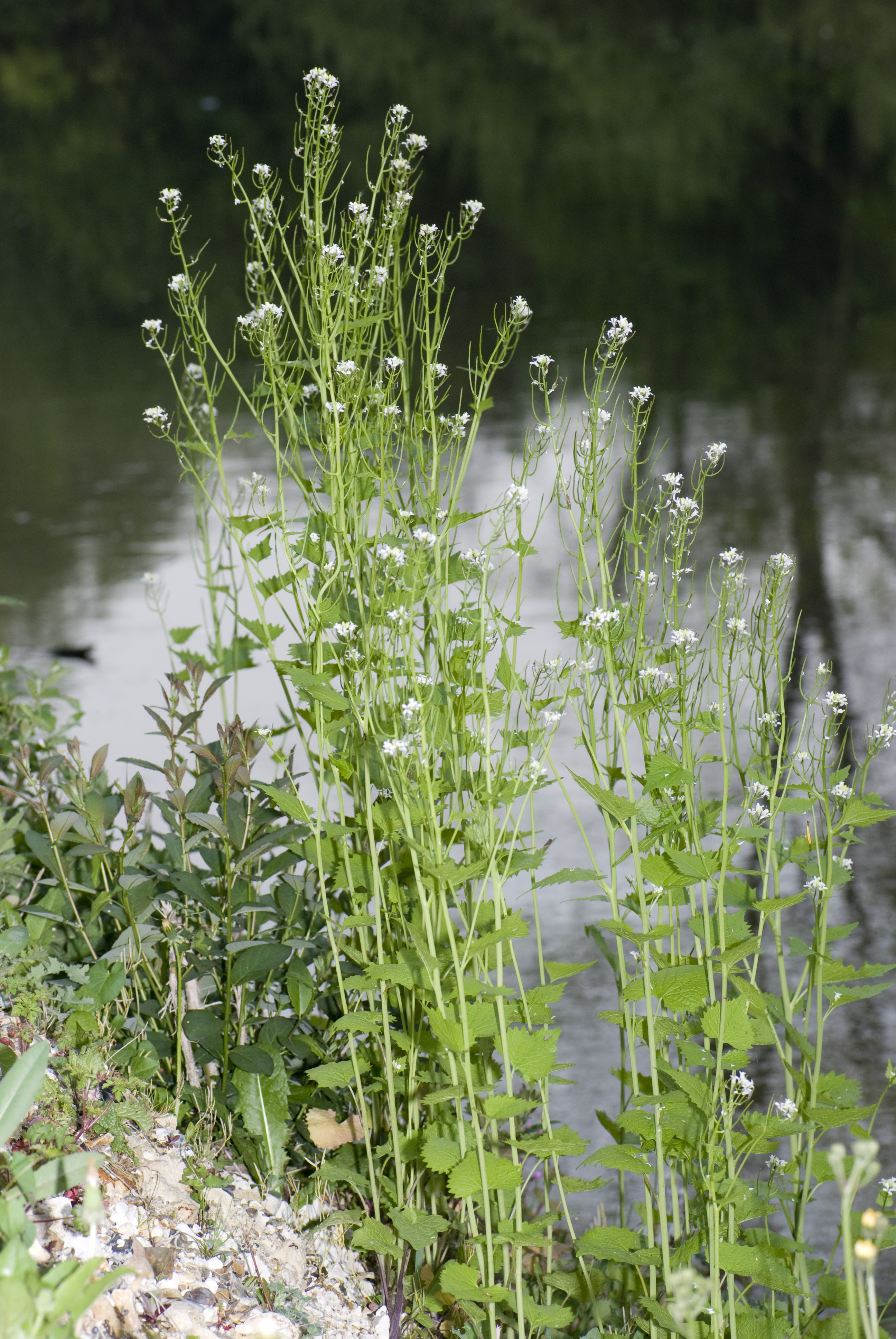
Alliaria is a genus of flowering plants in the mustard family (Brassicaceae, order Brassicales). It is native to Europe, western and central Asia, and north-western Africa, and comprises two recognized species. The most widespread and well-known member is Alliaria petiolata, commonly called garlic mustard — a biennial herbaceous plant named for the garlic-like odour its crushed foliage emits.
Garlic mustard grows from a thin, whitish taproot and forms a rosette of round, slightly wrinkled leaves in its first year. In its second year, it sends up flowering stems 30–100 cm tall bearing stalked, triangular to heart-shaped leaves with coarsely toothed margins. The small white flowers are cross-shaped (four petals, 4–8 mm), produced in dense terminal clusters in spring. The fruit is an erect, slender, four-sided silique 4–5.5 cm long, containing two rows of small shiny black seeds that scatter when the pod splits open. A single plant can produce hundreds of seeds. All parts of the plant carry the characteristic garlic scent. Young first-year plants contain up to 100 ppm cyanide (eliminated by chopping).
Alliaria petiolata is a tenacious invasive species across the northern United States and south-eastern Canada, where it is one of the few herbaceous plants capable of dominating forest understories, reducing native biodiversity and proving toxic to larvae of certain native butterflies. In its native range it is host to 69 insect herbivores and seven fungi, with weevils of the genus Ceutorhynchus being notable natural enemies.
The genus has a long history of human use: phytolith evidence in European pottery dating to 4100–3750 BCE marks it as one of the oldest known spices. Traditionally used as a flavouring, diuretic, and wound disinfectant, its young leaves are still used today in salads, pestos, and sauces.
Etymology
The genus name Alliaria means "resembling Allium" (the onion genus), referring to the strong garlic-like odour released when the plant's foliage is crushed. All parts of the plant, including the roots, carry this scent.
Distribution
Alliaria is native to Europe, western and central Asia, and north-western Africa, ranging from the British Isles and Iberia north to Scandinavia and east to Pakistan and Xinjiang in western China. Alliaria petiolata was introduced to North America by European settlers in the 1800s and has since become invasive across the northern United States and south-eastern Canada, absent only from the far south and some prairie states and provinces.
Ecology
In its native range, garlic mustard grows along hedgerows and in woodland understories. It supports 69 insect herbivores and seven fungal species, with weevils (Ceutorhynchus spp.), leaf beetles, butterflies, and moths being important natural enemies. Flowers are self-fertile but also visited by midges and hoverflies.
In North America, it is a highly invasive understory species — one of the few herbaceous plants able to dominate forest floors, where it reduces biodiversity, inhibits ectomycorrhizal fungi, and is toxic to larvae of native pierid butterflies (Pieris oleracea, Pieris virginiensis). Biological control using specialist weevils (C. scrobicollis, C. constrictus) has been researched since the 1990s but not yet approved for release in the United States.
Cultivation & Uses
Garlic mustard has been used as a culinary herb since prehistory: phytolith evidence in pottery of the Ertebølle and Funnelneck-Beaker cultures (4100–3750 BCE) marks it as one of Europe's oldest spices. In 17th-century Britain it was recommended for flavouring salt fish and as a sauce for roast lamb. Chopped young leaves (best when young) are used today in salads, pestos, and sauces, contributing both garlic and mustard notes. The seeds are occasionally used as a seasoning in France. Historically it was also planted for erosion control and used medicinally as a diuretic and wound disinfectant.










