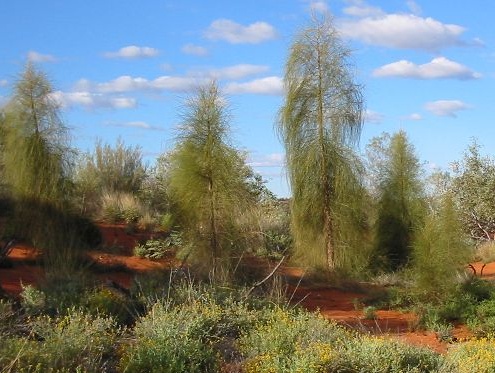
Allocasuarina, commonly known as she-oak or sheoak, is a genus of flowering plants in the family Casuarinaceae (order Fagales) endemic to Australia. The genus comprises trees and shrubs recognised by their soft, pendulous green branchlets and leaves reduced to 4–14 scale-like teeth arranged in whorls around ribbed, jointed stems — giving the plants a feathery, conifer-like appearance.
Plants are either monoecious (bearing both male and female flowers on one plant) or dioecious (with separate male and female individuals). Male flowers are borne in slender spikes along the branchlets, while female flowers develop on short side-branches and mature into distinctive cone-like fruiting structures. The enclosed seeds are winged samaras, reddish-brown to black in colour, with thickly woody bracteoles that extend only slightly beyond the cone body — a key diagnostic feature separating Allocasuarina from its close relative Casuarina.
The genus was formally described in 1982 by Australian botanist Lawrence Johnson in the Journal of the Adelaide Botanic Gardens. At the same time, Johnson transferred a number of species previously placed in Casuarina into the new genus, with Allocasuarina torulosa designated as the type species. GBIF recognises 19 accepted species within the genus.
Most species grow in nutrient-deficient soils across southern Australia, though four species extend into north-eastern Queensland and one occurs in the north of Western Australia.
Etymology
The name Allocasuarina means "other Casuarina", combining the Greek prefix allo- ("other") with the genus name Casuarina. The name reflects the genus's close relationship with — and former inclusion within — Casuarina, from which it was formally separated in 1982.
Distribution
Allocasuarina is endemic to Australia. Most species are concentrated in southern Australia, typically growing in nutrient-deficient soils. Four species occur in north-eastern Queensland and one species is native to the north of Western Australia.
Taxonomy Notes
Allocasuarina was segregated from Casuarina by Lawrence Johnson in 1982, based on consistent morphological differences: Allocasuarina species have 4–14 scale-like teeth per whorl (versus 6–20 in Casuarina), reddish-brown to black samaras (versus grey or yellowish-brown), and fruiting cone bracteoles that extend only slightly beyond the cone body (versus well beyond in Casuarina). The type species is Allocasuarina torulosa.










