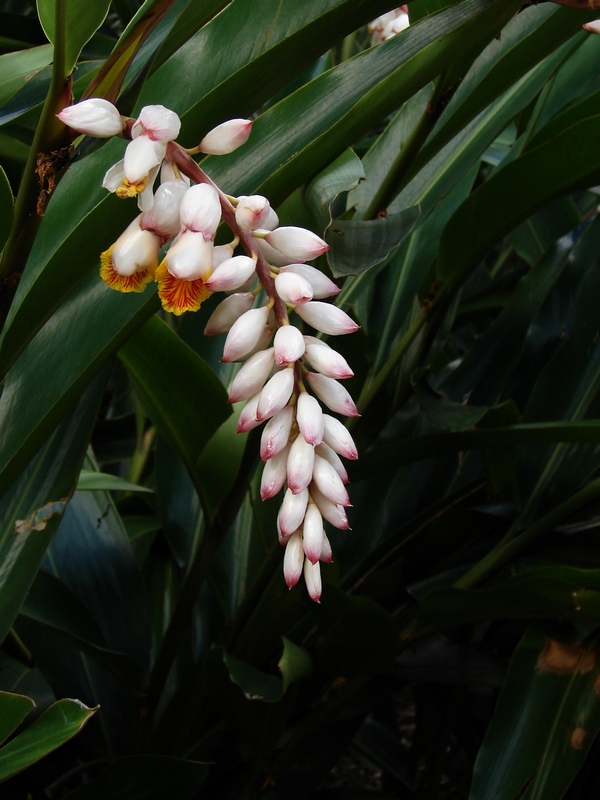
Alpinia is the largest genus in the ginger family (Zingiberaceae), comprising around 250 or more accepted species of aromatic herbaceous plants native to tropical and subtropical Asia and the Pacific. Plants grow from thick, fleshy rhizomes and produce tall pseudostems — leafy shoot structures formed by overlapping leaf sheaths — that typically reach 2–3 metres in height, though some species may attain 8 metres. The lance-shaped to oblong leaves are arranged alternately along the pseudostem and release a spicy fragrance when crushed.
Flowers are produced in upright spikes, panicles, or racemes. Each flower has a shallowly toothed calyx and a cylindrical corolla tube with three lobes. A distinctive petal-like labellum, formed by fused staminodes, is the showiest part of the flower and often bears bold coloration. A single fertile stamen bears the pollen. Fruits are rounded capsules, either dry or fleshy, and the entire plant — rhizomes, stems, leaves, and fruits — is aromatic owing to abundant essential oils.
The genus spans a broad geographic range, from the Himalayan foothills and the Indian subcontinent through Southeast Asia to southern China, Japan, the Philippines, New Guinea, Australia, and across the Pacific islands as far as Fiji, Samoa, and Vanuatu. Within this range, Alpinia species typically occupy the shaded understorey of tropical forests, often along streamsides or in moist montane habitats. Pollination is carried out mainly by large bees, though some species are visited by birds or bats.
Alpinia is economically important across its native range. The rhizomes of Alpinia galanga (greater galangal) are an essential ingredient in the cuisines of Thailand, Indonesia, and neighbouring countries. Several species have a long history in traditional medicine, and modern research has identified anti-inflammatory, hypolipidemic, and anti-tumour activities in various Alpinia extracts. Ornamentally, species such as Alpinia purpurata (red ginger) and Alpinia zerumbet (shell ginger) are prized in tropical and subtropical gardens worldwide for their striking inflorescences.
Etymology
The genus name Alpinia honours Prospero Alpini (1553–1617), an Italian physician and botanist celebrated for his pioneering studies of exotic plants, particularly those of Egypt and the Middle East. The name was applied by William Roxburgh when he formally described the genus in 1810, publishing it in Asiatic Researches (volume 11, page 350).
Distribution
Alpinia has its centre of diversity in tropical Asia, with species recorded across a vast arc from Nepal and the Indian subcontinent (including the Andaman and Nicobar Islands, Sri Lanka, and Bangladesh) through mainland Southeast Asia (Myanmar, Thailand, Laos, Cambodia, Vietnam), southern China (including Hainan), Taiwan, and Japan (including the Ryukyu Islands). The genus extends through the Malay Archipelago — Borneo, Sumatra, Java, Sulawesi, the Maluku Islands, and the Lesser Sunda Islands — and into the Pacific, reaching the Philippines, New Guinea, the Solomon Islands, Vanuatu, New Caledonia, Fiji, Samoa, and the Caroline and Volcano Islands. In Australia it occurs in Queensland and New South Wales. Several species are cultivated well outside this native range and have naturalised in parts of the Americas, Africa, and other tropical regions.
Ecology
Alpinia species are primarily plants of the humid tropical forest understorey, thriving in the filtered light and high moisture of lowland and montane rainforests, forest margins, and stream banks. Their tall pseudostems allow leaves to intercept light in shaded environments, while the robust rhizomes store water and nutrients. Pollination is predominantly carried out by large bees attracted to the nectar-rich, petal-like labellum; some species have evolved bird or bat pollination, a pattern associated with particular floral colours and morphologies. The fleshy fruits of many species are dispersed by birds and mammals.
Taxonomy notes
Alpinia Roxb. (1810) is placed in the family Zingiberaceae (the ginger family) within the order Zingiberales, class Liliopsida (monocots). It is recognised as the largest genus in Zingiberaceae. GBIF records 377 descendant taxa under the genus, while species-level accepted counts in the literature vary around 249; the discrepancy reflects synonyms, unresolved names, and ongoing taxonomic revision of this large tropical group. The genus was established by William Roxburgh and has remained broadly circumscribed, though individual species limits continue to be refined by molecular and morphological revisionary work.
Cultural uses
Within its native range Alpinia has been woven into cuisine, medicine, and ritual life across many cultures. The rhizomes of Alpinia galanga (greater galangal) are indispensable in Thai, Indonesian, and Malaysian cooking, used fresh or dried to flavour soups, curries, and spice pastes. Alpinia officinarum (lesser galangal) has a long history in Chinese and Ayurvedic medicine, used as a digestive tonic and remedy for nausea and inflammation. Modern pharmacological research has found anti-inflammatory, antioxidant, hypolipidemic, and anti-tumour activities in various Alpinia extracts. Ornamentally, Alpinia purpurata (red ginger) is a major cut flower in tropical floriculture worldwide.

