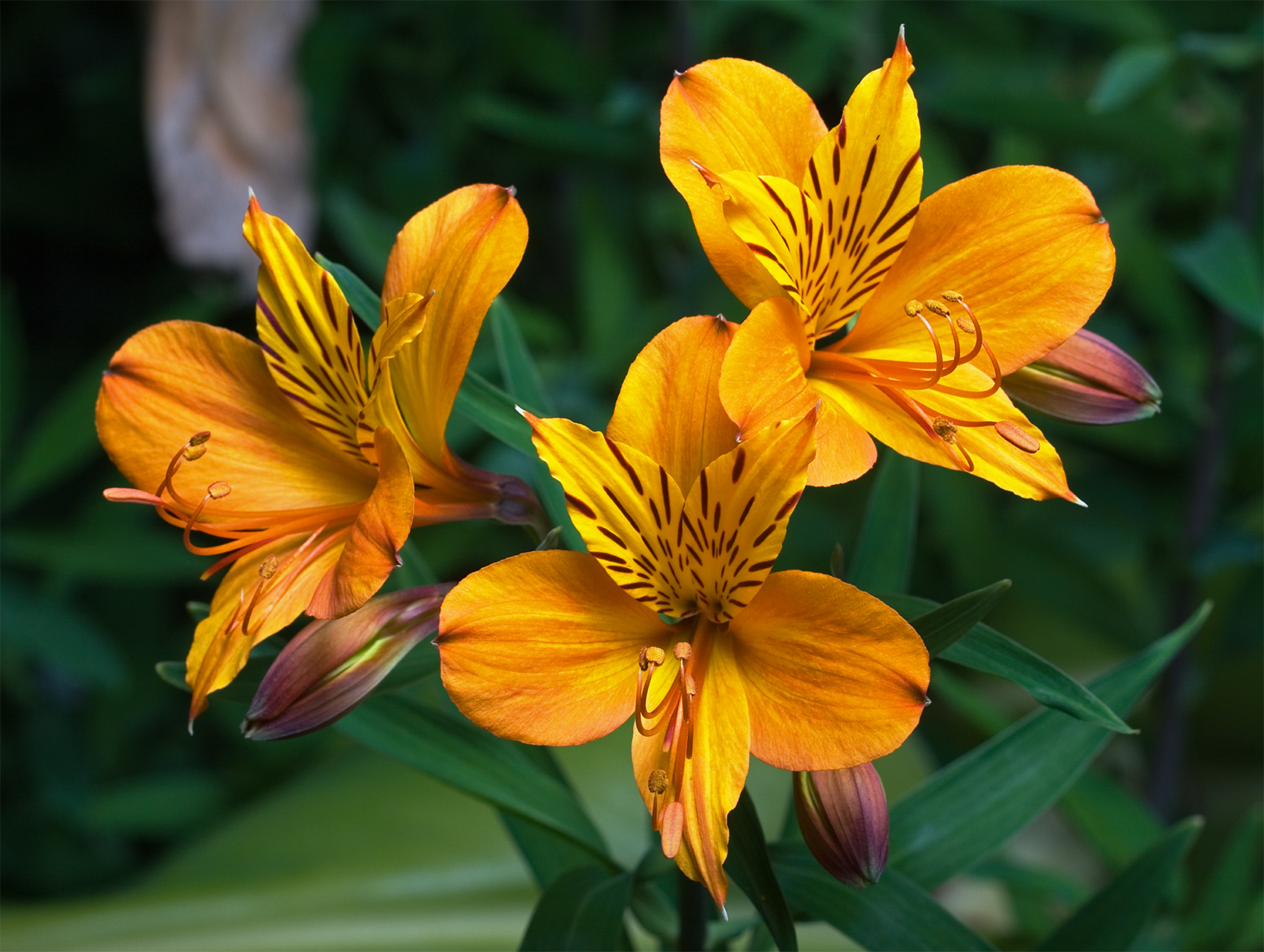
Alstroemeria L., commonly known as Peruvian lily, lily-of-the-Incas, or parrot lily, is a genus of about 170 species of herbaceous flowering perennials in the family Alstroemeriaceae, order Liliales. Plants grow from clusters of fleshy, brittle tubers and produce both fertile and sterile stems reaching up to 1.5 metres tall. The leaves are alternately arranged and distinctively resupinate — twisted at the base of the petiole so that the underside faces upward. Flowers are borne in terminal umbel-like clusters; each bloom has six petal-like tepals up to 5 cm long, usually marked with contrasting streaks, flecks, or spots in combinations of red, orange, yellow, green, purple, pink, and white. Six curved stamens and a three-lobed stigma are present, and the fruit is a three-valved explosive capsule.
The genus is exclusively native to South America, ranging from Venezuela in the north to Tierra del Fuego in the south. Two centres of diversity are recognised: one in Brazil, home to more than 40 species, and one in Chile, where some 50 or more taxa occur, roughly 80% of them endemic to the Mediterranean-climate matorral zone of central Chile. Brazilian species are characteristically summer-growing while Patagonian species are winter-growing, a difference that plant breeders have exploited to produce modern hybrids that flower nearly year-round.
Alstroemeria is one of the most commercially significant cut flower genera in the world. Flowers remain fresh in water for up to 14 days — exceptional longevity that makes them a staple of the florist trade. Systematic hybridisation began in the United States in the 1980s and has since shifted to the Netherlands, yielding more than 190 named cultivars in a wide range of colours and markings. All parts of the plant contain tuliposides and α-methylene-γ-butyrolactones (tulipalin A), compounds that cause contact dermatitis in sensitive individuals; the sap can produce skin fissures, blistering, and itching. Despite this, the plants are non-toxic to common household pets including dogs, cats, and horses.
Etymology
The genus name Alstroemeria commemorates Clas Alströmer (1736–1794), a Swedish baron, merchant, and naturalist who was a close friend of Carl Linnaeus. Alströmer collected plant specimens during his travels and sent seeds back to Linnaeus; the surname itself is derived from the Swedish words al (alder) and ström (stream). The genus was formally published in 1762 by Linnaeus and Johan Peter Falk in the botanical dissertation Planta Alströmeria.
Distribution
Alstroemeria is entirely South American in natural origin, with a latitudinal range spanning roughly 56 degrees — from Venezuela at about 3° north of the equator southward to Tierra del Fuego, Argentina, at approximately 53° south. The genus is not naturally present on any other continent. Two major centres of species richness are recognised: Brazil supports more than 40 species, and Chile hosts approximately 50 or more taxa. Central Chile's Mediterranean matorral region is particularly rich, with around 80% of its Alstroemeria taxa occurring nowhere else. Several species have naturalised outside South America following horticultural introduction — notably A. pulchella, A. psittacina, and A. aurea in parts of Australia and New Zealand, where they can behave as garden weeds.
Ecology
Most Alstroemeria species are long-lived herbaceous perennials; the sole exception is A. graminea, an annual restricted to the extremely arid Atacama Desert of Chile. A broad seasonal division exists within the genus: species originating in Brazil are summer-growing, while those from Patagonia and the Chilean south are winter-growing — a trait reflecting the contrasting rainfall regimes of their native habitats. Flowers attract a range of pollinators including butterflies and hummingbirds. Several cultivated species, particularly A. pulchella, A. psittacina, and A. aurea, have escaped gardens in the Southern Hemisphere and established naturalised populations in Australia and New Zealand. In garden settings, plants can spread aggressively via their thin, fleshy rhizomatous roots and may become locally invasive.
Cultivation
Alstroemeria is among the most important genera in the commercial cut flower industry, with blooms lasting up to 14 days in a vase. More than 190 cultivars are in cultivation, ranging widely in flower colour, marking pattern, and plant stature. The Royal Horticultural Society has awarded the Award of Garden Merit to thirteen cultivars including 'Apollo', 'Coronet', 'Friendship', 'Orange Glory', and 'Spitfire', all rated H4 or H5 for UK hardiness. In temperate gardens, plants are grown in USDA hardiness zones 7a–10b; roots are hardy to approximately −5°C (23°F), and deeper frost tolerance to −10–15°C is achievable with heavy root mulch. Plants prefer full sun (at least six hours per day) or partial shade, fertile and moisture-retentive but well-drained soil, and consistent watering. Heights range from roughly 30 cm to 1.2 m depending on cultivar. Deer resistance and attraction of hummingbirds, butterflies, and songbirds make Alstroemeria suitable for pollinator gardens, mixed borders, cutting gardens, and container plantings.
Modern hybrids were developed by crossing winter-growing Chilean species with summer-growing Brazilian species, achieving near-continuous flowering. Initial breeding work was concentrated in the United States during the 1980s; the Netherlands has since become the dominant breeding and production centre globally. Despite their ornamental appeal, all plant parts contain tuliposides and tulipalin A and can cause contact dermatitis — gloves are advisable when handling cut stems.
Propagation
Alstroemeria can be propagated by seed or by division of the tuberous root clumps. Seed germination benefits from a two-stage temperature treatment: warm stratification at 25°C for four weeks followed by a reduction to around 10°C; seeds should be sown individually in deep containers or a cold frame to avoid disturbing the fragile developing root. Division is best carried out in April or October in temperate climates; each division must carry at least one growth bud, and roots should be handled carefully as they are both brittle and sensitive to disturbance. Large, well-established clumps can be carefully lifted in late summer and replanted elsewhere. Once established, plants spread by thin fleshy roots and may colonise surrounding soil if not contained.
Cultural Uses
The roots of several Alstroemeria species contain significant quantities of nutritious starch and have historically been used as a food source, though specific species and cultural contexts are not well documented in available horticultural sources. The genus has no documented medicinal applications in mainstream botanical literature. Its overwhelmingly dominant cultural role is as an ornamental cut flower: commercially grown Alstroemeria cultivars are ubiquitous in supermarket and florist bouquets worldwide, prized for their vivid colours, intricate markings, and exceptional vase longevity of up to two weeks.










