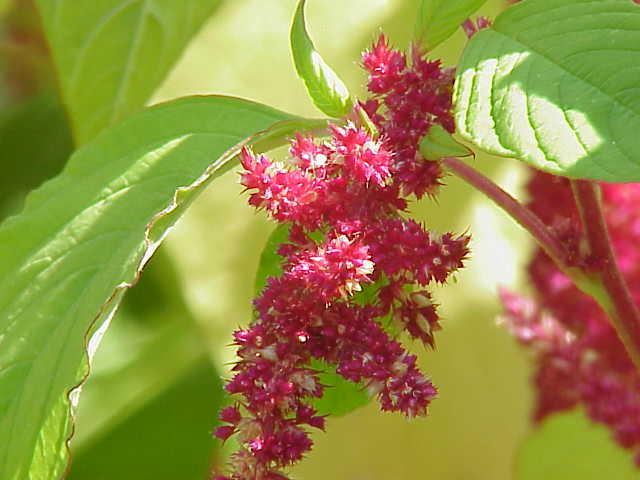
Amaranthus L. is a large genus of annual and occasionally perennial herbaceous plants in the family Amaranthaceae, comprising at least 75 recognized species distributed across six continents. Plants typically grow 1–2.5 metres tall, with cylindrical, succulent, hollow stems and alternate or opposite oval to elliptical leaves measuring 6.5–15 cm. Inflorescences are catkin-like cymes of densely packed small flowers that bloom in summer and autumn, producing smooth, shiny circular seeds of 1–1.5 mm. The genus is subdivided into three subgenera — Acnida, Amaranthus, and Albersia — and phylogenetic analysis recognises five major clades including dioecious and hybridus lineages.
A defining physiological trait of the genus is its use of the C4 photosynthetic pathway, which enables highly efficient carbon fixation and underpins the rapid growth rates observed across the genus. Leaves are alternate and petiolate, ranging in shape from rhombic-ovate and ovate to spatulate and lanceolate; flowers are radially symmetric with 3–5 tepals and produce single-seeded utricles.
The genus spans food crops, ornamental garden plants, and some of the world's most troublesome agricultural weeds. Three species — A. caudatus, A. cruentus, and A. hypochondriacus — are cultivated as grain crops, valued for their high-protein, lysine-rich, gluten-free seeds. Several species, including A. tricolor and A. dubius, are widely grown as leaf vegetables across tropical and subtropical regions. At the same time, nine species are considered invasive in North America, with A. palmeri in particular having evolved resistance to glyphosate and multiple other herbicide classes, causing significant losses in soybean and cotton farming.
Etymology
The genus name Amaranthus derives from the Ancient Greek amárantos, meaning "unfading" or "undying," formed from the privative prefix a- ("without") and maraínō ("to fade" or "to consume"). The name reflects the long-lasting quality of the dried flowers, which retain their colour. The same root gives the English word "amaranth" its longstanding association with immortality and undying beauty, a symbolism Milton invoked in Paradise Lost.
Indigenous names for the plant vary by region. In Nahuatl, the language of the Aztec, the plant was known as huauhtli; Quechua-speaking Andean peoples used the names kiwicha and ataĉo. In many European languages the genus is also called "pigweed," reflecting the weedy species' ubiquity in disturbed agricultural land.
Distribution
Amaranthus is a cosmopolitan genus with its centre of origin most likely in Central America. Species occur across tropical and subtropical regions worldwide, extending into temperate zones as naturalisations and casual introductions. The genus spans elevational ranges from sea level through the Himalayas.
In the southwestern United States, more than 50 species are documented across ecosystems ranging from the Sonoran Desert and Colorado Plateau to National Forest highlands; key regional taxa include A. palmeri, A. powellii, A. hybridus, A. californicus, and A. fimbriatus. In Europe, 16 species have been recorded in Switzerland alone, several as neophytes (post-1500 introductions), including A. retroflexus, A. hybridus, A. powellii, A. blitum, and A. deflexus.
Ecology
The C4 photosynthetic pathway shared by all Amaranthus species confers high water-use efficiency and rapid biomass accumulation, making the genus competitive in warm, high-light environments. Weedy species are characterised by extended germination periods, fast growth, and prodigious seed output, traits that have allowed nine species to become invasive across North America: A. albus, A. blitoides, A. hybridus, A. palmeri, A. powellii, A. retroflexus, A. spinosus, A. tuberculatus, and A. viridis.
Amaranthus palmeri (carelessweed) has emerged as one of the most economically damaging weeds in North American row-crop agriculture, causing 17–68% soybean yield reductions in infested fields and having evolved resistance to glyphosate and multiple other herbicide modes of action. Most species prefer disturbed soils, sandy or gravelly substrates, and open sunny conditions, frequently appearing in agricultural fields, roadsides, and waste ground. Several species serve as larval food plants for nutmeg moths and Coleophora case-bearers.
Cultivation
Grain amaranths (A. caudatus, A. cruentus, A. hypochondriacus) are grown as annual cereal crops, seeded at approximately 1 kg/ha with yields typically exceeding 1,000 kg/hectare. Unlike true cereals the seed has no hull requiring removal after harvest. Grain is processed by grinding into flour, popping (analogous to popcorn), or flaking; it is gluten-free and notably rich in protein (approximately 13.5 g per 100 g uncooked), with a favourable amino acid profile high in lysine and arginine.
Leaf amaranths, principally A. tricolor, A. dubius, and A. hybridus, are widely cultivated as fast-growing warm-season vegetables across tropical Africa, South and Southeast Asia, the Caribbean, and Brazil. All Amaranthus species grow in full sun and well-drained soil, tolerating sandy, gravelly, or disturbed substrates and mildly acid to basic pH. They are drought-tolerant once established.
Ornamental cultivars of A. caudatus (love-lies-bleeding) and A. hypochondriacus (prince's feather) are grown for their showy pendulous or upright inflorescences.
Propagation
All cultivated Amaranthus species are propagated from seed. Seeds are small (1–1.5 mm) and can be direct-sown into prepared seedbeds after the last frost, or started under cover and transplanted. Germination is rapid in warm soil. Because seeds are tiny, shallow sowing at 0.5–1 cm depth is recommended. The extended germination period of many weedy species — a survival strategy — can be exploited in cultivation by pre-germinating seed in warm conditions before sowing.
History
Archaeological evidence places amaranth cultivation in Mesoamerica at least 6,000 years before present, with carbonised Amaranthus cruentus seeds recovered from sites in the Tehuacán Valley, Mexico. Seeds of A. hypochondriacus from the same cave system date to approximately 1,500 years before present. Evidence from Argentina's Puna desert extends the record to some 4,500 years ago, suggesting independent domestication events across the Americas.
In pre-Hispanic Mesoamerica, amaranth was cultivated by the Aztec and their tributary communities in quantities reportedly comparable to maize and beans. It held religious significance, being prepared as ritual food during the festival of Panquetzaliztli in honour of the deity Huitzilopochtli: effigies fashioned from amaranth seeds bound with honey were distributed to worshippers. Following the Spanish conquest, cultivation declined sharply, partly as a result of deliberate suppression of indigenous religious practices with which the grain was associated.
Cultural uses
Amaranth grain has been a central food and ritual plant in Mesoamerican and Andean cultures for millennia. In Aztec society it was fashioned into effigies of gods during religious festivals, the images consumed communally after ritual. Following the Spanish conquest this practice was suppressed, but the grain survived in regional cuisines. The contemporary Mexican confection alegría (meaning "joy") consists of toasted amaranth grains mixed with honey, molasses, or chocolate — a direct descendant of pre-Columbian preparations.
Leaf amaranths are consumed across sub-Saharan Africa, India, China, Vietnam, and the Caribbean, where they are valued as an affordable, fast-growing green vegetable. Seed oil, containing approximately 5% squalene, is extracted commercially for use in dietary supplements and cosmetics. The 'Hopi Red Dye' cultivar of A. cruentus was used by Hopi peoples to produce a deep red natural dye. A synthetic version of the dye — known as Red No. 2 (USA) or E123 (EU) — is derived from the plant's pigment chemistry, though it is now manufactured synthetically.
In Western literary tradition, amaranth became a symbol of immortality and undying love, prominently invoked by John Milton in Paradise Lost.
Conservation
Amaranthus pumilus (seabeach amaranth) was listed as a federally endangered species in the United States in 1993. It is a coastal specialist restricted to the beaches and dunes of the Atlantic seaboard, where habitat loss through coastal development and storm disturbance has driven its decline.
At the other end of the conservation spectrum, multiple weedy Amaranthus species present significant conservation challenges as invasive plants outside their native range, displacing native vegetation and causing substantial agricultural losses. The genus thus illustrates a striking contrast between species of conservation concern and species that are themselves conservation threats in introduced regions.
Taxonomy notes
The genus Amaranthus was formally described by Carl Linnaeus in 1753, and the name has been accepted without ambiguity at genus rank within Amaranthaceae (order Caryophyllales) ever since. Three subgenera are recognised: Acnida (dioecious, largely North American), Amaranthus (grain and ornamental species), and Albersia (weedy cosmopolitan species). Molecular phylogenetic analyses resolve five major clades within the genus.
GBIF recognises the name Amaranthus L. (usageKey 3085074) as accepted, with Linnaeus (1753) as authority, in family Amaranthaceae, order Caryophyllales, class Magnoliopsida, phylum Tracheophyta, kingdom Plantae. GBIF records at least 73 accepted species in the genus, with the full dataset containing additional taxa. The total species count cited in the literature is approximately 75 recognised species, though estimates vary by treatment.










