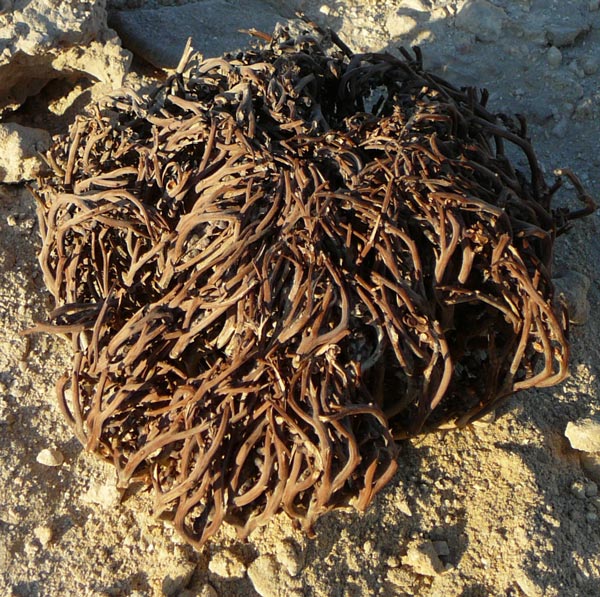
Anastatica is a monotypic genus of flowering plants in the family Brassicaceae, containing the single species Anastatica hierochuntica, commonly known as the rose of Jericho or Maryam's flower. The genus is found in arid regions of the Middle East and North Africa, from the Sahara Desert across to Iran and Pakistan.
The plant is a small gray annual herb, rarely growing above 15 centimetres tall, with tiny white flowers. What makes Anastatica exceptional among plants is its pronounced hygroscopic behaviour. After completing its annual life cycle, the plant does not decompose — it lignifies, forming a persistent woody skeleton. As moisture drops, its branches curl inward into a tight, fist-like ball. Inside that ball, the capsular fruits remain sealed, protecting the seeds and preventing premature dispersal.
This dried ball can persist for years, essentially serving as a mobile seed bank. When rainfall returns, the branches uncurl and the fruits open, releasing seeds that can germinate within hours if sufficient water is available. The curling and uncurling cycle is completely reversible and can repeat many times; it is linked to the presence of trehalose, a disaccharide sugar associated with several mechanisms of cryptobiosis. Because the plant's dead tissues do not revive or turn green when rehydrated, Anastatica is not a true resurrection plant in the biological sense, despite its popular reputation.
Anastatica has been called the most famous tumbleweed, as the dried ball can become detached from the soil and be carried by wind across steppes and desert — dispersing its enclosed seeds widely. A fraction of seeds are also dispersed locally by raindrops striking a spoon-like appendage on each seed.
Etymology
The name rose of Jericho — the plant's most widely used common name — derives from a reference in the biblical book of Sirach (Ecclesiasticus 24:14). Other common names include Maryam's flower, flower of St Mary, St. Mary's flower, Mary's flower, and white mustard flower.
Distribution
Anastatica grows in arid and semi-arid environments across the Middle East and the Sahara Desert, with documented occurrences in North Africa, Egypt, Israel, Jordan, Saudi Arabia, Iraq, Iran, and Pakistan. Its tumbleweed habit — the dried ball being carried by wind — facilitates long-distance dispersal across steppe and desert borders.
Ecology
The genus is adapted to extreme drought through hygroscopic movement: branches curl into a sealed ball in dry conditions, enclosing ripened seeds, and uncurl upon rehydration so fruits open and seeds disperse. Seeds can remain dormant for years and germinate within hours once adequate moisture is present. The hygroscopic mechanism is attributed to trehalose. Seed dispersal occurs via both wind (tumbleweed habit) and localised raindrop splash on seed appendages.
Cultural Uses
Since ancient times, Anastatica has been used as a natural hygrometer: because the plant opens and closes in response to atmospheric humidity, traditional knowledge used its behaviour to forecast weather and approaching rain. The plant holds religious and cultural significance across the Middle East and North Africa, associated with the Virgin Mary under the name Maryam's flower, and referenced by name in the biblical book of Sirach.










