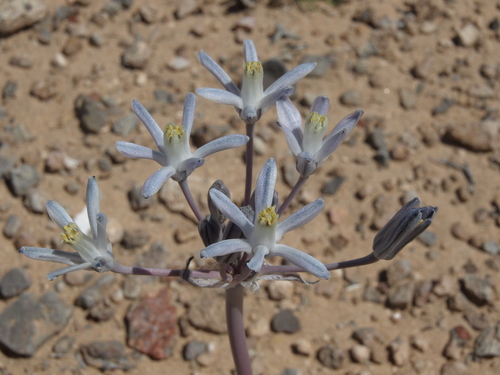
Androstephium is a small genus of perennial, bulbous herbs in the family Asparagaceae (order Asparagales), placed within the cluster lily subfamily Agavoideae. It contains two species endemic to North America, restricted to the southwestern and south-central United States.
Plants grow from fibrous-coated corms and are scapose — they produce a single cylindrical scape bearing no stem leaves. Several linear, channeled leaves arise from the base. The inflorescence is umbellate and terminal, subtended by three lanceolate bracts, and bears funnel-shaped flowers that give the genus its common names: blue funnel lily (A. caeruleum) and pink funnel lily (A. breviflorum).
The flowers are distinctive within their family. Six tepals are prominently fused at the base into a funnelform tube that extends to roughly half the total tepal length. The six stamens are epitepalous (attached to the tepals), with filaments dilated along their entire length and fused into a nectariferous tube; the tips of the filaments bear erect, two-cleft appendages that together form a crown between the anthers. The ovary is superior and three-locular. Fruits are three-angled, subglobose capsules that open loculicidally; the seeds are black and flat with a crusted coat.
Morphologically and molecularly, Androstephium is most closely related to Muilla, another small western North American genus in the same subfamily.
Etymology
The genus name Androstephium derives from the Greek aner (ἀνήρ, genitive andros) meaning "man" or "stamen," and stephanos (στέφανος) meaning "crown," referring to the crown-like structure formed by the fused, appendaged filaments around the anthers.
Distribution
The two species of Androstephium are native exclusively to North America. A. caeruleum (blue funnel lily) occurs in the south-central United States, primarily Texas, Oklahoma, and Kansas, while A. breviflorum (pink funnel lily) is found in the southwestern United States including Arizona, Nevada, Utah, and Colorado. The full distribution of both species is noted as poorly documented in the literature.
Taxonomy Notes
Androstephium is placed in the subfamily Agavoideae of the family Asparagaceae (order Asparagales). Recent molecular and morphological studies (Pires 2000) indicate the genus is closely related to Muilla, a similarly small western North American genus. GBIF recognizes two accepted species; a third name, A. coeruleum, is treated as a synonym of A. caeruleum by some authorities.

