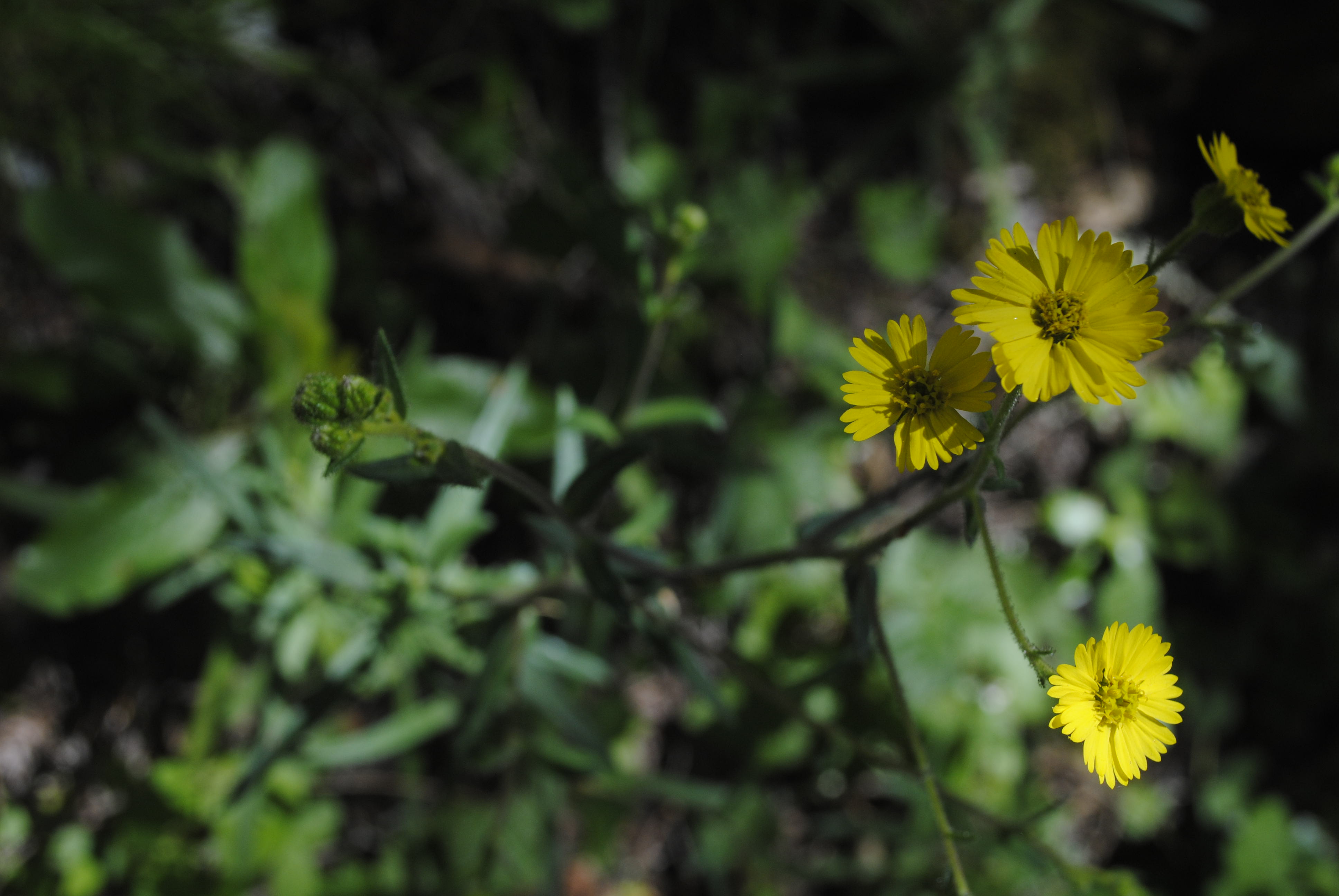
Anisocarpus is a small genus of perennial herbaceous plants in the tribe Madieae within the family Asteraceae, comprising just two species endemic to western North America. The genus was circumscribed by B. G. Baldwin based on molecular phylogenetic evidence showing a sister-group relationship between its two members, which historically had been placed in different genera and even different tribes.
Plants are perennials reaching 10–80 cm in height, with erect stems branched from the base or throughout. Leaves are both basal and cauline, with proximal leaves opposite (sometimes forming rosettes) and distal leaves alternate; they are sessile or nearly so, with oblong to linear, lance-linear, or oblanceolate blades that may be entire or toothed and are hirsute to strigose or pubescent, with stipitate glands on distal leaves.
The inflorescences are radiate or discoid heads borne singly or in corymbiform or racemiform arrays. Involucres are globose to broadly ellipsoid or campanulate, 4–6+ mm in diameter. Phyllaries are either absent or numbering 1–3 or 7–15 in a single series. Ray florets, when present, number 1–3 or 8–15 and are pistillate and fertile with yellow corollas; disc florets number 5–30, with yellow corollas having tubes shorter than their funnelform throats. The fruits (cypselae) are distinctive: ray cypselae are black or grayish, compressed or obcompressed, clavate, and arcuate with offset adaxial beaks; disc cypselae are terete and clavate with hairy faces. The pappus consists of 0 or a coroniform crown in ray florets and 5–8 or 11–21 ciliolate-plumose scales in disc florets. The chromosome base number is x = 7, with both species having 2n = 14, making them the only perennial members of subtribe Madiinae at that ploidy level.
The two species, Anisocarpus madioides and Anisocarpus scabridus, differ markedly in their ecological preferences: A. madioides grows in low- to mid-elevation forest and woodland understories from British Columbia to California, while A. scabridus is restricted to high-elevation exposed scree slopes and ridges in northern California. Artificial hybrids between the two are vigorous but largely pollen-sterile.
Distribution
Anisocarpus is endemic to western North America. Anisocarpus madioides ranges from British Columbia south through Washington and Oregon to California, occurring in low- to mid-elevation forest and woodland understories. Anisocarpus scabridus is restricted to high-elevation exposed scree slopes and ridges in northern California.
Ecology
The two species of Anisocarpus occupy strikingly different ecological niches. Anisocarpus madioides inhabits low- to mid-elevation forest and woodland understories, while Anisocarpus scabridus is confined to high-elevation exposed scree slopes and ridges. The species can be artificially hybridized — F1 hybrids are vigorous but largely pollen-sterile, producing only large diploid pollen grains that have been used in intergeneric crosses with members of the Hawaiian silversword alliance (Dubautia).
Taxonomy
Anisocarpus was re-circumscribed by B. G. Baldwin based on molecular phylogenetic data (1996) showing a sister-group relationship between two historically disparate taxa. A. scabridus was originally placed in Raillardella or Raillardiopsis, both in tribe Senecioneae, until Carlquist's (1959) anatomical studies clarified its affinities. A. madioides was treated within Madia under D. D. Keck's informal "section Anisocarpus," alongside other pappose species now placed in Harmonia, Jensia, and Kyhosia. The genus is notable as the only group of perennial herbaceous tarweeds combining non-scapiform capitulescences, radiate heads, ellipsoid or spheric involucres, yellow anthers, and a chromosome count of 2n = 14 — the sole perennials in subtribe Madiinae at that ploidy level.










