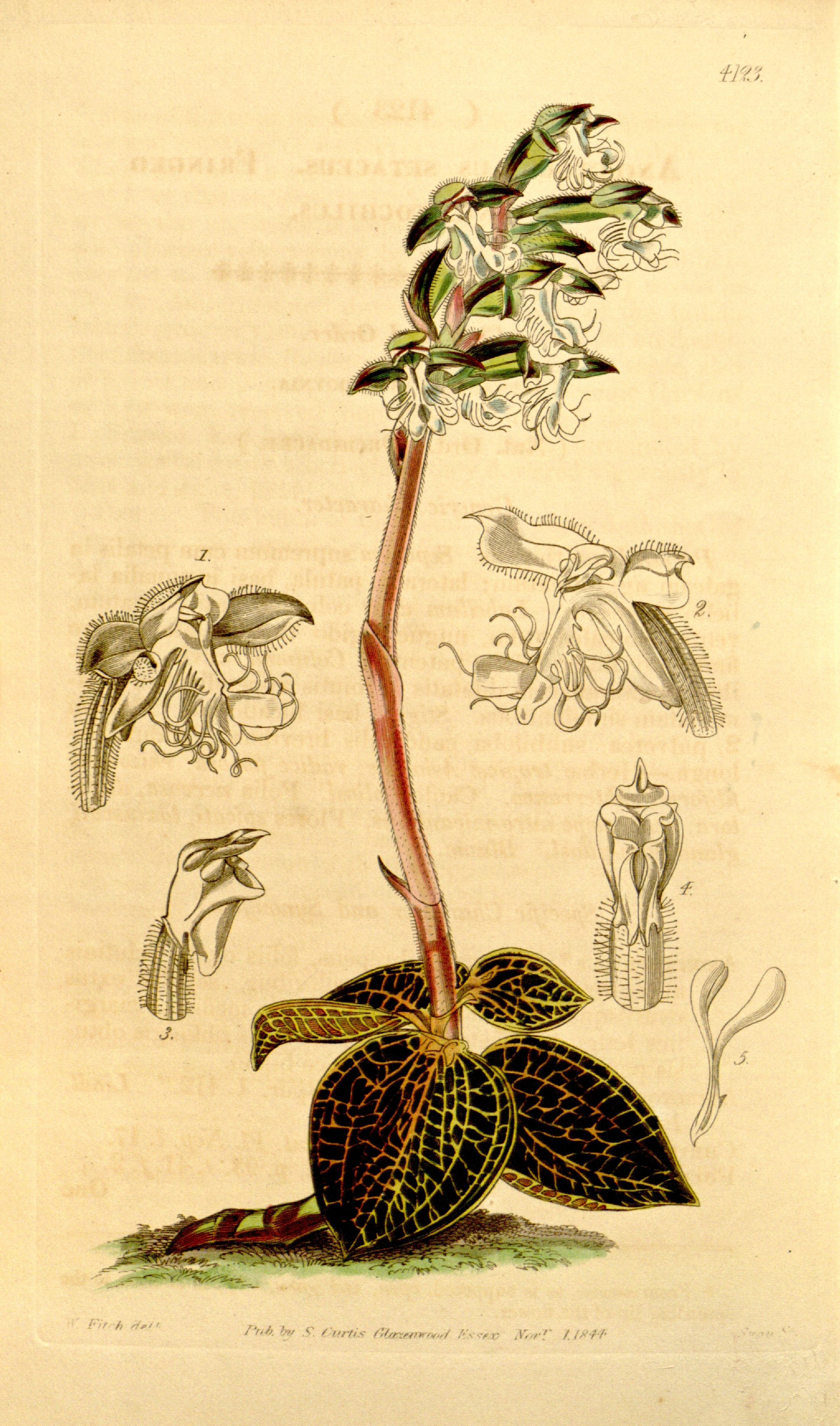
Anoectochilus is a genus of approximately fifty terrestrial orchids in the family Orchidaceae, sometimes called jewel orchids, marbled jewel orchids, or filigree orchids. The genus was established by the Dutch-German botanist Carl Ludwig Blume in 1825 and is placed in the subfamily Orchidoideae, tribe Cranichideae, subtribe Goodyerinae alongside other shade-loving forest-floor orchids.
Plants are small, evergreen, perennial herbs that creep along the leaf litter on a fleshy above-ground rhizome anchored by woolly roots. The foliage is the main draw: dark green to brownish-purple, velvety leaves are arranged in loose rosettes and overlaid with a glittering network of silvery, gold, copper, or reddish veins, the feature that earned the group its common names. From these rosettes the plant sends up short, erect flowering stems six to ten inches tall, carrying spikes of comparatively large, hairy white or pale-yellow flowers. The flowers are most readily recognized by their distinctive labellum, which is divided into two clearly defined sections — a basal hypochile and a distal epichile — a structural feature reflected in the genus name, derived from the Greek anoiktos ("opened") and cheilos ("lip").
The genus is native to tropical and subtropical Asia and the western Pacific. Its range stretches from the Himalayas, Sri Lanka, and the Indian subcontinent across southern China, Taiwan, and the Ryukyu Islands, through mainland and insular Southeast Asia, and east to New Guinea, northern Queensland, and the islands of Melanesia, including Fiji, Samoa, Vanuatu, the Solomons, and New Caledonia. Across this range the plants colonize moist, deeply shaded forest floors where high humidity, leaf-litter substrates, and dappled light are the rule.
Several Anoectochilus species are economically and culturally important. The Taiwanese A. formosanus and the mainland Chinese A. roxburghii, known in Chinese as jinxianlian, are cultivated commercially and have long traditions of medicinal and culinary use across East and Southeast Asia.
Etymology
The genus name Anoectochilus combines the Ancient Greek words anoiktos (ἀνοικτός), meaning "opened," and cheilos (χεῖλος), meaning "lip." The reference is to the labellum, the modified third petal of the flower, which in this genus is conspicuously divided into a basal hypochile and a distal epichile — appearing as if "opened up" relative to the simpler lip of related goodyeroid orchids. The original spelling Blume used in 1825, Anectochilus, was later regularized to Anoectochilus and conserved under the International Code of Nomenclature.
Distribution
Anoectochilus is restricted to tropical and subtropical Asia and the western Pacific. In South Asia the genus occurs from Sri Lanka and the Andaman and Nicobar Islands north through India, Nepal, Bangladesh, Assam, and the Himalayas into Tibet. Across Southeast Asia it is recorded from Myanmar, Thailand, Laos, Vietnam, peninsular Malaysia, Borneo, Sumatra, Java, Sulawesi, and the Moluccas. In East Asia populations extend through south-central and southeast China, Taiwan, Hainan, and the Nansei-shoto (Ryukyu Islands). The genus reaches its eastern limit in the Pacific, with species in New Guinea, northern Queensland, the Solomon Islands, the Santa Cruz Islands, Vanuatu, New Caledonia, Fiji, and Samoa.
Ecology
Anoectochilus species are terrestrial orchids of moist, deeply shaded tropical and subtropical forests. They creep across humus-rich leaf litter on a fleshy above-ground rhizome and depend on the constant high humidity, low light, and stable temperatures of the closed forest understory. Like other Goodyerinae, they form intimate mycorrhizal associations and are slow-growing, with populations often patchy and easily disturbed when forest cover is broken.
Cultivation
Anoectochilus orchids are grown for their foliage rather than their flowers and are demanding by houseplant standards. They prefer cool to intermediate or warm indoor conditions with dappled shade and consistently high humidity. A free-draining mix of fir bark, perlite, sharp sand, and organic-rich soil keeps the rhizomes moist without waterlogging; the substrate should stay evenly moist and never dry out completely. Outside the tropics they are kept as houseplants, vivarium or terrarium subjects, or container specimens, and are usually classed as high-maintenance. Common pest and disease problems include mealybugs, thrips, aphids, spider mites, scale, slugs and snails, and various fungal and bacterial rots.
Conservation
Anoectochilus is not currently listed in the Global Invasive Species Database, and the genus has no record of invasiveness anywhere in its range. Like the rest of Orchidaceae, however, all wild Anoectochilus species are covered by CITES Appendix II controls on international trade, and several taxa — notably A. roxburghii and A. formosanus — face heavy collection pressure for the traditional-medicine market in addition to habitat loss from forest clearance across their tropical Asian range.
Cultural uses
Several Anoectochilus species, most prominently A. roxburghii and A. formosanus, are deeply embedded in East and Southeast Asian traditional medicine, where they are known in Chinese as jinxianlian or jinxianlan ("golden-thread orchid"). The whole plant has historically been used for ailments ranging from diabetes to chronic liver complaints and the infirmities of old age, and is consumed in teas, soups, and culinary preparations as well as in formal herbal remedies. Modern pharmacological research has focused on a characteristic glycoside, kinsenoside, alongside polysaccharides, phenolics, and flavone glycosides; published studies report hepatoprotective, anti-hyperglycemic, anti-inflammatory, vascular-protective, and antioxidant activity. The cultural and economic importance of these plants has driven both large-scale tissue-culture production in Taiwan and mainland China and continuing scientific interest in the genus.
History
Anoectochilus was established by Carl Ludwig Blume in 1825 in his Bijdragen tot de Flora van Nederlandsch Indië, based on material from Java. Blume's original spelling, Anectochilus, was later corrected to Anoectochilus and formally conserved under the International Code of Nomenclature. The type species, A. setaceus from Sri Lanka, was figured in 1844 in Curtis's Botanical Magazine — an early reflection of the horticultural interest the "jewel orchids" attracted in 19th-century European glasshouses. The genus has been re-circumscribed several times since, and current treatments follow Pridgeon et al. (2003) and Wood (2008).
Taxonomy notes
Anoectochilus belongs to the subfamily Orchidoideae, tribe Cranichideae, subtribe Goodyerinae. Plants of the World Online currently accepts 51 species in the genus, while Wikipedia, citing the World Checklist of Selected Plant Families, gives roughly 50; GBIF aggregates a wider range of 27–94 descendants depending on which dataset and synonymy treatment is consulted. Recognized heterotypic synonyms include the orthographic variant Anectochilus Blume and the genus Chrysobaphus Wall. The genus name is conserved (nom. cons.) against the earlier spelling Anectochilus under Melbourne ICN Article 14.11.
Propagation
Published horticultural and pharmaceutical practice relies heavily on stem-cutting propagation of the creeping rhizomes and on in-vitro tissue culture for large-scale commercial production, especially of A. roxburghii and A. formosanus for the medicinal market in Taiwan and mainland China. Seed-based propagation is documented less often in the general literature.










