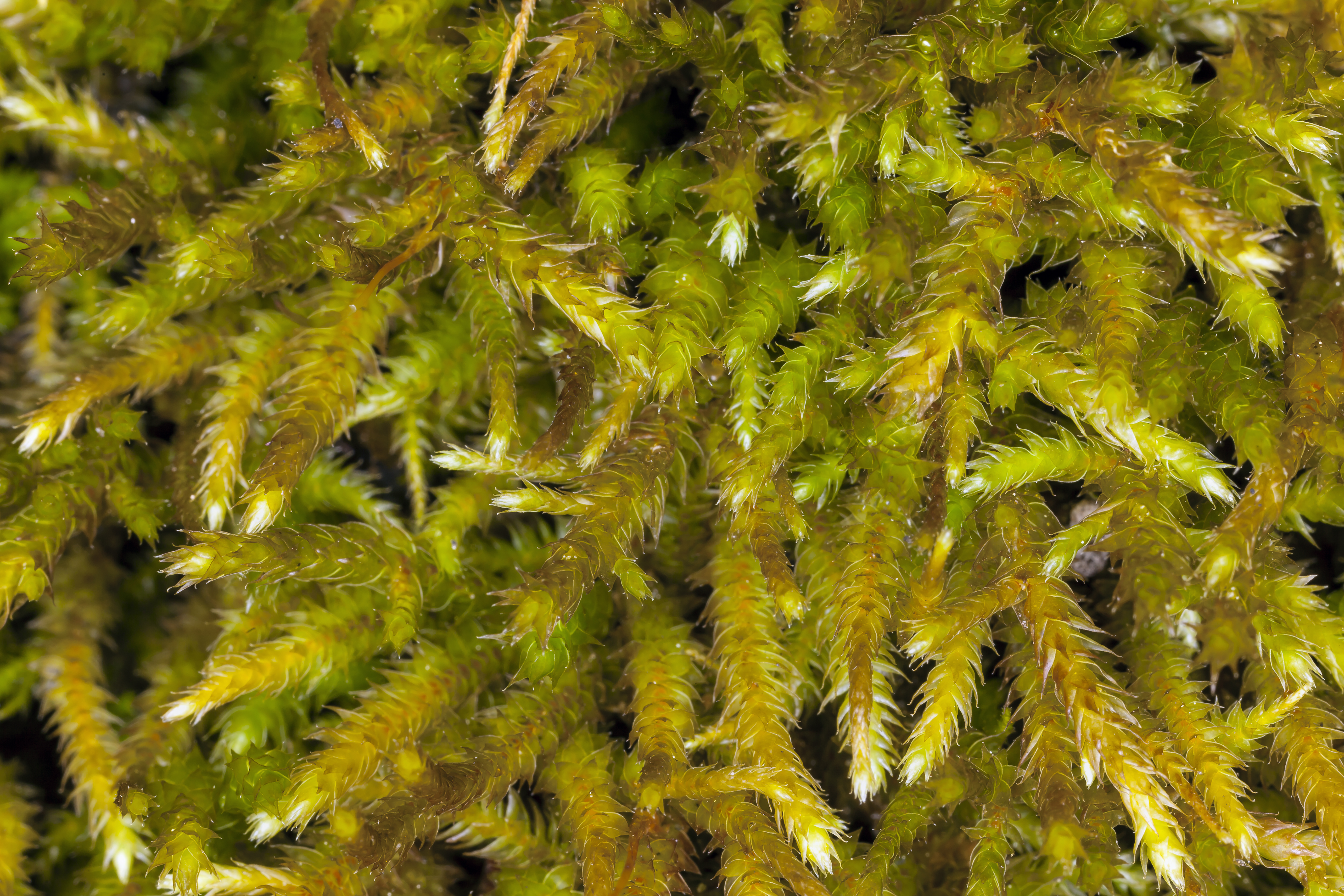
Antitrichia is a genus of pleurocarpous mosses in the family Leucodontaceae, order Hypnales, class Bryopsida. The genus has a cosmopolitan distribution and contains two widely recognised species.
The best-known member, Antitrichia curtipendula (pendulous wing moss or hanging moss), is an epiphytic feather-moss found predominantly along the western coast of North America and on the Atlantic-facing coasts of western Europe. Its stems grow to 15–30 cm in length and bear green leaves that create an overall mat with a distinctive rusty-yellow to olive colouration that varies with moisture content. A diagnostic feature of the genus is the three-midribbed leaf: one prominent central midrib flanked by two shorter, fainter lateral ribs, a character that separates Antitrichia from superficially similar genera such as Rhytidiadelphus. The dark red stems contrast with the green foliage and contribute to the genus's characteristic appearance.
Antitrichia species are epiphytes — they grow on the bark of branches, stumps, and tree trunks, forming large, carpet-like clumps high in the forest canopy without rooting in the soil. They are not parasitic; the host tree provides only physical support. Water and dissolved nutrients are captured directly from rainfall, mist, and humid air. Like all mosses, Antitrichia reproduces by spores rather than seeds or flowers; spores are dispersed by wind and by birds and insects brushing through the canopy.
Antitrichia californica, found along the Pacific coast of North America, is the second accepted species.
Etymology
The genus name Antitrichia derives from Greek, reflecting aspects of the plant's morphology; the specific epithet of the type species, curtipendula, is Latin for "short-hanging," alluding to the pendulous growth habit of the stems.
Distribution
Antitrichia has a cosmopolitan distribution. The primary species, A. curtipendula, is native to the western coast of North America from southern Alaska south to northern California — where its range closely mirrors that of coastal redwoods — and also occurs in scattered Atlantic-coastal localities in western Europe (western France, western Spain, coastal Norway, Denmark, Austria). A. californica is restricted to the Pacific coast of North America. Both species inhabit low- to high-elevation (0–2100 m) coniferous forests in temperate, seasonally moist climates.
Ecology
Antitrichia species are obligate epiphytes of mid- to old-growth coniferous forests, growing on bark of tree trunks, branches, and stumps rather than on soil. They capture water and nutrients entirely from the air, rain, and throughfall, and engage in photosynthesis from their elevated canopy positions. Their preference for established forest canopy means they are sensitive to deforestation and slow to recolonise disturbed sites due to their slow growth rate. Spore dispersal occurs via wind currents and incidentally via birds and insects moving through the canopy.
Taxonomy Notes
Within the order Hypnales, Antitrichia is placed in the family Leucodontaceae. The genus is morphologically close to Rhytidiadelphus (family Hylocomiaceae); both share red stems, green leaves, and mat-forming growth, but Antitrichia is distinguished by its uniquely three-midribbed leaves versus the double midrib of Rhytidiadelphus loreus. GBIF recognises two accepted species: A. curtipendula (Hedw.) Brid. and A. californica Sull.

