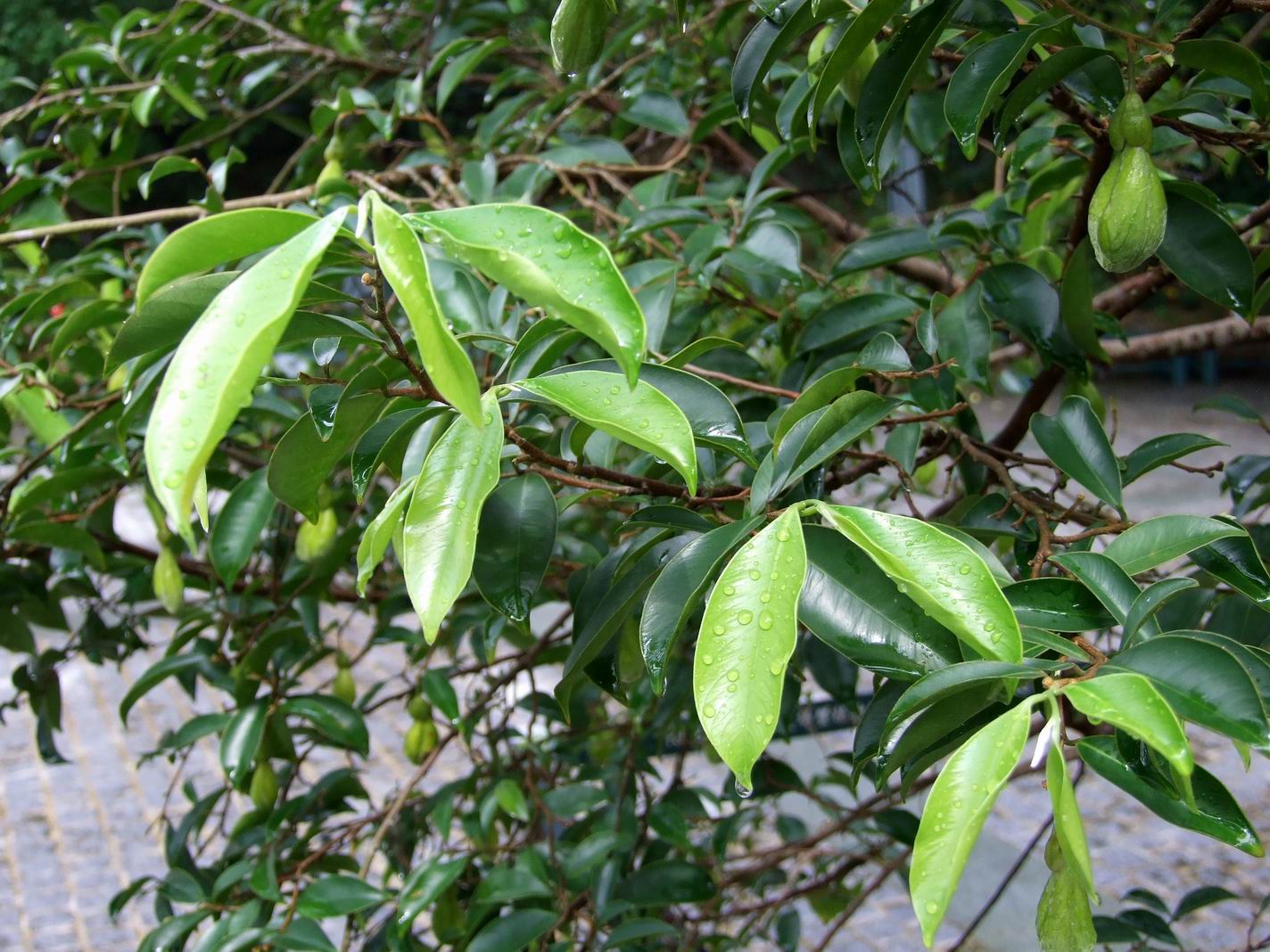
Aquilaria is a genus of approximately 21 tropical tree species in the family Thymelaeaceae (order Malvales), native to the rainforests of Southeast Asia and surrounding regions. Commonly called lign aloes or agarwood trees, they are found across Indonesia, Thailand, Cambodia, Laos, Vietnam, southern China, Malaysia, Northeast India, Bangladesh, the Philippines, Borneo, and New Guinea.
The trees typically reach 6 to 20 metres in height. Their leaves are alternate, 5 to 11 cm long, with a short acuminate tip and an entire margin. The flowers are yellowish-green and produced in umbels; the fruit is a woody capsule 2.5 to 3 cm long. Undiseased wood is soft and light, with a density of around 400 kg/m³.
Aquilaria is most renowned as the primary source of agarwood — a dense, dark, resin-impregnated heartwood that forms when trees become infected by certain moulds. Together with the related genus Gyrinops, Aquilaria trees (especially A. malaccensis) produce this resin, which has been prized for millennia as incense, perfume, and medicine across Buddhist, Hindu, and Confucian traditions. Agarwood oil (oud) is among the most expensive natural materials used in luxury perfumery.
Because of intense demand, wild Aquilaria populations have been severely depleted by indiscriminate logging. Several species are now listed as endangered, and conservation efforts across Southeast Asia include programs to artificially induce agarwood formation in plantation-grown trees, enabling more sustainable production.
Etymology
The name Aquilaria derives from the Latin aquila (“eagle”), though the connection to the plant is debated; the genus has historically been associated with the biblical “lign aloes” and the aromatic wood traded throughout the ancient world under names such as oud, agar, and gaharu.
Distribution
Aquilaria species are native to the tropical rainforests of Southeast Asia and adjacent regions, ranging from Northeast India and Bangladesh through Myanmar, Thailand, Cambodia, Laos, Vietnam, southern China, Malaysia, the Philippines, and the Indonesian archipelago including Borneo and New Guinea. They occur mainly in lowland primary and secondary forest, but extend onto hillsides and ridges up to approximately 750 metres elevation.
Ecology
Aquilaria trees grow scattered in primary and secondary tropical rainforest, from lowland plains to hillside ridges up to 750 m. The most ecologically significant trait of the genus is its response to fungal or microbial infection: infected trees produce a dense, dark, highly aromatic resin in their heartwood — agarwood — as a wound response. This resin occurs naturally in only a small proportion of wild trees, making it exceptionally rare.
Cultural Uses
Agarwood from Aquilaria has been central to religious and ceremonial life across Asia for thousands of years. It is burned as incense in Buddhist, Confucian, and Hindu rituals throughout South and East Asia; in Thailand it is placed in funeral pyres, and in Japan it is used in traditional tea ceremonies. The essential oil distilled from agarwood — known as oud — is one of the most expensive ingredients in luxury perfumery, valued for its balsamic, woody, long-lasting aroma. In traditional Chinese and Indian medicine, agarwood preparations are used as sedatives, antispasmodics, and tonics. The inner bark has historically been woven into cloth and rope, and used as a writing material for religious texts.
Conservation
Wild Aquilaria populations have been severely depleted by unsustainable harvesting for agarwood, which commands very high market prices. Multiple species are listed as endangered. Artificial inoculation programs — in which cultivated trees are deliberately infected to stimulate resin formation — are underway across Indonesia, Thailand, and other range countries as a strategy to supply demand without further stripping wild forest populations.
Cultivation
Plantation cultivation of Aquilaria focuses on inducing agarwood formation through deliberate wounding or inoculation with fungi or bacteria rather than harvesting from naturally infected wild trees. Undiseased plantation timber (“karas”) is lightweight (density ~400 kg/m³), soft, and pale; it is used for boxes, light construction, and veneer. Bark fibre is strong and can be processed into rope and cloth. Trees are found naturally in lowland rainforest and tolerate secondary forest conditions, suggesting moderate adaptability for cultivation in tropical settings.

