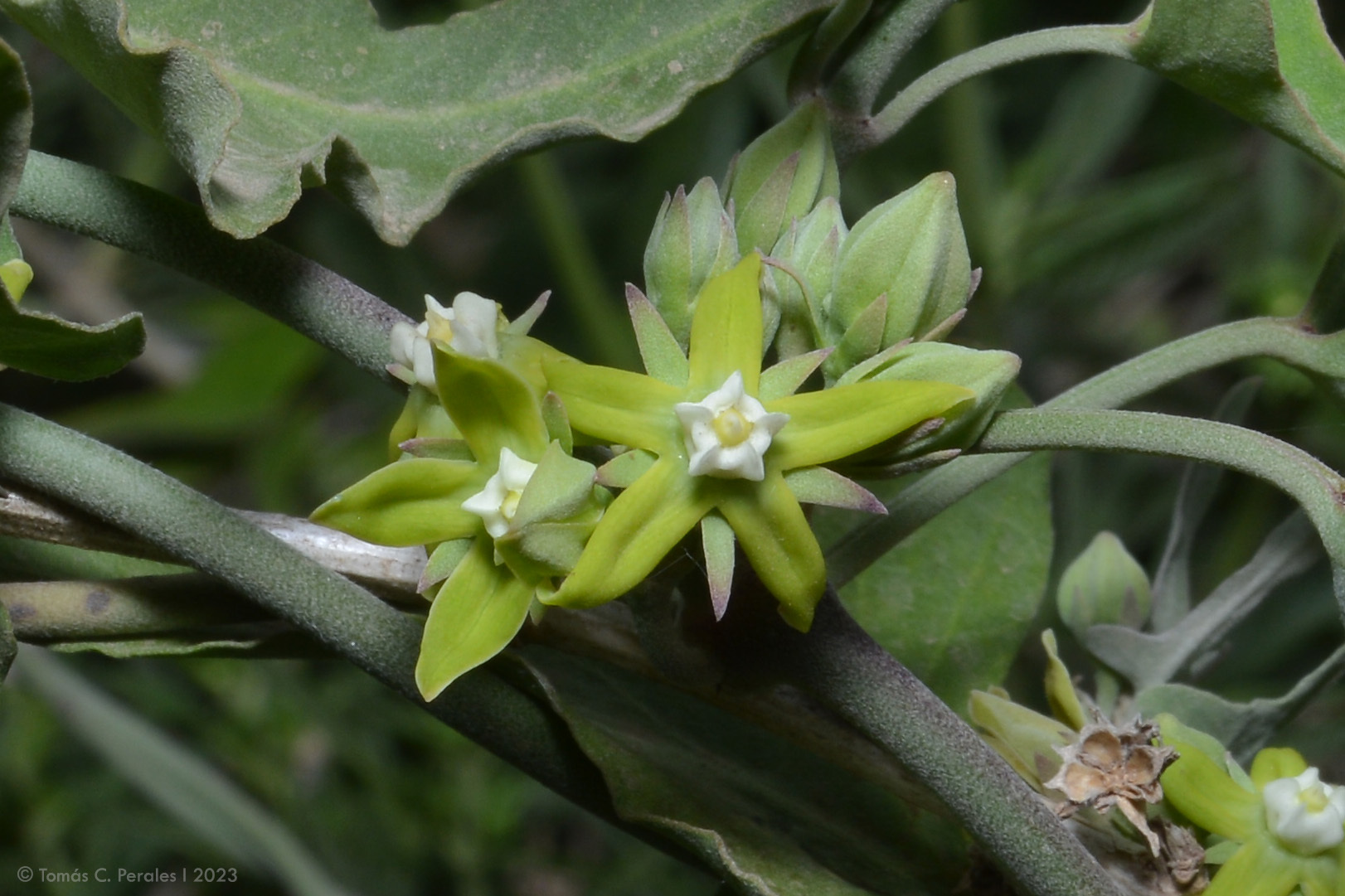
Araujia is a small genus of perennial climbing vines in the family Apocynaceae (dogbane family, order Gentianales), formerly placed in Asclepiadaceae before that family was subsumed into Apocynaceae. The genus was first formally described in 1817 and is native to South America, particularly southern Brazil and Argentina.
Plants in the genus are rampant, evergreen vines capable of reaching 10 metres in height. They produce a milky, malodorous latex throughout all parts of the plant, which is toxic. Stems are twining, flexible, tough, and downy, becoming woody near the base. Leaves are opposite, ranging from 3 to 12 cm long by 2 to 6 cm wide, dark green and hairless above, greyish-downy on the underside. Flowers are bell-shaped, approximately 20–25 mm in diameter, white and occasionally marked with pale pink streaks, borne in clusters of 2–4. An unusual feature of the flowers is their ability to trap and sometimes kill visiting insects. Fruiting bodies are distinctive large, pear-shaped pods roughly 10 × 7 cm, thick and leathery, filled with kapok-like fibre; they split open to release numerous black seeds each attached to a plume of silky hairs, enabling wind dispersal.
The best-known member of the genus is Araujia sericifera (moth plant or moth vine), notorious as an invasive weed in New Zealand and other warm-temperate regions where it was introduced as an ornamental. It has been listed under New Zealand's National Pest Plant Accord and recognised as an environmental weed. The genus name honours António de Matos Araújo, a 19th-century Portuguese statesman and plant collector.
Etymology
The genus name Araujia honours António de Matos Araújo, a 19th-century Portuguese statesman and plant collector. The name was applied when the genus was first described in 1817.
Distribution
Araujia is native to South America, originating in southern Brazil and Argentina. Araujia sericifera (moth vine) has been widely naturalised outside its native range, including in New Zealand (where it has been recorded since 1888), Australia, and other warm-temperate regions, typically spreading along coastal areas, roadsides, and disturbed habitats.
Ecology
Plants in this genus grow in coastal and lowland habitats, including cliffs, bluffs, waste places, and disturbed ground. The flowers have a mechanism that can trap and kill visiting insects. Seeds are viable for at least five years and each pod produces approximately 400 seeds dispersed by wind via silky plumes. Outside their native South American range, species such as Araujia sericifera are regarded as environmentally damaging invasive plants; in New Zealand the species is listed under the National Pest Plant Accord (2020) and as an Environmental Weed (2024).
Taxonomy Notes
Araujia was historically placed in the family Asclepiadaceae (the milkweed family). Under modern molecular-based classification, Asclepiadaceae is treated as a subfamily (Asclepiadoideae) within the broader Apocynaceae. GBIF accordingly places the genus in Apocynaceae, order Gentianales. The genus was first described in 1817.

