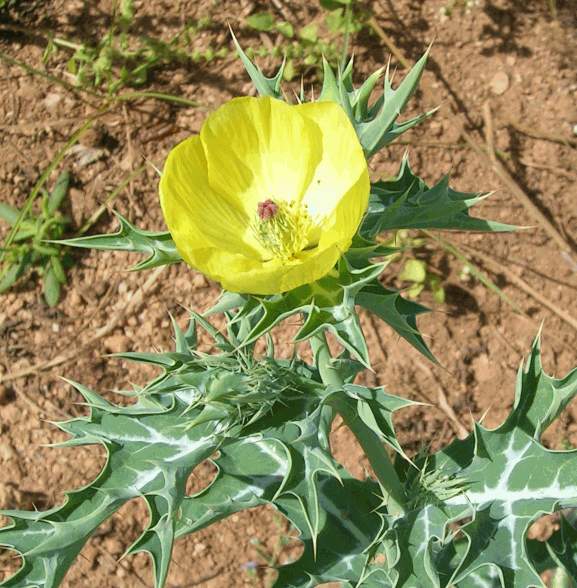
Argemone, commonly known as prickly poppies, is a genus of roughly 32–36 species of flowering plants in the family Papaveraceae (order Ranunculales). The plants are herbs or subshrubs — annual or perennial — with a characteristic glaucous appearance and white to orange sap. Stems are leafy and branching, typically 0.5 to 1.2 metres tall, and are covered in prickles. Leaves are sessile, with toothed margins where each tooth ends in a sharp prickle. The conspicuous flowers are most often white or yellow, bearing 20 to 250 or more stamens, and the fruits are prickly capsules that open at the apex.
The genus was named and described by Carl Linnaeus in 1753, published in Sp. Pl. 508. It sits within subfamily Papaveroideae and tribe Papavereae. The centre of diversity is the Americas, with the majority of species found in the southern and southwestern United States and Mexico, extending through Central America to a limited presence in South America (only the pantropical weeds Argemone mexicana and A. ochroleuca reach there), and one endemic species in Hawaii (A. glauca, known there as "pua kala"). Plants contain alkaloids throughout all their parts, which have been studied both for taxonomic purposes and for their documented toxicity.
Etymology
The genus name Argemone derives from the ancient Greek word ἀργεμώνη (argemonē), which the physician Dioscorides applied to a poppy-like plant used to treat cataracts. The underlying Greek root ἄργεμον means "cataract." Carl Linnaeus adopted the name formally in 1753 when he described the genus in Species Plantarum.
Distribution
The genus is native to the Americas and Hawaii. The greatest species diversity occurs in the southern and southwestern United States and Mexico, with further representatives in Central America. Only two species — the pantropical weeds Argemone mexicana and A. ochroleuca — have ranges extending into South America. Argemone glauca is the sole Hawaiian endemic. Eastern North American species range from Connecticut south to Florida and west to Texas and Illinois.
Ecology
Plants grow in disturbed, open habitats: waste ground, roadsides, cultivated fields, beaches, dunes, and coastal plains, from sea level to about 300 m elevation. They are adapted to poor, well-drained, sandy or loamy soils under full sun and tolerate drought as well as mildly alkaline to acidic conditions. The sap contains alkaloids throughout all vegetative and reproductive parts, which appears to function as a deterrent to herbivores and has been studied extensively as a chemotaxonomic marker within the genus.
Cultivation
Prickly poppies are grown ornamentally for their large, showy flowers. They require full sun and well-drained, even poor soils; fertile or waterlogged conditions are not tolerated. Plants resent root disturbance and are therefore best raised from seed sown directly into the final growing position rather than transplanted. They tolerate drought once established and thrive in hot, dry situations. In cultivation they behave as annuals in most temperate climates.
Propagation
Seed is the standard propagation method. Seeds should be sown in situ in spring (approximately April in temperate climates) as plants are sensitive to root disturbance. At around 15°C, germination typically occurs within three to four weeks. No stratification requirement is noted in available sources.
Cultural Uses
All parts of Argemone plants are toxic due to their alkaloid content, and the seed oil in particular can cause glaucoma and tissue oedema. Despite this, several species have a long history of use in folk medicine across their native range. A tea prepared from the leaves has been employed as a demulcent, emetic, and purgative. Traditional applications include treatment of jaundice, skin conditions, colds, colic, and wound care. The Hawaiian species Argemone glauca (pua kala) holds cultural significance in Hawaii. Any medicinal use carries serious cautions given the toxicity profile of the genus.
Taxonomy Notes
Argemone L. is the accepted name at genus rank, published in Sp. Pl. 508 (1753). It belongs to family Papaveraceae, subfamily Papaveroideae, tribe Papavereae, within order Ranunculales. GBIF (key 2888474) lists approximately 36 child taxa including one hybrid (Argemone ×hybrida); SEINet cites approximately 31 species. Most herbaceous species in the genus can hybridize with one another, but crosses between parents of differing ploidy levels typically yield sterile F₁ offspring.










