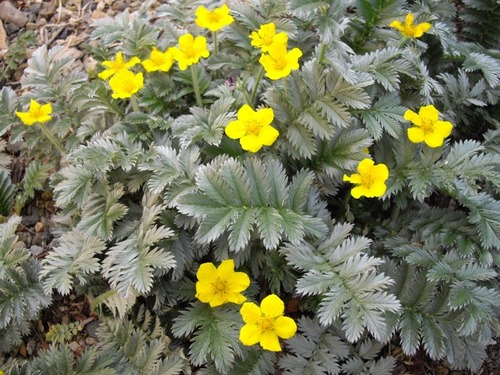
Argentina, commonly known as silverweeds, is a genus of flowering plants in the rose family (Rosaceae), placed in the order Rosales. The genus was described by Hill in 1756 and contains approximately 64 species according to authors who accept it as distinct, though other taxonomists treat these plants as Potentilla sect. Leptostylae, making Argentina either a full genus or a section within the large genus Potentilla.
Plants in this genus are perennial herbs, typically low-growing and spreading vigorously by long stolons — creeping above-ground stems that root at nodes. The leaves are pinnately compound with toothed leaflets, often silvery beneath due to a dense covering of silky hairs, which gives rise to the common name "silverweeds." Flowers are yellow with five petals, characteristic of the Rosaceae, and are pollinated by bees, flies, and beetles. The plants are self-fertile hermaphrodites.
The best-known member of the genus is Argentina anserina (common silverweed), which grows across temperate regions of the Northern Hemisphere — from Europe and temperate Asia through the Pacific to North America — as well as parts of northwestern South Asia. It colonises disturbed ground, roadsides, ditches, and moist calcareous soils and can spread aggressively in cultivation. Other members of the genus occur in New Zealand (Argentina anserinoides), the Pacific coast of North America (Argentina pacifica), and sub-Arctic regions (Argentina egedei).
Argentina anserina has a long history of human use. Its roots are starchy and edible raw or cooked, and were historically consumed in parts of Scotland and other regions during times of scarcity. Young shoots are also eaten, and leaves are brewed as a tea. Medicinally, the plant has been used as a mild astringent, antispasmodic, and haemostatic agent, and remains approved by the German Commission E (as Potentilla anserina) for diarrhoea and oral inflammation.
Etymology
The genus name Argentina derives from the Latin argentum ("silver"), referring to the characteristic silvery appearance of the leaves, particularly their undersides, which are densely coated in white silky hairs. This same Latin root gives the name to the South American country.
Distribution
Argentina has a broadly temperate and sub-Arctic distribution across the Northern Hemisphere. Argentina anserina, the most widespread species, is native across Europe (including Iceland and the Faroe Islands), temperate Asia (from the Caucasus east to Japan and China), northwestern South Asia, and northern North America from Alaska and Canada south through the northern United States. Other species are restricted to more specific regions, including New Zealand and the Pacific coast of North America.
Ecology
Silverweeds typically colonise disturbed or open habitats: ditches, moist calcareous soils, roadsides, grasslands, and coastal areas with maritime exposure. They spread vigorously via stolons and can become invasive in gardens or cultivated land. The plants are tolerant of a wide range of soil types and pH levels, from sandy to heavy clay, and can grow in semi-shade as well as full sun. They are rarely browsed by deer. All parts contain tannin.
Cultural Uses
Argentina anserina (silverweed) has been used as a food plant across its range. The starchy roots are edible raw or cooked and were historically ground into flour and mixed with cereals or used in soups; cultivation for the root was historically practised in Scotland. Young shoots are edible raw and leaves are used to brew tea. Medicinally, the whole plant is valued as a mild astringent, antispasmodic, diuretic, and haemostatic; it is used to treat diarrhoea, oral inflammation, piles, and menstrual cramps, and is approved by the German Commission E (under the synonym Potentilla anserina) for several of these uses. Externally, the powdered plant treats ulcers and haemorrhoids, and a leaf infusion serves as a skin-soothing cosmetic lotion. A sprig placed in footwear is a traditional folk remedy for preventing blisters.
Taxonomy Notes
The circumscription of Argentina is contested. Some authors accept it as a distinct genus of approximately 64 species; others place the same plants within Potentilla sect. Leptostylae (Th. Wolf) T. T. Yü & C. L. Li, rendering Argentina a synonym of that section. GBIF accepts Argentina as a genus in Rosaceae. The genus was originally described by Hill in 1756. Within Rosaceae it falls in subfamily Rosoideae, tribe Potentilleae, subtribe Potentillinae.










