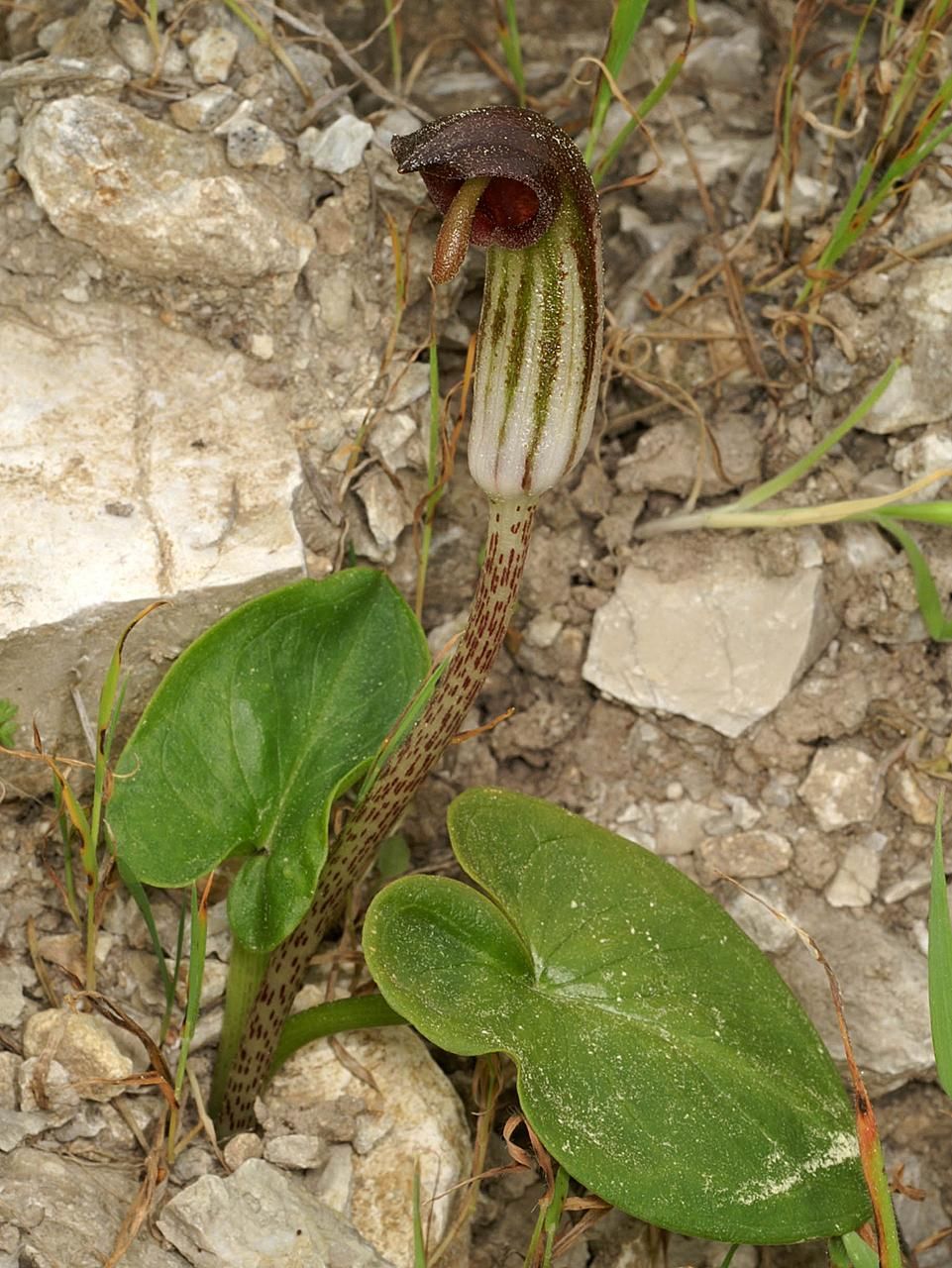
Arisarum is a small genus of flowering plants in the family Araceae (order Alismatales), comprising only a handful of accepted species. The genus is restricted to the Mediterranean Basin and adjacent regions, extending east to the Caucasus and west to Macaronesia. Its closest relative is Ambrosina, from which it diverged approximately 46 million years ago; the two genera together form a lineage sister to Peltandra and Typhonodorum within the broader aroid family.
Plants in this genus are herbaceous perennials that produce arrow-shaped or hastate leaves and bear their flowers on a spadix enclosed within a spathe — the characteristic inflorescence structure of the Araceae. The two primary species differ subtly in their morphology: in Arisarum simorrhinum the flower stalk is shorter than or roughly equal to the leaf stalk, while in Arisarum vulgare (friar's cowl) the flower stalk overtops the leaf stalk and the spadix is generally longer. A natural hybrid between these two species, Arisarum × aspergillum, is known from Spain, Algeria, and Morocco.
The most widely known member of the genus is Arisarum proboscideum (mouse plant), recognizable by its elongated, tail-like spathe tip that gives the appearance of a mouse burrowing into the foliage. All species typically grow in shaded, rocky, or scrubby Mediterranean habitats, flowering in winter or early spring before summer drought.
Etymology
The name Arisarum derives from the ancient Greek and Latin names used by Dioscorides and Pliny for plants of this group; the root is related to aron (ἄρον), a classical Greek term for aroids, with the diminutive or locative suffix -arum reflecting its Mediterranean usage.
Distribution
Arisarum is native to the Mediterranean region, ranging from Macaronesia (the Canary Islands, Madeira, and the Azores) in the west, through southern Europe and North Africa, to the Caucasus in the east. Species occur in shaded, rocky, or scrubby habitats and typically favor calcareous soils, flowering in the cooler, wetter months of winter and early spring.
Ecology
Arisarum foliage supports a distinctive set of parasites. The siphonous green alga Phyllosiphon arisari Kühn invades the intracellular spaces of leaves, causing necrotic patches. Two fungal pathogens — Phyllosticta arisari and Melanustilospora arisari — also affect the foliage. The scale insect Icerya purchasi (cottony cushion scale) feeds on the plants. Like other aroids, Arisarum species are likely pollinated by flies attracted to the spathe, though species-level pollination ecology is not well documented.
Taxonomy Notes
Arisarum belongs to family Araceae, order Alismatales. Phylogenetic analyses place it as sister to Ambrosina, from which it diverged roughly 46.1 million years ago; together they are related to Peltandra and Typhonodorum. The genus currently contains two widely accepted species (A. vulgare and A. simorrhinum) and one natural hybrid (A. × aspergillum). Arisarum proboscideum is also recognized in some treatments.










