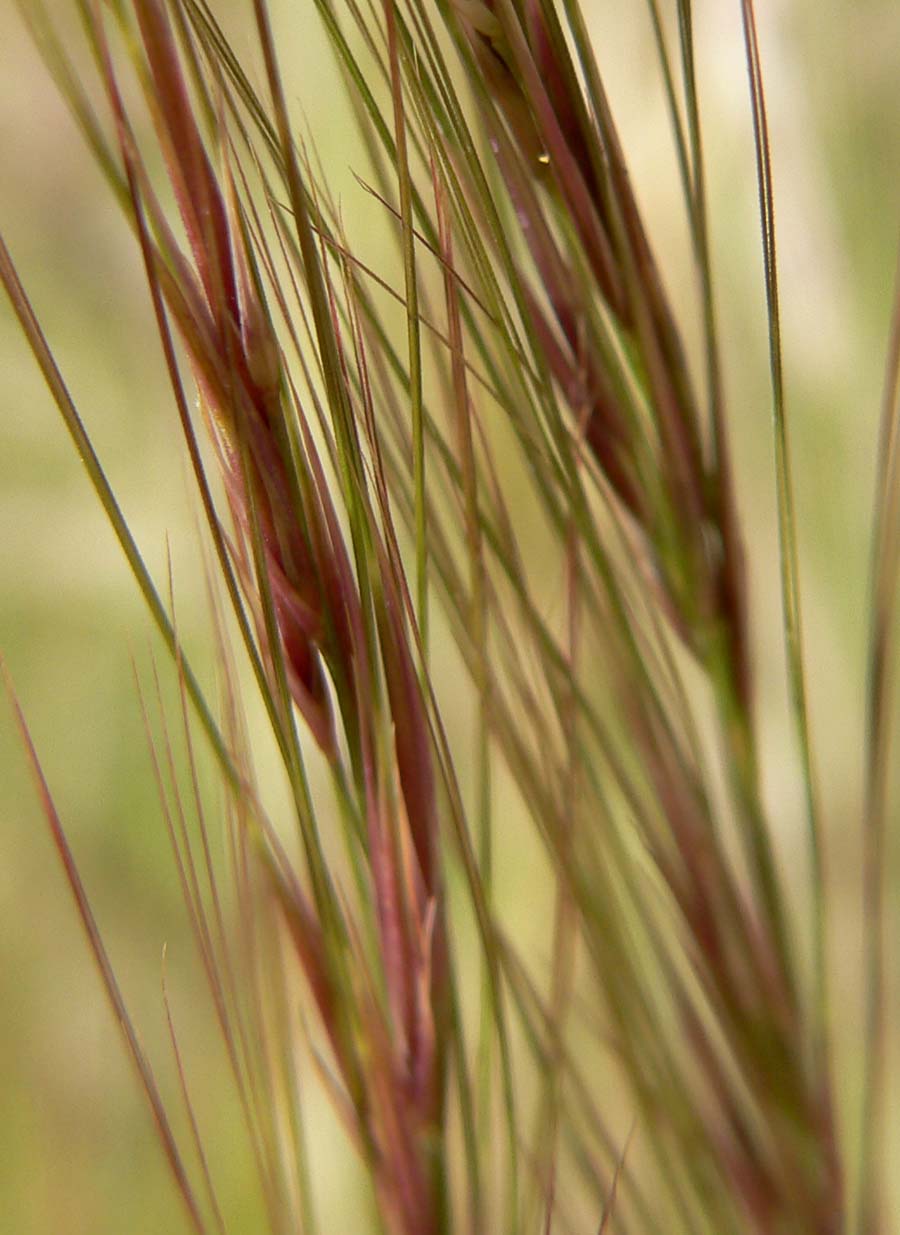
Aristida L. is a large genus of grasses in the family Poaceae, subfamily Aristidoideae, named by Carl Linnaeus in 1753. The genus is immediately recognizable by the presence of three awns (bristles) arising from each lemma — a feature encoded in both its Latin name (from arista, meaning "awn") and its most widespread common name, "three-awns." With roughly 300 to more than 450 described taxa recognized across different authorities, Aristida is one of the larger grass genera on Earth.
Plants are typically cespitose (forming dense tufts), with culms ranging from 10 to 150 cm tall. Leaves are narrow and often inrolled (involute), and the inflorescences are terminal panicles or racemes with single-flowered spikelets. The awns can be remarkably long; in A. purpurea var. longiseta they may reach 10 cm, giving the plants their characteristic spiky, bristled appearance that has also earned them the vernacular names wiregrasses, speargrasses, and needlegrasses.
Aristida has a nearly cosmopolitan distribution, occurring on every inhabited continent but centered on arid and semiarid warm regions. In North America the genus is especially diverse in the southwestern United States and Mexico, with over 50 species documented in the southwestern US alone. The Wiregrass Region of the southeastern US is named after A. stricta, which dominates fire-maintained longleaf pine flatwoods. In Australia the genus is represented by more than 70 species, where it is known variously as wind-grass, kerosene grasses, and three-awned spear grasses. African representatives thrive in dry savannas and around arid lake systems such as Lake Turkana in East Africa.
Ecologically, three-awns are characteristic of poor, dry, often sandy or rocky soils in grasslands, savannas, and open shrublands. Many species are opportunists: an increase in wiregrass abundance is a recognized indicator of overgrazing, since livestock typically avoid the plants. Several species are considered weedy or invasive in disturbed habitats.
Etymology
The genus name Aristida is derived from the Latin word arista, meaning "awn" — the stiff, bristle-like extension that projects from the tip of the lemma in grass florets. The name was applied by Carl Linnaeus in his Species Plantarum (1753) and directly describes the most conspicuous morphological feature of the genus: each floret bears not one but three such awns. The common English names "three-awns," "wiregrasses," and "needlegrasses" are all vernacular translations of the same morphological observation.
Distribution
Aristida has a nearly cosmopolitan distribution, with its center of diversity in warm arid and semiarid regions. In North America, the genus is richest in the southwestern United States and Mexico; SEINet records more than 50 species for the Arizona–New Mexico region alone, including A. arizonica and A. californica. The Wiregrass Region of the southeastern United States takes its name from A. stricta, which dominates the longleaf pine ecosystem. The genus is also well represented in the Great Plains through species such as A. purpurea and A. oligantha.
In Australia, the Atlas of Living Australia lists more than 70 species, where the genus bears vernacular names including wind-grass, kerosene grasses, spear grass, and three-awned spear grasses. African representatives are widespread in sub-Saharan savannas, with xeric grasslands around Lake Turkana in Kenya being one notably documented habitat. The genus also occurs across South America, southern Europe, the Middle East, and Asia.
Ecology
Three-awns are characteristic of nutrient-poor, dry, and often disturbed soils in grasslands, savannas, open shrublands, and sandy or rocky substrates. Many species thrive under conditions that exclude more palatable competitors: they are documented as often weedy, colonizing overgrazed or degraded ground. An increase in wiregrass abundance relative to other ground cover is recognized as a reliable field indicator of overgrazing, since livestock tend to avoid the plants.
Notable ecological roles include: the dominance of A. stricta in the fire-maintained longleaf pine flatwoods and Carolina sandhills of the southeastern United States; the structural importance of Aristida spp. in Australian mulga scrub communities; and the presence of the genus in xeric African grasslands. The long, sharp awns may assist in wind and animal dispersal of seeds.
Taxonomy
Aristida L. was formally described by Carl Linnaeus in Species Plantarum (1753), with Aristida adscensionis L. as the type species. The genus belongs to the family Poaceae, subfamily Aristidoideae, tribe Aristideae, and is classified within the order Poales, class Liliopsida. GBIF records 455 descendant taxa under this genus key (2706249).
Numerous historical names have been reduced to synonymy, including Arthratherum P.Beauv., Chaetaria P.Beauv., Curtopogon P.Beauv., Streptachne Kunth, Streptachne R.Br., Kielboul Adans., Moulinsia Raf., Trixostis Raf., Cyrtopogon Spreng., and Aristopsis Catasús.










