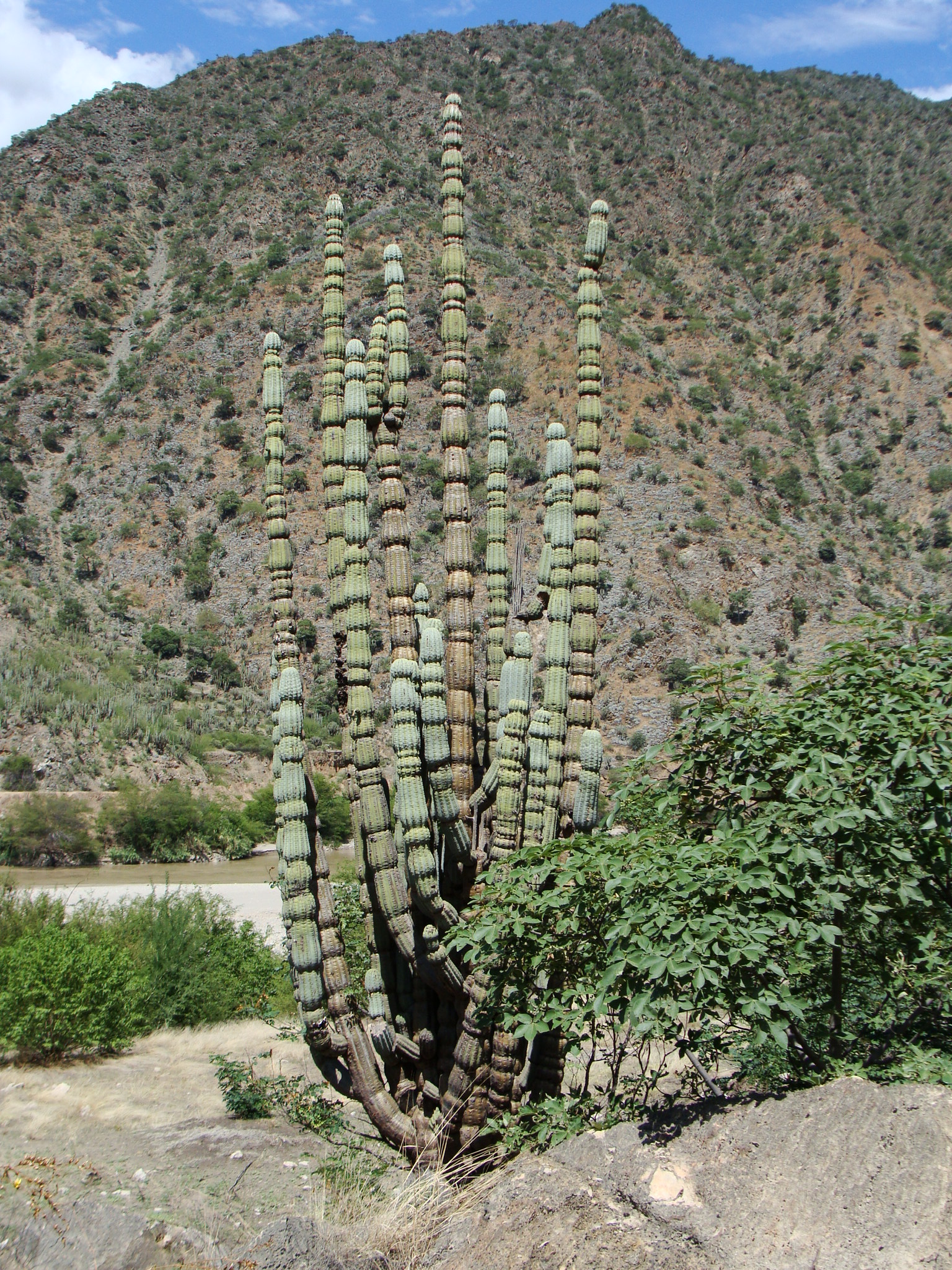
Armatocereus is a genus of columnar cacti in the family Cactaceae (order Caryophyllales), native to the Andean regions of Ecuador and Peru. The plants are bushy or tree-like in form, with upright cylindrical stems that branch freely and are divided into distinct sections by conspicuous narrow "necks" — constrictions that mark the boundary between each year's growth. Stems typically bear 5–12 prominent ribs lined with large areoles carrying strong spines.
Flowers are narrow and tubular, opening at night. They are mostly white, though Armatocereus rauhii is notable for producing red flowers — an unusual trait within the genus. The ovary and floral tube are spiny. Fruits are large, globular to ovoid, red or green, and bear strong spines that are shed as the fruit matures, revealing the flesh within. Seeds are large, black, ovoid or kidney-shaped.
The genus name was coined by Curt Backeberg in 1934 and first validly published in 1938 once the required Latin description was supplied, as mandated by the International Code of Botanical Nomenclature at the time. "Armatocereus" means "armed cereus," a direct reference to the genus's formidable spination. Plants of the World Online currently accepts several species, with the majority occurring in Peru. Some taxa historically placed here — such as Stenocereus humilis — have since been moved to other genera.
Etymology
The name Armatocereus derives from the Latin armatus ("armed") and cereus ("pliant" or "soft," a traditional genus name for columnar cacti), together meaning "armed cereus" — an allusion to the genus's prominent, strong spines. The name was introduced by Curt Backeberg in 1934 but did not become nomenclaturally valid until 1938, when the required Latin diagnosis was formally published.
Distribution
Armatocereus is endemic to the western slopes and inter-Andean valleys of Ecuador and Peru, with the majority of species restricted to Peru. The genus occupies arid to semi-arid habitats typical of the dry Andes and Pacific coastal drainages. Older taxonomic treatments also placed Stenocereus humilis from Colombia within Armatocereus, but this is no longer accepted.

