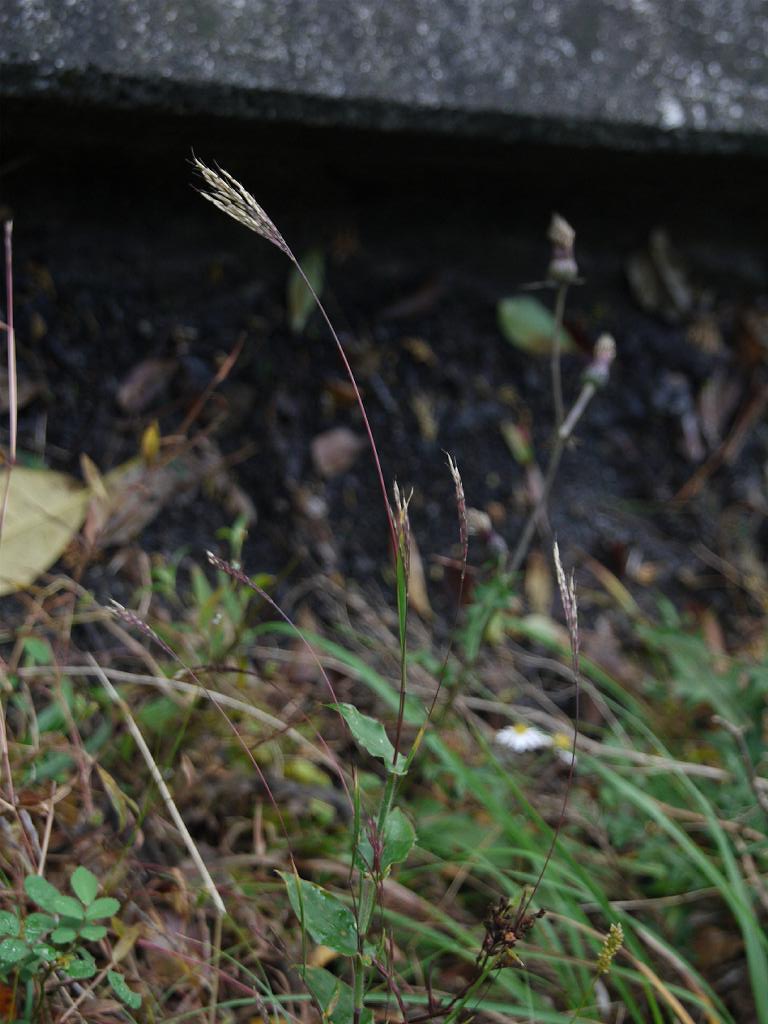
Arthraxon is a genus of annual grasses in the family Poaceae (order Poales), commonly known as carpetgrass or jointgrass. The genus is native to Asia, Africa, and Australia, and is characterised by low-growing, mat-forming plants that spread by rooting at stem nodes wherever they contact the ground.
The most widespread member is Arthraxon hispidus (small carpetgrass or hairy jointgrass), an annual grass reaching 0.3–0.6 m in height. Its leaves are ovate to lanceolate with heart-shaped (cordate) bases, 2.5–7.6 cm long, with hairy margins and sheaths. Stems are otherwise hairless and upright. The inflorescence is digitate to subdigitate, and fruits are caryopses that may bear awns or be awnless depending on the subspecies. The upper glume is distinctively purple while the lower glume is green; flowering and fruiting occurs from September through November.
The genus has undergone taxonomic revision: species formerly placed in Arthraxon, including those now known as Microstegium batangense and Dimeria hohenackeri, have been transferred to the genera Dimeria and Microstegium. A. hispidus itself is taxonomically variable, with some authorities recognising subspecies based on awn presence or absence.
Arthraxon hispidus has been introduced outside its native range and is considered an invasive weed across much of the eastern United States (recorded since the 1930s, now in at least 25 states) and parts of Central and South America. Conversely, in Australia — part of its native range — it holds threatened species status. It thrives in moist, sunny riparian, wetland, and floodplain habitats, and its seeds are readily dispersed by water.
In parts of Asia, the genus has a history of ethnobotanical use: A. hispidus has been employed in traditional medicine to treat inflammatory conditions and has been used to produce kihachijo, a yellow silk cloth historically associated with Hachijo Island in Japan.
Etymology
The name Arthraxon derives from the Greek words arthron (joint) and axon (axis), referring to the jointed rachis of the inflorescence — a characteristic feature of these grasses. The common name "carpetgrass" reflects the genus's mat-forming, ground-hugging growth habit.
Distribution
Arthraxon is native to Asia, Africa, and Australia. The principal species, A. hispidus, is native to East Asia and to New South Wales and Queensland in Australia. It has been accidentally introduced to the United States (first recorded in Virginia in the 1930s, now in at least 25 states), as well as to Central and South America, where it is classified as invasive in many jurisdictions and is explicitly prohibited in Connecticut and New York.
Ecology
Arthraxon hispidus favours moist, sunny environments and is typically found in riparian zones, wetlands, and floodplains. Seeds are dispersed by water. Germination is rapid (approximately three days) and occurs across a wide temperature range (8–37°C) and pH range (5–10), though the species germinates poorly under high salinity, drought conditions, or when seeds are buried more than 1–2 cm deep. In Australia, fire is believed to promote germination, and the species shows resilience to variable weather patterns.
Conservation
In the United States, Arthraxon hispidus is classified as an invasive weed; it is explicitly forbidden in Connecticut and New York, and management typically involves mowing, hand-weeding, or glyphosate application before seed set. In Australia, where it is native, A. hispidus is listed as a threatened species, with its natural plant community uncertain due to a long history of human development; it grows most successfully alongside other native species of New South Wales near the northern coast.
Cultural Uses
In Asia, Arthraxon hispidus has a documented history of use in traditional medicine, particularly for treating inflammatory conditions such as asthma. The compound 7-methoxy-luteolin-8-C-β-6-deoxy-xylo-pyranos-3-uloside (mLU8C-PU), isolated from the plant, has shown potential in tumor cell research. The species is also associated with kihachijo, a traditional yellow silk cloth from Hachijo Island, Japan; the yellow dye is produced from flavonoid C-glycosides including luteolin 8-C-rhamnoside, apigenin 8-C-rhamnoside, and tricin.










