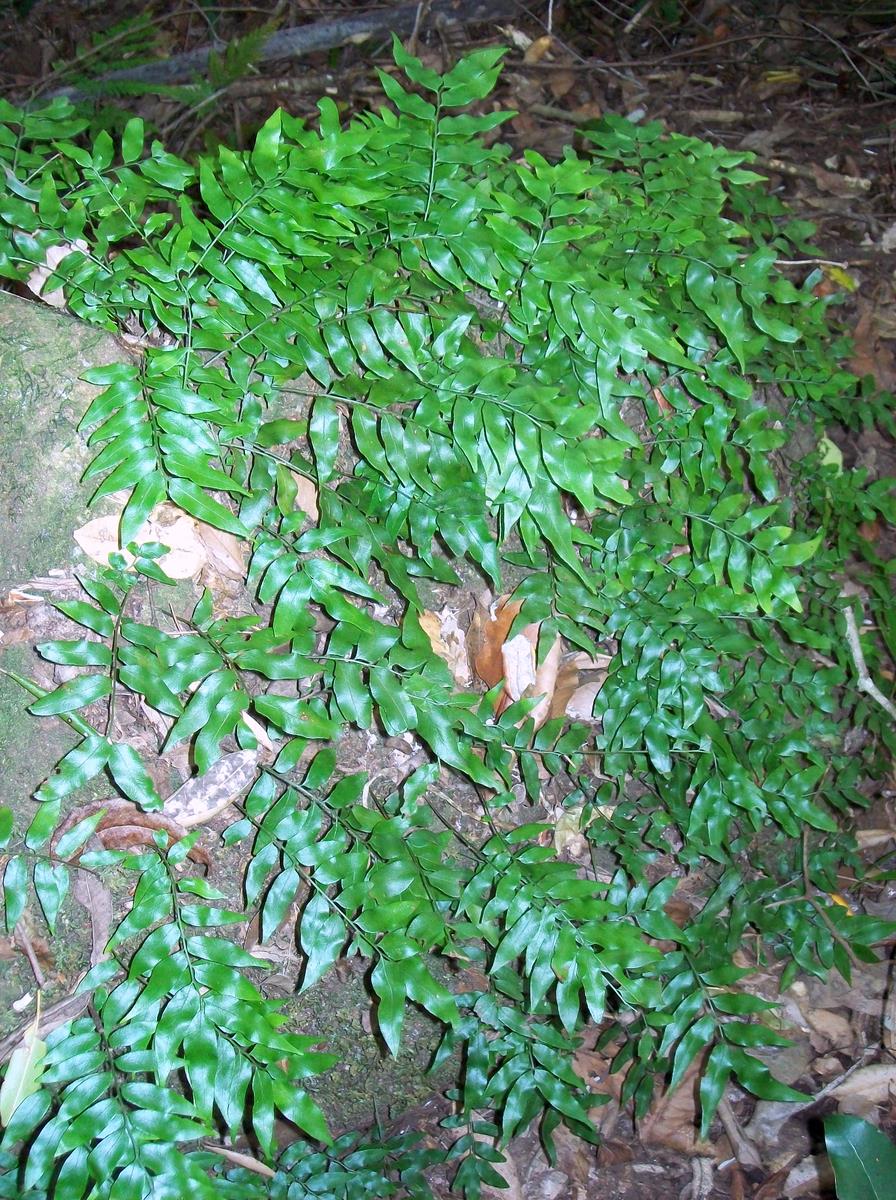
Arthropteris is a small genus of ferns belonging to the family Tectariaceae, placed there by the Pteridophyte Phylogeny Group classification of 2016 (PPG I). Before this reclassification, the genus had been variously assigned to the families Oleandraceae and Davalliaceae, reflecting the shifting understanding of fern systematics over the past two centuries. Within Tectariaceae the genus sits in the order Polypodiales, the largest order of leptosporangiate ferns, and belongs to the class Polypodiopsida in the phylum Tracheophyta.
The genus contains somewhere between 12 and 21 species, depending on the circumscription applied; the Checklist of Ferns and Lycophytes of the World (as of February 2020) recognizes 13 species. The type species is Arthropteris tenella (G.Forst.) J.Sm. ex Hook.f., originally described by Georg Forster. The genus was formally established by John Smith, published in Joseph Dalton Hooker's Flora Novae-Zelandiae (1854).
A key morphological feature that gives the genus its name is a distinct articulation — a joint — at the base of the leaf stalk (petiole) where it attaches to the rhizome. This joint is characteristic of the genus and the source of the Greek-derived name: arthron (joint) + pteris (fern). The rhizomes are typically long-creeping, and the fronds are pinnate to bipinnate in form.
The genus has a wide but largely tropical and subtropical distribution, native to Australia, Africa, Asia, and Europe (including Atlantic island groups). Notable species include Arthropteris tenella, the type species from Australia and the Pacific; Arthropteris palisotii, found in Africa; Arthropteris beckleri from eastern Australia; Arthropteris neocaledonica from New Caledonia; and Arthropteris submarginalis from Australia.
Etymology
The name Arthropteris is derived from Greek: arthron (ἄρθρον, "joint") and pteris (πτέρις, "fern"). It refers to the distinctive articulation at the base of the petiole — the joint where each leaf stalk meets the rhizome — which is a defining characteristic of the genus.
Distribution
Arthropteris is native to Australia, Africa, Asia, and Europe (primarily in tropical and subtropical zones, with European representation likely on Atlantic island groups such as the Canary Islands or Macaronesia). The genus is primarily found in moist, shaded habitats across these regions.
Taxonomy Notes
Arthropteris was established by John Smith, published in Hooker's Flora Novae-Zelandiae 2: 53 (1854). The genus has been historically placed in Oleandraceae and Davalliaceae before its current placement in Tectariaceae under the PPG I classification (2016). The number of accepted species varies between authorities — approximately 12 to 21 — reflecting ongoing disagreement over species limits. GBIF's backbone taxonomy recognizes 19 descendants.










