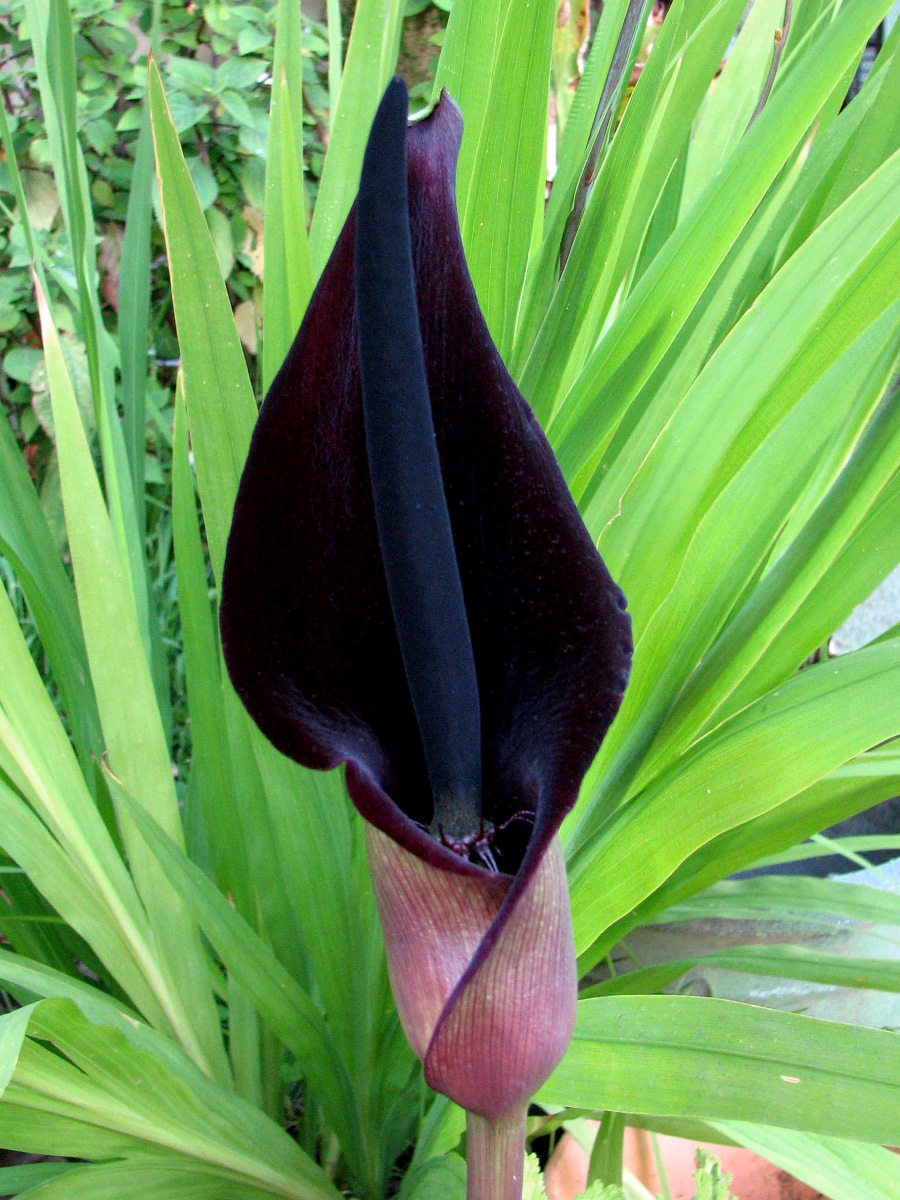
Arum is a genus of about 27–32 rhizomatous, tuberous herbaceous perennials in the family Araceae, native to Europe, northern Africa, and western and central Asia. Plants grow 20–60 cm tall, producing bold arrowhead-shaped leaves 10–55 cm long that are often attractively variegated in many cultivated selections.
The genus is best known for its striking inflorescence: a tubular spathe — ranging in color from greenish-white to deep purple — that unfurls to reveal a slender, club-shaped spadix at its center. The spathe draws attention in spring before the plant retreats to summer dormancy. After pollination, the spathe withers to reveal a dense cluster of glossy orange or red berries that persist into autumn, providing a final ornamental flourish.
Arum is notable for thermogenesis: the spadix generates heat significantly above ambient temperature through cyanide-insensitive cellular respiration, vaporizing odor compounds — often resembling dung or carrion — to lure flies and gnats into a temporary trap that ensures pollination. This is one of the most studied examples of heat production in flowering plants.
All parts of Arum plants are toxic if consumed raw, containing needle-like calcium oxalate crystals that cause intense burning and irritation in the mouth and throat. The toxins can be rendered harmless by thorough cooking or prolonged drying, and tubers of certain species have historically been processed as food in parts of the Mediterranean and Middle East. The berries are especially hazardous and should be treated as poisonous.
Etymology
The genus name Arum is the Latinized form of the ancient Greek word aron, which was the classical Greek name for these plants. The genus was formally described by Linnaeus in his Species Plantarum of 1753 (Sp. Pl.: 966), establishing the binomial nomenclature still in use today.
Distribution
Arum is native to a broad arc spanning Europe, northern Africa, and western to central Asia, with its greatest species richness concentrated in the Mediterranean Basin. Its documented native range encompasses countries including Great Britain, Ireland, France, Germany, the Netherlands, Belgium, Denmark, Spain (including the Balearic and Canary Islands), Italy, Corsica, Crete, Greece, the East Aegean Islands, the Balkan Peninsula, Crimea, Bulgaria, Hungary, Austria, Czechia-Slovakia, Cyprus, Turkey, Lebanon-Syria, Iraq, Iran, Kazakhstan, Kyrgyzstan, Afghanistan, Nepal, Algeria, Libya, Morocco, Madeira, and the Azores, according to the World Checklist of Vascular Plants.
Outside its native range, Arum has been introduced to parts of North America — including California, Illinois, Maryland, Missouri, and New York — and to northeastern Argentina. In several of these regions, naturalized populations have been documented, and some western North American plantings have escaped cultivation.
Ecology
Arum species are plants of shaded and semi-shaded habitats: woodlands, hedgerows, scrub, and rocky slopes, often on calcareous soils. Many function naturally as ground-cover understory plants, thriving beneath deciduous canopy where competition from grasses is reduced.
The most distinctive ecological trait of the genus is thermogenesis. The spadix produces heat — sometimes 10–20°C above ambient air temperature — through a cyanide-resistant alternative oxidase pathway in mitochondria. This heat vaporizes volatile compounds (typically amines and indole, often mimicking the smell of dung or rotting matter) that attract dipteran pollinators. Small flies and gnats enter the spathe, become temporarily trapped by downward-pointing hairs, deposit pollen from previously visited plants on the receptive female flowers, and are eventually released. This precise, insect-trap pollination mechanism is one of the best-documented examples of floral thermogenesis in flowering plants.
Where introduced, certain species — particularly A. italicum — can spread aggressively in moist, shaded conditions and are considered a weed concern in parts of the western United States.
Cultivation
Arum species are grown as ornamental perennials in temperate gardens, valued for their architectural foliage, spring spathes, and colorful autumn berries. They perform best in well-drained, moisture-retentive, humus-rich soil in partial to deep shade, conditions that mimic their natural woodland habitat. Most species are hardy in USDA zones 5a–9b.
Plants have medium maintenance requirements and are notably deer-resistant. They tend to flower in spring, then enter summer dormancy; in warmer climates, foliage re-emerges in autumn and persists through winter, providing year-round interest. Many species and cultivars offer attractive variegated or marbled leaf markings that are especially valued during the dormant winter months when little else is growing.
No significant pest or disease problems have been noted for the genus under typical garden conditions.
Propagation
Arum can be propagated by seed or by division of corms. Seed requires a period of warm stratification to break dormancy, with germination typically taking one to six months at 15°C. Division of established clumps is the more reliable and faster method: corms are lifted and separated after flowering in summer, then replanted at appropriate depth. Division also ensures that named cultivars with specific foliar markings are reproduced true to type.
Conservation
No genus-level conservation concerns have been flagged by major international databases for Arum as a whole. Individual species vary in status, however: some Mediterranean endemics with restricted ranges may face localized habitat pressures, while introduced populations of A. italicum in North America have been flagged as potentially invasive in moist woodland settings of the Pacific coast states.
Toxicity & Uses
All parts of Arum plants, including the berries, are toxic if consumed raw due to the presence of calcium oxalate crystals, which cause an intense burning and needle-like sensation in the mouth, tongue, and throat. Effects can include contact dermatitis, oral swelling, breathing difficulty, nausea, vomiting, and abdominal pain; ingestion of significant quantities can be fatal, particularly in children. The plants are toxic to cats, dogs, horses, and cattle as well as humans.
Despite this toxicity, Arum tubers have a long history of human use in Mediterranean and Middle Eastern cultures. The calcium oxalate crystals are destroyed by thorough cooking, prolonged drying, or extended soaking in water, rendering the starchy tubers edible. Palestinian Arab peasants historically processed leaves by leaching before eating them. The root of certain species has also been noted in ethnobotanical records as an abortifacient, though this use carries significant risk.
Taxonomy
Arum was formally established by Linnaeus in Species Plantarum (1753) and belongs to the family Araceae (order Alismatales, class Liliopsida). The GBIF backbone recognizes 97 descendant taxa in the genus, while Plants of the World Online (WCVP) currently accepts approximately 27 species and one hybrid as of 2025 — a lower count reflecting stricter circumscription under the WCVP standard. The genus is placed within the subfamily Aroideae of Araceae.
Species circumscription within Arum has been historically contentious, with numerous synonyms accumulated under widely studied species such as A. maculatum and A. italicum. The World Checklist of Vascular Plants documents introduced populations in Argentina and several U.S. states, all derived from cultivated escapes.










