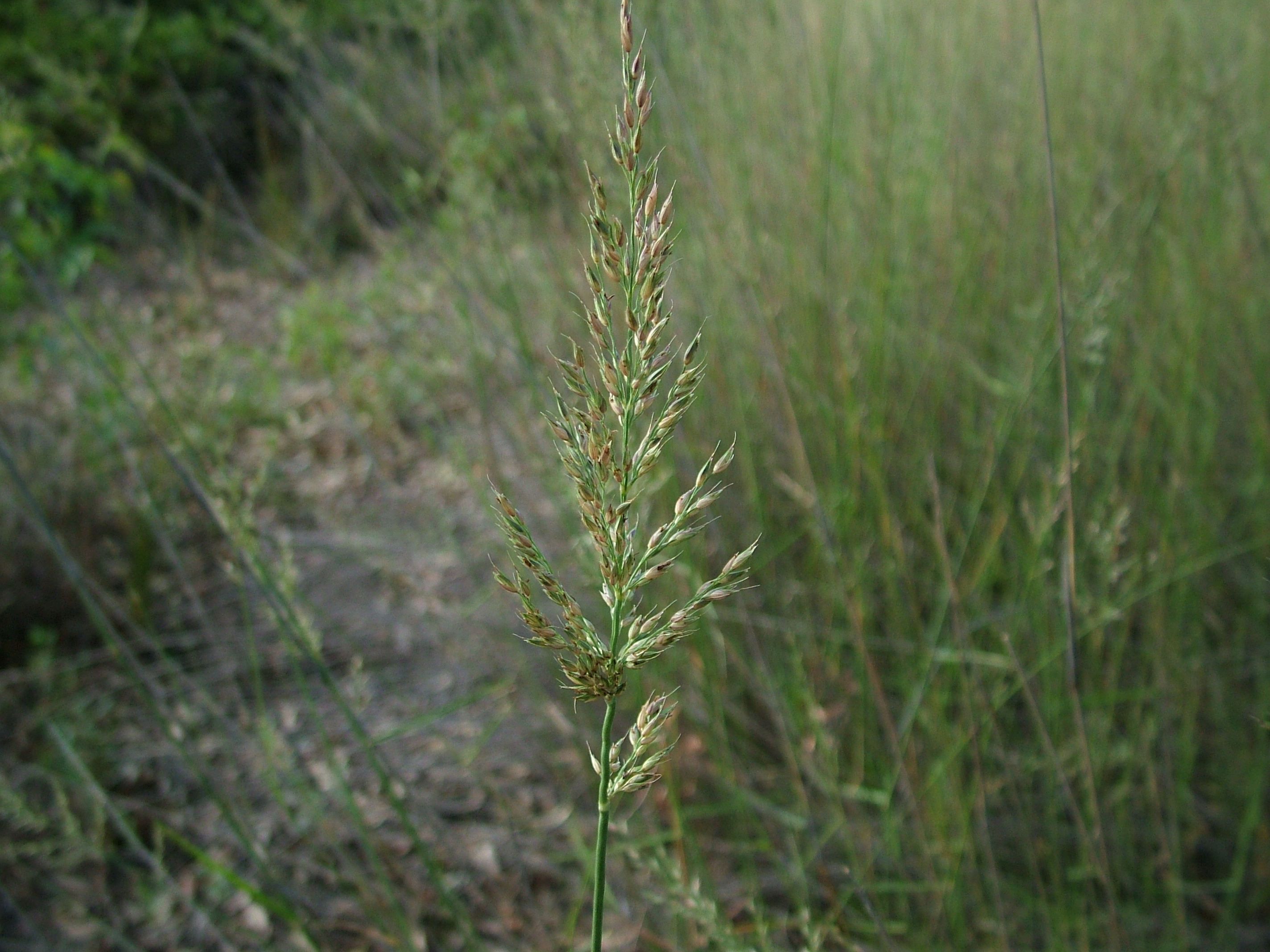
Arundinella is a genus of grasses in the family Poaceae, placed in the order Poales. First described by the Italian botanist Giuseppe Raddi in Agrostographia Brasiliensis (1823), the genus encompasses approximately 60 species distributed across tropical and subtropical regions of the world, with its greatest diversity in Asia — about 20 species occur in China alone, eight of which are endemic.
Members of Arundinella are perennial or annual grasses, sometimes growing from scaly rhizomes. The leaf blades are typically linear, and the ligule is very short and membranous, with a distinctive dense fringe of long hairs at the base of the blade. The inflorescence is a panicle, either open or contracted, bearing simple raceme-like primary branches; spikelets occur in pairs on unequal pedicels that are briefly joined at the base.
Each spikelet contains two florets and is lanceolate to ovate in shape, often gaping and frequently purplish in colour. The lower floret is either staminate (male) or sterile, while the upper floret is bisexual. The glumes are unequal, with the upper glume as long as the spikelet and often bearing a tail-like extension (caudate). The upper lemma is terete and firmer in texture, usually tipped with a geniculate (bent) awn with a brown twisted column; the callus is short, rounded, and bearded. The base chromosome number is x = 7.
Etymology
The genus name Arundinella is a Latin diminutive of arundo (reed), meaning "little reed," reflecting the reed-like habit of many species in this grass genus. The name was established by Giuseppe Raddi in 1823.
Distribution
Arundinella is distributed across tropical and subtropical regions worldwide, with the centre of diversity in Asia. About 60 species are recognised globally; 20 species occur in China (eight endemic), and representatives are also found across South and Southeast Asia, Africa, and the Americas.
Ecology
Species of Arundinella occupy a range of habitats within tropical and subtropical landscapes, including river banks, floodlands, mountain meadows, and forest margins. The Flora of China notes distinct habitat preferences among species, with some growing in mountain meadows and others along river banks and floodlands.

