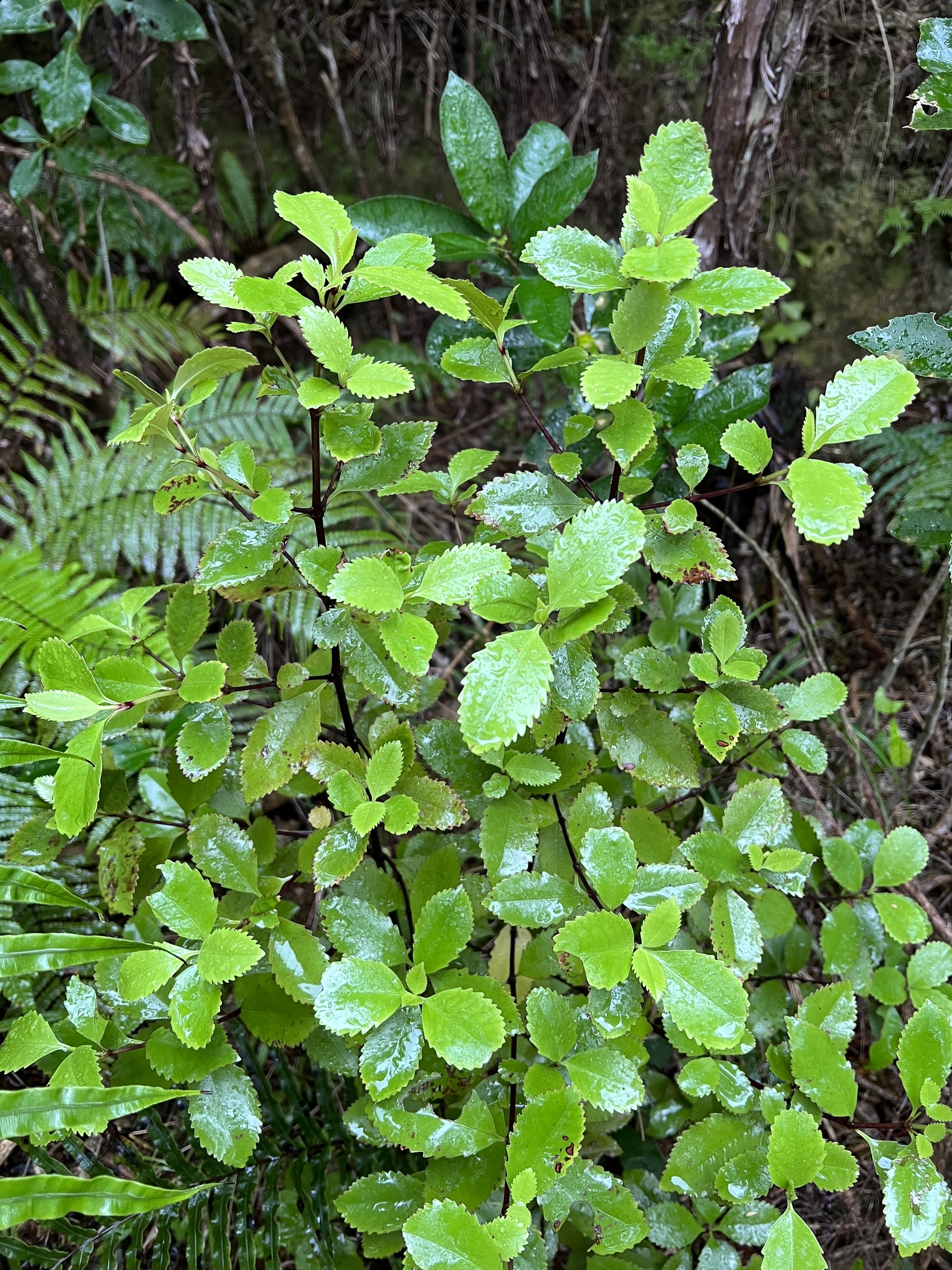
Ascarina is a genus of 12 species of woody, dioecious flowering plants in the family Chloranthaceae (order Chloranthales), one of the earliest-diverging lineages of angiosperms. Native to Pacific islands, insular Southeast Asia, and Madagascar, Ascarina species are predominantly tropical cloud-forest trees and shrubs reaching up to 6 metres in height. The flowers are minute, wind-pollinated, and lack a perianth; male flowers bear 1–5 stamens subtended by 1–3 bracts, while female flowers have a single carpel with a sessile, dry, papillose stigma. The fruit is a small drupe-like berry. Leaves are opposite, elliptic, with lightly serrated margins and a distinctive festooned craspedodromous venation pattern unique within the family. Pollen is mostly monosulcate with reticulate sculpturing. The most widespread and ecologically flexible species is Ascarina lucida (hutu) of New Zealand, which ranges from sea level to montane forest and occasionally produces bisexual flowers — a trait otherwise absent in the genus. Ascarina is the sister group to the clade containing Sarcandra and Chloranthus, with Hedyosmum being the first genus to diverge within Chloranthaceae. Fossil pollen attributed to the genus (notably Clavatipollenites hughesii) extends back to the Early Cretaceous, indicating a formerly much broader distribution.
Distribution
Ascarina species occur on islands across the Pacific and insular Southeast Asia — from New Zealand, New Caledonia, Fiji, and the Marquesas to Borneo, the Philippines, and Sulawesi — with one disjunct species on Madagascar. Most are restricted to high-humidity montane cloud forests at 1000–3300 m elevation; Ascarina lucida is the notable exception, growing from sea level to 1500 m in New Zealand. The genus was far more widespread during the Eocene and early Pleistocene; its current range has contracted due to climatic cooling, increased competition, and sensitivity to frost and drought.
Ecology
Ascarina species are generally pioneer plants of high-humidity tropical montane forests, thriving in sunny disturbed sites — an ecological strategy shared with its sister genus Hedyosmum. They are wind-pollinated (anemophilous), a trait proposed as an adaptation to open, early-successional habitats. Most species require consistently high rainfall and are vulnerable to even light frost, which damages leaves and flower buds. A. lucida in New Zealand grows reliably where annual rainfall exceeds ~1500 mm and is abundant above ~2500 mm. The sole shade-preferring species is A. swamyana of Fiji and Vanuatu.
Conservation
The range of Ascarina lucida in New Zealand has contracted, driven by vulnerability to drought and frost rather than pollen limitation — the species produces abundant wind-dispersed pollen capable of reaching offshore islands. Climate change and increased competition from later-successional vegetation are the primary threats limiting the genus's modern distribution relative to its much broader prehistoric range.
Fossil History
Ascarina has a deep fossil record. Pollen assigned to the genus (or indistinguishable from it), particularly Clavatipollenites hughesii, appears in Early Cretaceous deposits, making Chloranthaceae one of the oldest documented angiosperm lineages. During the mid-Eocene and early Pleistocene, Ascarina pollen was far more widespread globally than the genus's present-day insular distribution, and its occurrence on Madagascar is attributed to long-distance wind dispersal from the African continent during more favourable climatic periods.
Taxonomy
Ascarina was described by J.R. Forster & G. Forster in Characteres Generum Plantarum (1775). Within Chloranthaceae, molecular phylogenies place Ascarina as sister to the Sarcandra + Chloranthus clade, with Hedyosmum diverging first. The genus is unique in the family in having male flowers with more than one stamen (1–5), a trait that has been interpreted either as retention of a primitive condition following reduction elsewhere in the family, or as a secondary elaboration. The occasional occurrence of bisexual flowers in A. lucida adds to the uncertainty. Fossil pollen of the Clavatipollenites hughesii type, dating to the Early Cretaceous, closely resembles Ascarina pollen in its monosulcate, reticulate-columellar structure and supratectal spinules; the exact relationship remains unresolved.










