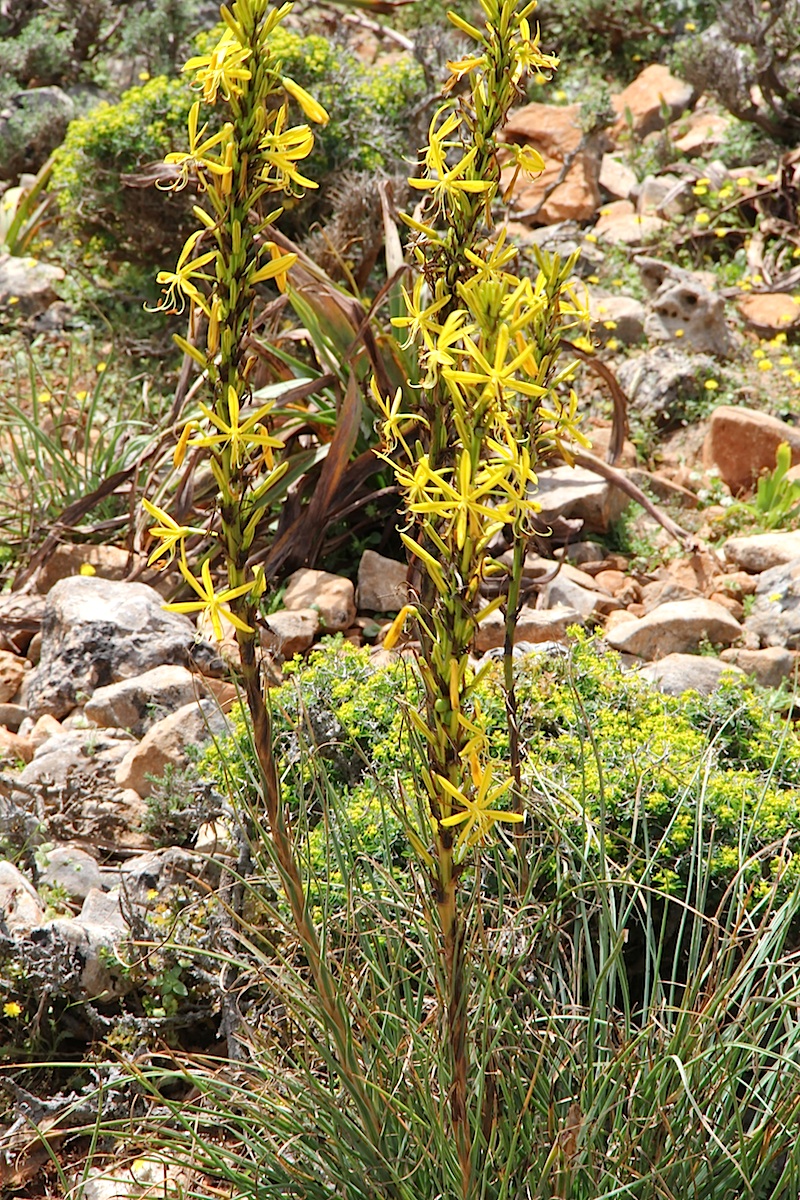
Asphodeline is a genus of perennial flowering plants belonging to the family Asphodelaceae, within the order Asparagales. The genus was first formally described in 1830 and comprises roughly a dozen species distributed across the eastern Mediterranean region and the Middle East.
Plants in this genus are herbaceous perennials with fleshy, storage roots and a characteristic blue-green, grass-like foliage. Tall, narrow flower spikes rise above the basal leaves, bearing fragrant, star-shaped yellow flowers that bloom from May through June. Individual flowers along each spike open in a seemingly random sequence and are individually short-lived, though the overall flowering display is sustained as new blooms continuously replace spent ones. Mature plants reach approximately 1.2 m (4 ft) in height in suitable conditions.
Asphodeline species favour well-drained soils and sunny, open habitats typical of the Mediterranean basin. Newly planted seedlings require at least three years to reach flowering maturity. The most widely cultivated member is Asphodeline lutea (yellow asphodel or king's spear), valued as an ornamental for its striking spikes and late-spring garden interest.
Etymology
The name Asphodeline is a diminutive form derived from Asphodelus, the genus of true asphodels, reflecting the close relationship and morphological similarity between the two groups. The root traces to the Ancient Greek ἀσφόδελος (asphódelos), the asphodel of classical antiquity.
Distribution
Asphodeline is native to the eastern Mediterranean region and the Middle East, with a range extending from Italy and Algeria in the west to Iran in the east. The genus is concentrated in Turkey, the Balkans, the Levant, and adjacent regions, where it grows in open, rocky, and scrubby habitats.
Ecology
Asphodeline species grow in well-drained soils in sunny, open habitats across the Mediterranean basin. The fleshy roots serve as water and nutrient storage organs, an adaptation suited to seasonally dry conditions. Flowers are produced on tall spikes with individual blooms opening in a non-sequential order; each flower is short-lived but is rapidly replaced, sustaining the display over several weeks. Seedlings are slow to establish and do not typically flower until their third year.
Cultivation
Asphodeline species are cultivated as ornamental perennials, particularly Asphodeline lutea, which is well established in European and North American horticulture. They thrive in full sun and sharply drained soil, tolerating drought and poor, stony substrates once established. Division of mature clumps or growing from seed are the standard propagation methods, though seed-raised plants require patience — flowering is not expected until the third year after sowing.

