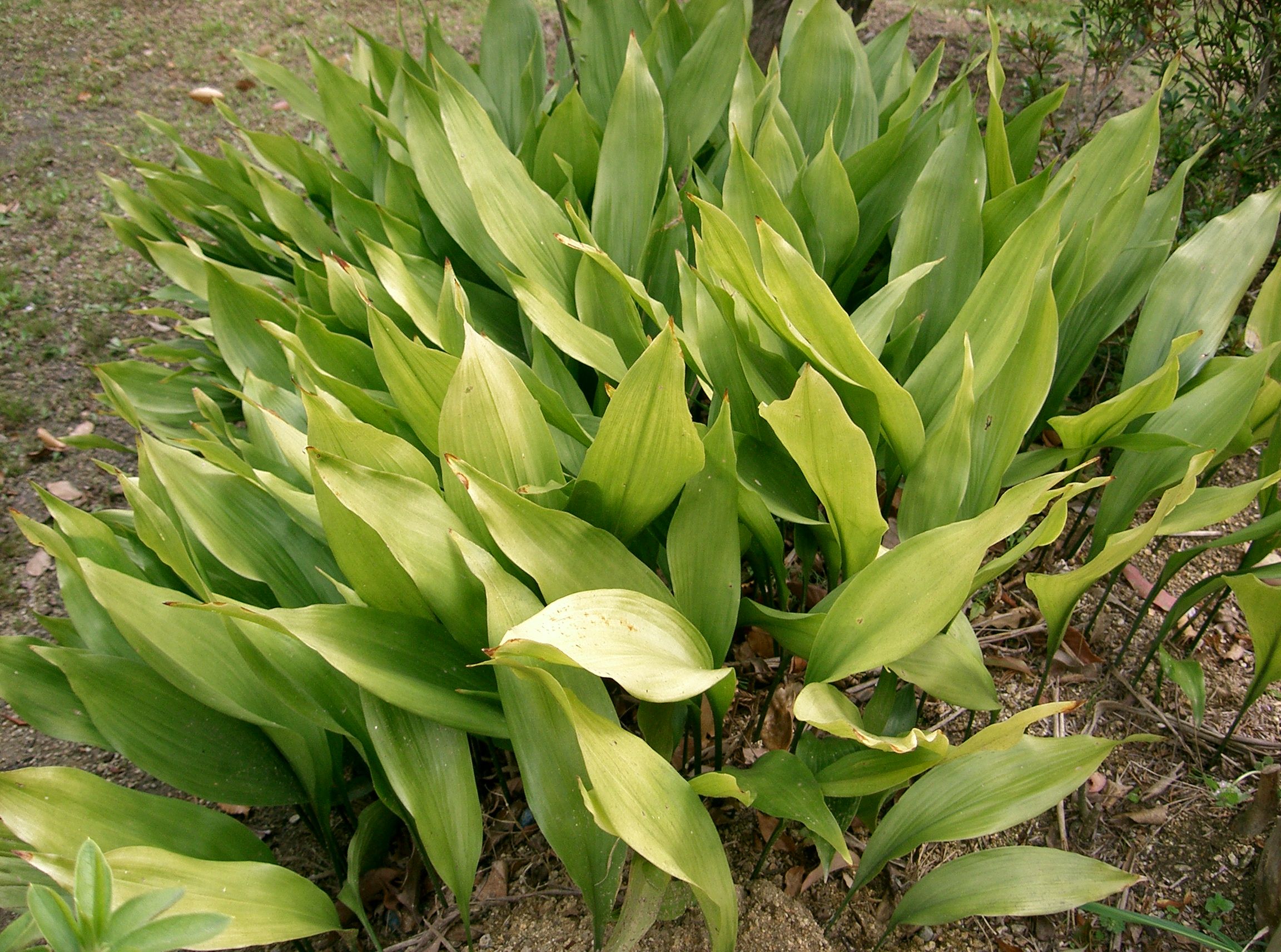
Aspidistra is a genus of perennial herbaceous flowering plants in the family Asparagaceae (subfamily Convallarioideae), native to eastern and southeastern Asia. Around 100 species are currently accepted, with the majority found in China — particularly Guangxi Province — and Vietnam. The number of known species increased dramatically from the 1980s onward as field botanists began documenting the genus in earnest; only 8–10 species were recognised in the late 1970s.
Plants grow from rhizomes and are typically stemless: leaves arise more or less directly from the ground on long stalks (petioles) with many-veined blades. Flowers appear at or near ground level on very short flowering stems (scapes) and are fleshy, bell-, urn-, or cup-shaped, and generally inconspicuous, though A. grandiflora bears spider-like flowers up to 12 cm across and A. longipedunculata produces unusual yellow flowers on scapes up to 20 cm high. The fruit is a berry, often containing a single seed.
The most widely cultivated member is Aspidistra elatior, the "cast-iron plant," prized as a foliage houseplant for its extraordinary tolerance of shade, neglect, temperature fluctuations, dry soil, and polluted indoor air. Several other species are also suitable for outdoor cultivation in temperate climates, generally surviving temperatures as low as −5 °C.
Etymology
The genus name Aspidistra was coined by English botanist John Ker Gawler in 1822. It is a blend of the Greek word ασπίς/ασπίδ- (aspid-), meaning "shield" — an allusion to the broad, flattened stigma — and the name of the closely related genus Tupistra.
Distribution
Aspidistra species grow as ground flora in forests and under shrubs across eastern and southeastern Asia, ranging from eastern India through Indochina and China to Japan. The genus reaches its highest species diversity in Guangxi Province, China, with Vietnam second. Many species are narrow endemics restricted to China or Vietnam; few have broad distributions.
Ecology
Species of Aspidistra inhabit the shaded forest floor in areas of high rainfall. Their flowers, which appear at or near ground level, are pollinated by an unusual array of invertebrates. Amphipods (small terrestrial crustaceans) are documented pollinators of A. elatior in Japan and of introduced Aspidistra in Australia. Springtails and fungus gnats have also been implicated as pollinators, and the Vietnamese species A. phanluongii is believed to be pollinated by flies of the genus Megaselia. The earlier claim that slugs and snails pollinate Aspidistra flowers is now considered a myth.
Cultivation
Aspidistra elatior, the "cast-iron plant," is one of the most shade-tolerant and forgiving of all foliage houseplants, capable of surviving deep shade, cool conditions, dry soil, hot temperatures, and polluted indoor air from burning coal or gas. For outdoor cultivation, aspidistras prefer an open, acidic, humus-rich soil and are generally hardy to around −5 °C (23 °F), with hard frosts below −10 °C likely causing damage. Species suitable for outdoor growing in temperate climates such as the UK include A. diabuensis, A. elatior, A. lurida, A. typica, and A. zongbyi.
Cultural Uses
In Japan, the large leaves of Aspidistra elatior have been traditionally cut into pieces and used as dividers inside bento and osechi boxes to keep individual foods separated. This practice has largely been replaced by plastic imitations known as "baran," though the tradition reflects the plant's deep cultural presence in Japanese daily life.
Taxonomy Notes
Aspidistra was historically placed within a broadly defined Liliaceae alongside many other lilioid monocots. It was subsequently moved to Convallariaceae and then Ruscaceae as classification was refined. Under the APG III system (2009), it is placed in Asparagaceae, subfamily Convallarioideae, alongside genera such as Tupistra. The genus was largely neglected by field botanists until the 1980s; approximately 30 new species were described from China in that decade alone, and subsequent work in Vietnam continued to expand the recognised species count to around 100.










