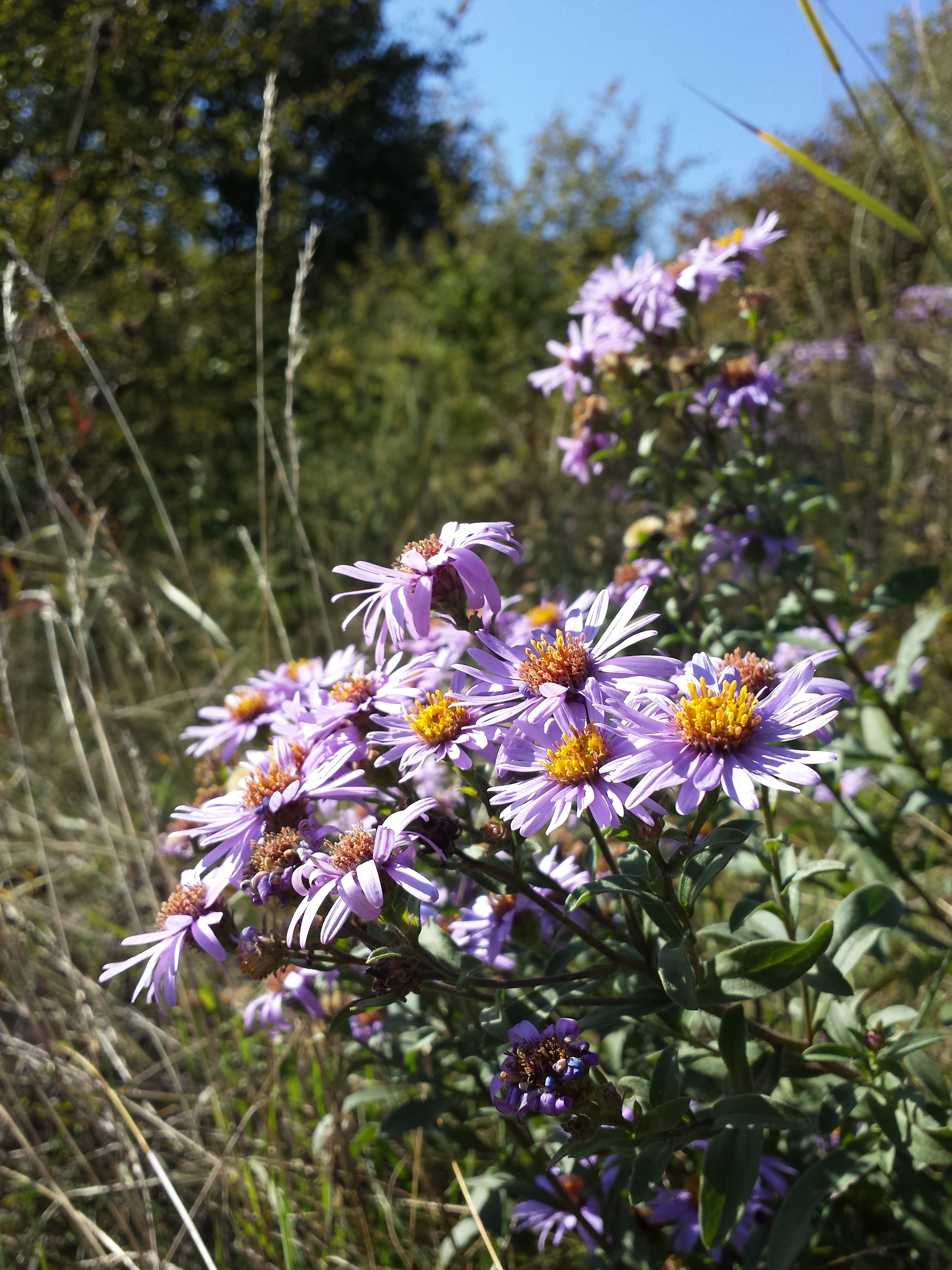
Aster is a genus of perennial flowering plants in the family Asteraceae, encompassing approximately 170–186 accepted species (depending on the treatment) after a sweeping taxonomic recircumscription in the 1990s. Plants grow from 6 cm to 3 m tall, are typically rhizomatous, and bear characteristic daisy-like composite flower heads: a central disc of small yellow florets surrounded by strap-shaped ray florets in shades of white, pink, purple, blue, violet, red, or gold. The disc florets transition from yellow-white to purplish-red as the head matures. Ray heads typically measure 2.5–7.5 cm across. Stems are ascending to erect with variable hairiness; leaves are basal and/or cauline, spatulate to linear, with entire or serrate margins. Fruits are obconic cypselae bearing persistent pappi of 20–30 barbellate bristles.
The genus belongs to the tribe Astereae within Asteraceae and takes its name from the Ancient Greek word for star, a reference to the radiating arrangement of the flower head. The genus was originally described by Linnaeus in 1753 in Species Plantarum, where it encompassed nearly 600 species spanning both Eurasia and North America. Following phylogenetic studies in the 1990s, the vast majority of North American "asters" were transferred to segregate genera including Symphyotrichum, Eurybia, Doellingeria, and Ionactis, all of which remain in tribe Astereae. In its modern, strict sense, Aster is almost exclusively Eurasian; Aster alpinus is the sole species with a notable native presence in North America.
Asters are important late-season garden plants, flowering from midsummer through autumn and providing a valuable nectar source for pollinators including bees and butterflies. Many species and hybrids are cultivated under the popular name "Michaelmas daisies." In addition to ornamental use, some Asian species have edible uses, and the genus contains flavonoids, terpenoids, saponins, and phenolic compounds of interest to researchers.
Etymology
The genus name Aster comes directly from the Ancient Greek word ἀστήρ (astḗr), meaning "star." The name alludes to the star-shaped appearance of the flower head, in which ray florets radiate outward from a central disc in the manner of a stellar burst. Linnaeus adopted this name when he formally described the genus in 1753 in Species Plantarum.
Distribution
In its modern circumscription, Aster is predominantly a Eurasian genus. Species are distributed across Europe, the Middle East, Central Asia, Siberia, East Asia (particularly China, Japan, Korea, and the Himalayas), and into South and Southeast Asia. Aster alpinus is the sole species with a confirmed native range extending into North America, where it occurs in alpine and subalpine habitats.
In Europe, several native species occur in open, often calcareous habitats — Aster amellus is found in dry grasslands and rocky slopes in central and southern Europe, while Aster alpinus inhabits mountain meadows and rock ledges across the Alps and other mountain systems. In Switzerland, the native species Aster alpinus, Aster amellus, Aster bellidiastrum, and Aster linosyris are recorded, alongside naturalized introductions of formerly North American taxa (now reassigned to Symphyotrichum and other genera but historically listed as Aster in Swiss flora).
East Asia harbors the greatest diversity of species in the genus, including Aster ageratoides, Aster tataricus, Aster tongolensis, and numerous endemic taxa found in the mountains of China.
Taxonomy
Aster was described by Linnaeus in 1753 (Species Plantarum 2: 872) and originally encompassed nearly 600 species distributed across Eurasia and North America. By the late twentieth century, morphological and molecular phylogenetic studies demonstrated that Linnaean Aster was polyphyletic — several lineages within it were more closely related to other genera than to each other.
The most consequential outcome of this research was the transfer of the great majority of North American "asters" to a set of segregate genera: Symphyotrichum, Eurybia, Doellingeria, Ionactis, and others. All of these segregates remain within tribe Astereae of Asteraceae and are still commonly called asters in horticultural usage, but they are no longer placed in Aster in any current checklist. The chromosome base number of x = 9 is shared across the group.
In its current, narrowly circumscribed sense, Aster comprises roughly 170–186 predominantly Eurasian species. Aster alpinus is the one species that retains a significant native range in North America alongside its Eurasian distribution. Further refinements have also removed elements such as the Crinitaria–Galatella–Tripolium complex, and segregates including Kalimeris, Heteropappus, and Diplactis were carved out of or redistributed within the broader Aster alliance. The type species of the genus is Aster amellus L.
Ecology
Asters are characteristically late-season bloomers, with most species flowering from midsummer through autumn. This phenology makes them exceptionally valuable for pollinators: the composite flower heads attract bees, butterflies, and other insects at a time when few other plants are in flower. They function as food plants for numerous Lepidoptera larvae.
Plants are typically rhizomatous perennials adapted to a wide range of habitats, from mountain grasslands and rocky ledges at high elevations to open woodlands and disturbed ground at lower altitudes. Hybrids form readily within the genus, indicating broad reproductive compatibility among related taxa.
In cultivation, asters are susceptible to fungal diseases including powdery mildew, downy mildew, rusts, and Verticillium wilt, as well as insect pests such as lace bugs, aphids, mites, and Japanese beetles.
Cultivation
Asters are widely grown as ornamental perennials, valued for their abundant late-season bloom and adaptability. They perform best in full sun to partial shade (2–6+ hours of direct sunlight daily) and tolerate a range of soil types including clay, loam, and organically rich soils. Soil pH tolerance is broad, from acidic to alkaline. Plants generally prefer well-drained to occasionally moist conditions. In temperate gardens, most cultivated forms are hardy to USDA zones 4a–8b.
The Royal Horticultural Society recognizes several Aster cultivars with the Award of Garden Merit. Popular cultivated species and their hybrids are often marketed as "Michaelmas daisies" and bloom from late summer into autumn. They suit borders, cottage gardens, naturalized areas, and cutting gardens, and are effective in mass plantings or as accent specimens. Growth rate is medium; maintenance requirements are low once established. The type species, Aster amellus, is the basis for a large number of named garden cultivars.
Propagation
Asters can be propagated by several methods. Division of established clumps in spring is the most common approach for garden cultivars and preserves cultivar characteristics. Stem cuttings taken in spring or early summer and root cuttings also produce true plants. Propagation from seed is feasible but most cultivars do not come true; species plants can be grown from seed sown under glass in late winter or direct-sown in spring.
Cultural Uses
The genus Aster has several cultural and practical associations. In East Asian traditions, certain species — notably Aster tataricus (known in Chinese as zi wan) — have a long history of use in traditional Chinese medicine, where the roots and rhizomes are used as expectorants and for respiratory conditions. Some Asian species are also noted as edible.
The genus has political and symbolic resonance in European history: the 1918 Hungarian Revolution, which toppled the Habsburg monarchy, became known as the "Aster Revolution" because demonstrators in Budapest wore aster flowers to signal their allegiance to the cause.
Phytochemically, the genus contains flavonoids (antioxidants), terpenoids, saponins (with antimicrobial properties), and phenolic compounds, which have attracted interest from researchers studying potential medicinal applications.










