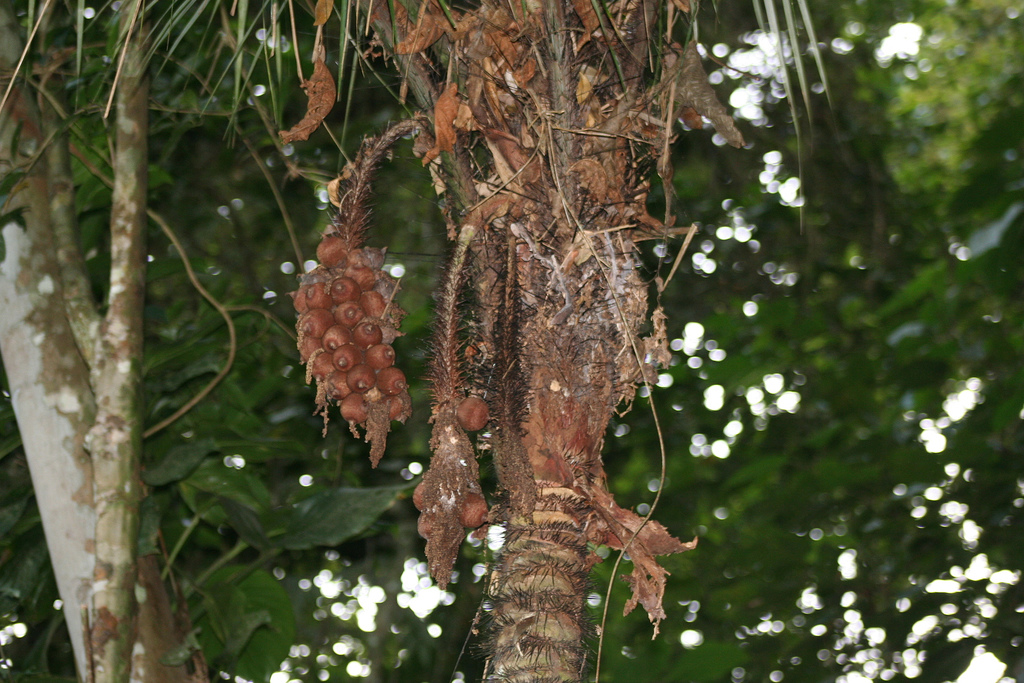
Astrocaryum is a genus of approximately 36 to 40 species of spiny palms in the family Arecaceae (order Arecales), native to Central and South America and the island of Trinidad. The genus is immediately recognizable by its formidable spines — borne on stems, leaf sheaths, and sometimes inflorescences — and its pinnately compound leaves, in which rows of leaflets emerge on either side of the central leaf axis in a feather-like arrangement.
Growth habit varies considerably across the genus: some species produce a single trunk, while others form multi-stemmed (caespitose) clumps. All species are pleonanthic, meaning individual plants flower repeatedly throughout their lifespan rather than dying after a single reproductive episode. They are also monoecious, carrying separate male and female flowers on the same plant.
The type species, Astrocaryum aculeatum, was first described by the German botanist Georg Friedrich Wilhelm Meyer in 1818, based on a specimen collected from the Essequibo River in Guyana. The genus encompasses around 39 accepted taxa according to GBIF.
Many species have significant economic and cultural importance across their native range. The fruit and seeds of several species are exploited for human food, edible oil production, and fish bait; leaves provide fibre for weaving and cordage; and stems serve as construction material. Several species are also used medicinally and harvested for palm heart.
Distribution
Astrocaryum is native to Central and South America and the island of Trinidad, spanning a range from southern Mexico and the Caribbean coast of Central America through most of tropical South America, including Brazil, Guyana, Colombia, and Peru.
Taxonomy Notes
The type species, Astrocaryum aculeatum, was described by Georg Friedrich Wilhelm Meyer in 1818 from a Guyanese specimen. GBIF recognises approximately 39 accepted descendants in the genus within the family Arecaceae, order Arecales. Species counts in the literature range from about 36 to 40, reflecting ongoing taxonomic revisions.
Cultural Uses
Across their native range, several Astrocaryum species are economically important to local communities. Fruits and seeds are eaten directly and pressed for edible oil; seeds are also used as fish bait. The long leaf fibres are woven into hammocks, baskets, and cordage. Stems serve as building poles. Various species are used in traditional medicine, and the apical growing bud (palm heart) is harvested as food, though this kills the plant.










