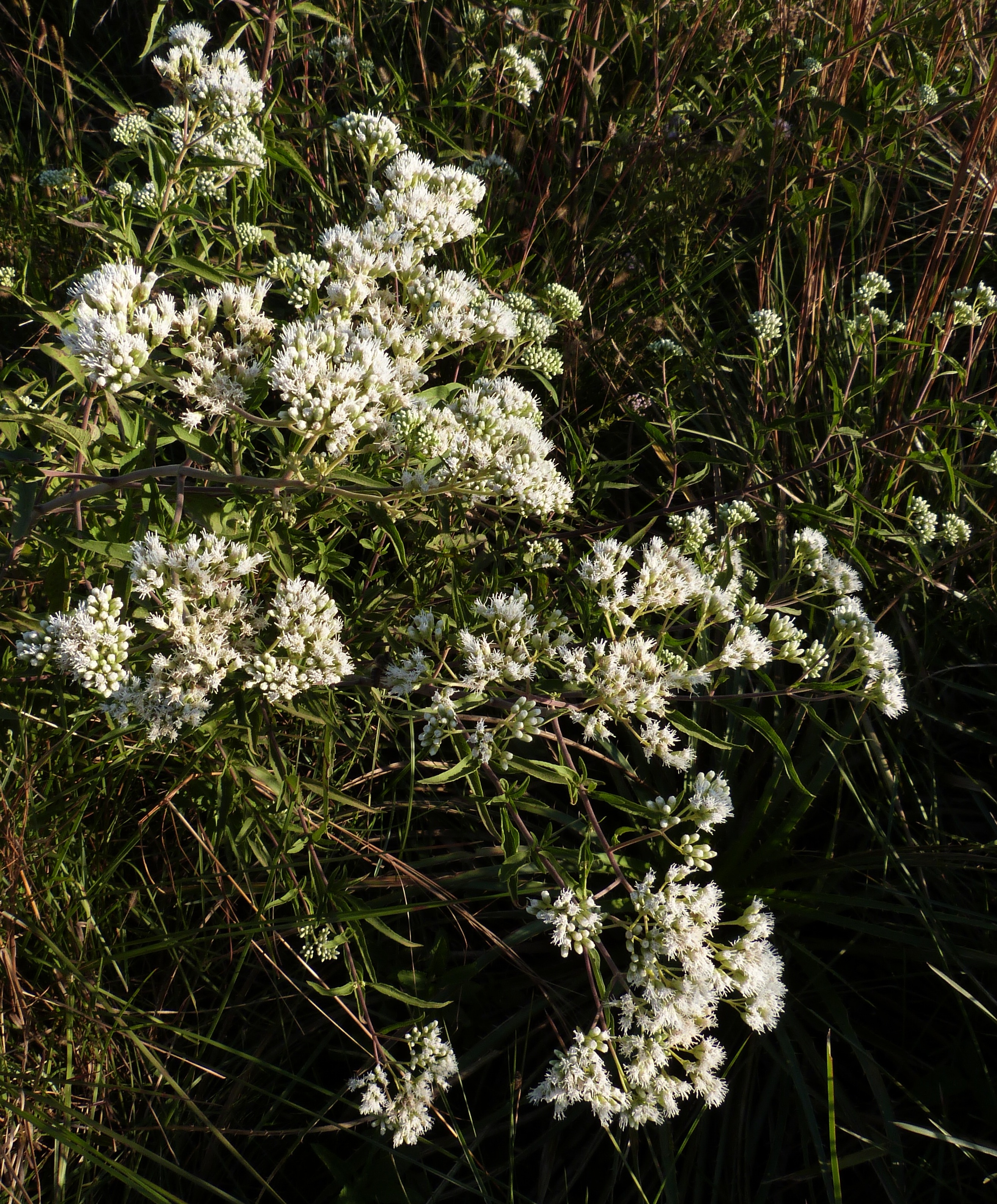
Austroeupatorium is a genus of flowering plants in the family Asteraceae (tribe Eupatorieae), order Asterales. It comprises herbaceous perennials and shrubs native primarily to South America, with its core range in eastern South America. The genus extends northward as far as Panama and Trinidad and Tobago, and westward to Bolivia. Around 16 accepted species are recognized, concentrated in Brazil, Paraguay, Argentina, Bolivia, and neighboring countries, with one species (A. patens) reaching Chile.
The genus was established by R.M. King and H. Robinson, segregated from the large aggregate genus Eupatorium. Its name reflects this origin, combining the Latin prefix austro- (southern) with Eupatorium, indicating a South American counterpart to that cosmopolitan genus.
Plants in Austroeupatorium are typical of the eupatorioid tribe within Asteraceae: they bear discoid flower heads (lacking ray florets) with small tubular florets, and their leaves are generally opposite. Members colonize a range of habitats from open forest margins to disturbed ground such as roadsides and agricultural edges.
The best-known member, Austroeupatorium inulifolium, ranges from Panama to Argentina and has been introduced beyond the Americas to Sri Lanka, Indonesia, Taiwan, the Philippines, and Sumatra. In Sri Lanka's Knuckles Range it is regarded as a highly invasive species, forming dense stands in disturbed areas including roadsides and fields.
Taxonomy Notes
Austroeupatorium was described by R.M. King and H. Robinson as a segregate of the broadly conceived Eupatorium, part of a major reclassification of tribe Eupatorieae in Asteraceae. The genus name combines the prefix austro- (Latin: southern) with Eupatorium, marking it as a southern-hemisphere counterpart to that genus. GBIF accepts it within family Asteraceae, order Asterales.
Distribution
The genus is native to eastern South America, ranging from southern Brazil, Paraguay, Uruguay, and northeastern Argentina northward to Colombia, Ecuador, Peru, Venezuela, Trinidad and Tobago, and Panama, with one species (A. patens) in Chile. Austroeupatorium inulifolium has been introduced as an invasive plant to Sri Lanka, Indonesia, Taiwan, the Philippines, and Sumatra.
Ecology
Austroeupatorium inulifolium is a noted invasive species in disturbed habitats outside its native range, particularly in the Knuckles Range of Sri Lanka. It colonizes roadsides, forest edges, and fields prepared for planting, growing as either a herbaceous perennial or a shrub up to two metres tall.










