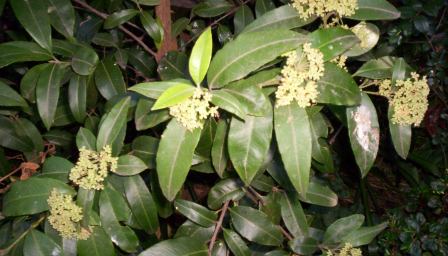
Backhousia is a genus of thirteen currently recognised species of flowering plants in the family Myrtaceae, order Myrtales. All known species are endemic to Australia, growing in the rainforests and seasonally dry forests of Queensland, New South Wales, and Western Australia.
Plants in this genus are aromatic shrubs or trees reaching 5 to 25 metres in height. Their leaves are arranged in opposite pairs and measure 3–12 cm long by 1–6 cm wide. The aromatic foliage is a defining characteristic of the group, and several species are used as culinary herbs and sources of essential oils.
The most widely cultivated member of the genus is Backhousia citriodora, the lemon myrtle, whose leaves carry a lemon fragrance attributable to high concentrations of citral. Backhousia myrtifolia, the grey myrtle, and Backhousia subargentea, the giant ironwood, are among the other notable members. The genus was formally described in 1845 by William Jackson Hooker and William Henry Harvey in the Botanical Magazine, and is named in honour of English-Australian botanist James Backhouse.
Etymology
The genus Backhousia was formally named in 1845 by William Jackson Hooker and William Henry Harvey, published in the European botanical journal the Botanical Magazine. It commemorates James Backhouse, an English botanist and Quaker missionary who worked extensively in Australia during the nineteenth century.
Distribution
All currently known species of Backhousia are endemic to Australia. Their range spans the rainforests and seasonally dry forests of Queensland and New South Wales on the east coast, with at least one species extending to Western Australia. Some taxa may also occur in New Guinea, but these have not been formally described and are not included in the Australian Plant Census.










