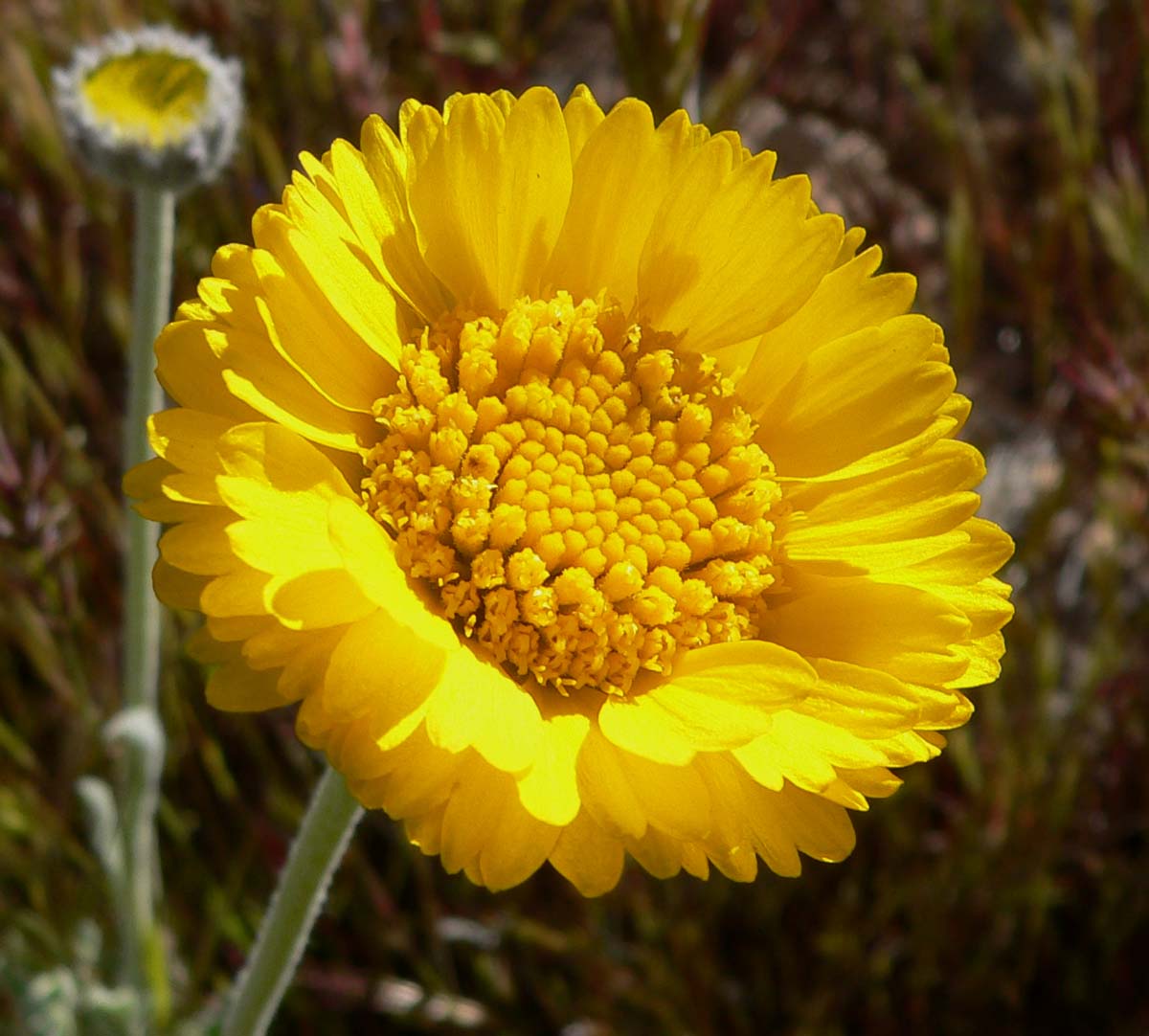
Baileya, commonly known as desert marigolds, is a small genus of flowering plants in the aster family (Asteraceae), order Asterales. It comprises three to four species, all native to arid and semi-arid landscapes of the southwestern United States and northern Mexico.
Plants in the genus are typically annual, though Baileya multiradiata — the most widespread species — may behave as a short-lived perennial under favorable conditions. The leaves vary from entire to deeply lobed and are concentrated in a basal rosette, from which arise several erect flowering stems reaching up to about 50 cm (18 inches) tall. Each stem typically terminates in a single bright yellow radiate flower head, giving the plants their characteristic cheerful appearance across desert roadsides, washes, and open sandy soils. Baileya pauciradiata is an exception, sometimes producing two or three flower heads per stem.
Desert marigolds bloom primarily in spring, extending through July. Summer monsoon rains in their native range can trigger a second flowering period in October and into November. The genus has ecological significance as a larval food plant for certain moths: Schinia miniana feeds exclusively on Baileya, while Schinia pallicincta is specifically tied to B. pauciradiata.
Etymology
The genus Baileya was named in honor of Jacob Whitman Bailey (1811–1857), an American microscopist and professor at the United States Military Academy at West Point, celebrated for his pioneering studies of diatoms.
Distribution
All species of Baileya are native to the southwestern United States and northern Mexico, where they grow in desert and semi-arid habitats including sandy flats, roadsides, washes, and open scrubland.
Ecology
Baileya species serve as larval host plants for certain noctuid moths. Schinia miniana feeds exclusively on the genus, while Schinia pallicincta is a specialist on Baileya pauciradiata. The plants' main bloom spans spring through July; summer monsoon moisture can stimulate a secondary flowering in autumn.

