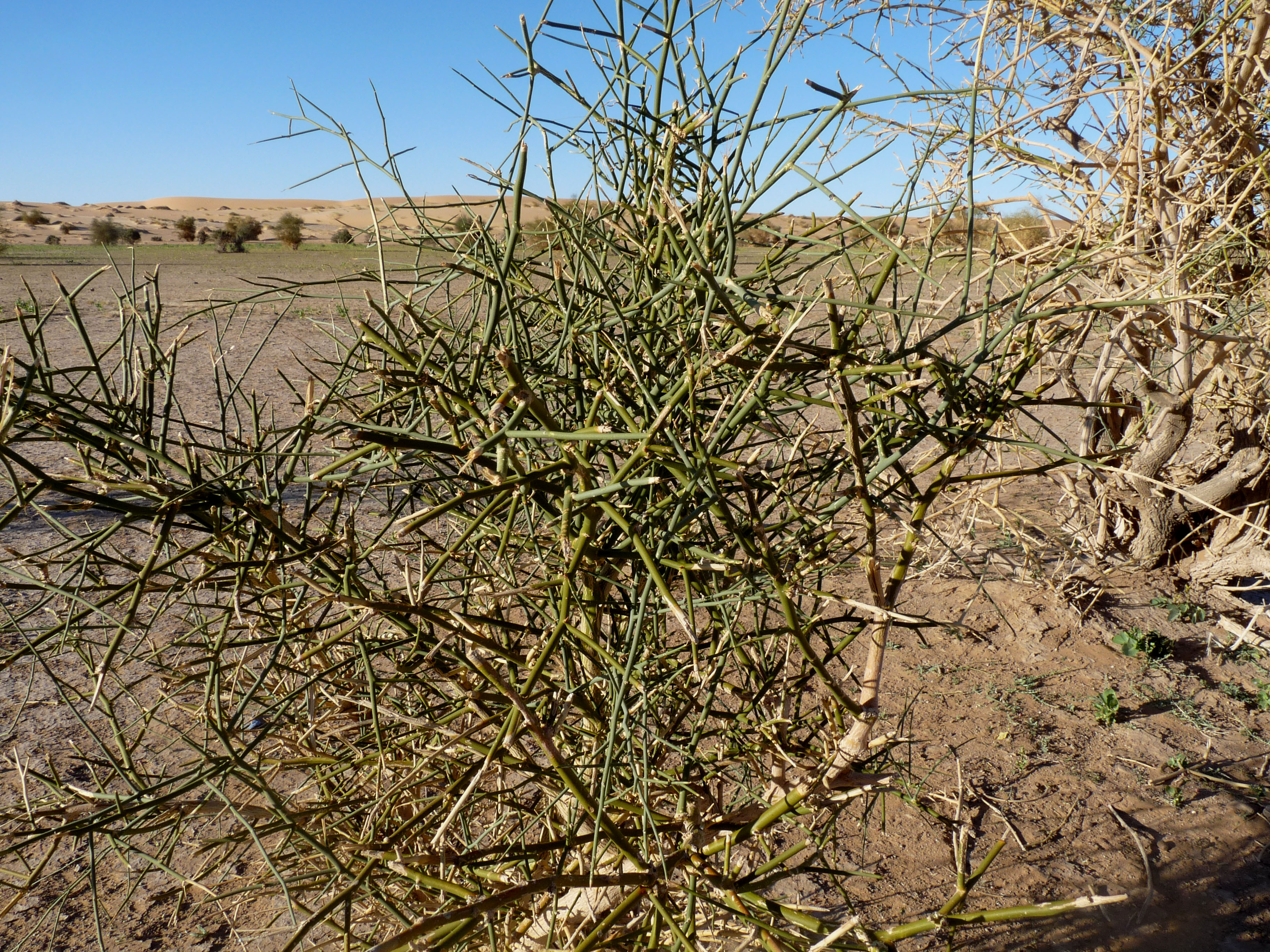
Balanites is a small genus of thorny trees and shrubs in the caltrop family, Zygophyllaceae (order Zygophyllales), distributed across the Afrotropical, Palearctic, and Indomalayan biogeographic realms — spanning much of Africa, the Middle East, and parts of South Asia. The genus comprises around nine recognized species of drought-adapted woody plants found in arid to subhumid savanna, scrubland, and dry woodland habitats.
Trees in Balanites typically grow to around 10 m in height with a narrow form. The branches bear long, straight green spines arranged in spirals, and the compound leaves — made up of two leaflets variable in shape and size — emerge from the base of the spines. The trunk is fluted with grayish-brown, ragged bark that reveals yellow-green patches where it exfoliates. Flowers are small, greenish-yellow, hermaphroditic, and radially symmetrical with five petals, typically 8–14 mm across. The fruit is a drupe whose shape — resembling an acorn — gave the genus its name.
The best-known member is Balanites aegyptiaca, widely known as the desert date or Egyptian balsam, a culturally and economically significant tree across sub-Saharan Africa and the Middle East. Its seeds yield a substantial fixed oil, its leaves and fruits are edible, and bark and fruit extracts have a long history of use in traditional medicine for treating parasitic infections and other ailments.
Etymology
The name Balanites derives from the Greek word for an acorn (balanos), a reference to the shape of the genus's characteristic drupe fruit. It was coined by the French botanist Alire Delile in 1813.
Distribution
Balanites occurs across the Afrotropical, Palearctic, and Indomalayan biogeographic realms. The most widespread species, B. aegyptiaca, ranges across much of continental Africa (excluding South Africa, Namibia, Madagascar, Senegal, and Tunisia) and extends into the Middle East from Syria south to Yemen. Species in the genus tolerate a broad range of soil types — from sand to heavy clay — and climatic conditions from arid to subhumid.
Ecology
Species in the genus are notably resilient, tolerating periodic flooding, heavy livestock browsing, and wildfire. Balanites aegyptiaca is visited by the carpenter ant Camponotus sericeus, which feeds on nectar exuded by the flowers. The larvae of the cabbage tree emperor moth (Bunaea alcinoe) can cause significant defoliation of the trees.
Cultural Uses
Balanites aegyptiaca has been used by human communities across Africa and the Middle East for millennia. Its fruits and leaves are edible; the seeds yield a fixed oil (30–48% by weight) with culinary and cosmetic applications. Bark and fruit extracts contain saponins (including diosgenin and yamogenin) with molluscicidal properties — historically exploited to reduce snail populations that act as intermediate hosts for Schistosoma and guinea worm parasites. In West African traditional medicine, bark decoctions are used as an antidote to arrow poison. The fruit pulp is also consumed medicinally and has demonstrated antiamoebic, antimicrobial, and antioxidant activity in laboratory studies.










