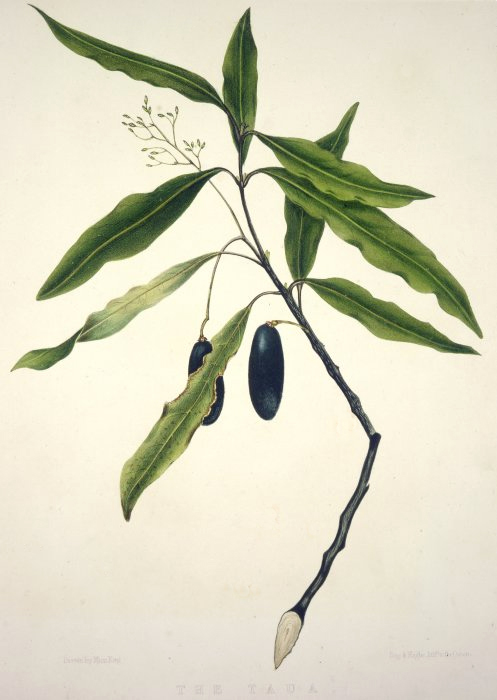
Beilschmiedia is a large genus of evergreen trees and shrubs in the laurel family, Lauraceae (order Laurales), comprising around 268 accepted species. The genus has a wide pantropical and warm-temperate distribution, with species occurring across tropical Asia, Southeast Asia, Africa, Madagascar, Australia, New Zealand, New Caledonia, the Caribbean, and Central and South America.
Plants in this genus are characterised by bark that is pale to dark brown, smooth or rough, and branchlets densely clothed in fine reddish-brown hairs. Leaves are alternate, leathery, and dark green, with distinctive depressed venation; young growth is often reddish-tinged. Flowers are small, greenish to cream or yellow-green, hermaphroditic, and borne in erect axillary panicles, frequently with dense reddish-brown indumentum. The fruit is a drupe — variable in form across species, but often large, globose, and dark purple to black when ripe, covered in a waxy bloom, enclosing a single seed. Many species rely on birds for seed dispersal; the large-seeded New Zealand endemics depend almost exclusively on the kererū (New Zealand pigeon), which is one of the few birds capable of swallowing and passing the seeds intact.
The greatest species richness occurs in cloud forests and tropical rainforests of Asia and Southeast Asia. The genus is notably important in the island flora of Madagascar, where it diversified in isolation after the island separated from Africa. A distinct Gondwanan thread runs through the genus, with related species in South America, Australia, New Zealand, and New Caledonia representing remnants of an ancient laurophyll flora linked to the Antarctic flora element.
Three species are endemic to New Zealand: taraire (B. tarairi), tawa (B. tawa), and tawaroa (B. tawaroa), all significant canopy trees in northern lowland forests. In Chile, B. miersii (northern belloto) and B. berteroana (southern belloto) are endemic, frost-tolerant, endangered trees of coastal and submontane forest, both protected in Chile's national reserve system. Seeds of B. bancroftii were traditionally used as food by Australian Aborigines, and the timber of several species is commercially valued.
Distribution
Beilschmiedia is distributed across tropical and warm-temperate regions worldwide, with its greatest diversity in the cloud forests and rainforests of Asia and Southeast Asia. It also occurs in Africa, Madagascar, Australia, New Zealand, New Caledonia, the Caribbean, and from Central America south to Chile and Argentina, including Mediterranean-climate zones between 38°–45° S latitude. A few species reach temperate areas in northern latitudes.
Ecology
The genus is adapted primarily to high-rainfall, humid environments — cloud forest, tropical rainforest, and laurel forest — but some lineages have evolved tolerance of drier, Mediterranean-type climates, a pattern linked to continental aridification since approximately 15 million years ago. Speciation has been driven in part by habitat fragmentation as forests contracted during arid periods, including the isolation of Malagasy populations after Madagascar separated from Africa. Beilschmiedia species grow in moist, well-drained soils and tolerate a range of soil types; some species occur in riverine and swamp forest understorey. Seed dispersal is largely by birds that swallow the large drupes, making avian frugivores critical to population dynamics.
Conservation
Beilschmiedia miersii (northern belloto) and B. berteroana (southern belloto) are endangered sclerophyllous endemics of central Chile, restricted to coastal forest and submontane Andean zones respectively; both occur within Chile's protected-areas network. Several African species (B. lebrunii) are rare trees with very restricted ranges. The genus as a whole includes relict species persisting in temperate refugia that are vulnerable to habitat loss and climate change.
Cultural Uses
Seeds of Beilschmiedia bancroftii (Queensland walnut or blush walnut) were used as a food source by Australian Aborigines. The timber of several species is commercially valued across their ranges.

