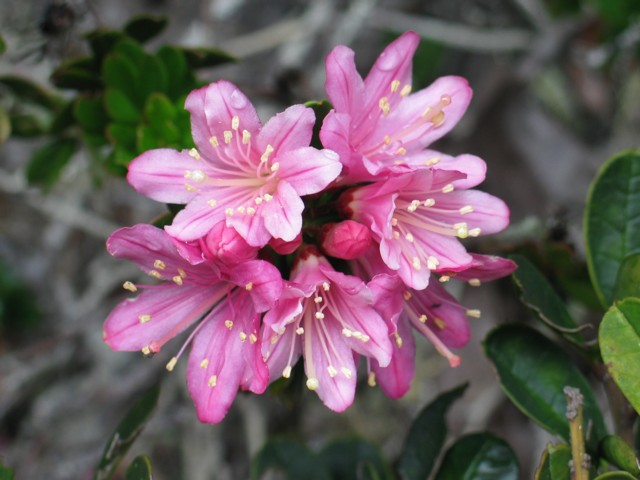
Bejaria is a genus of flowering shrubs in the family Ericaceae (the heath family), order Ericales. The genus comprises roughly 15 species distributed across the tropical and subtropical Americas, ranging from the southeastern United States and Mexico south through Central America and the Andes to Bolivia and northern Brazil. Within Ericaceae, Bejaria belongs to a predominantly New World lineage and shares the family's characteristic floral architecture: showy, often sticky-petalled flowers and a tendency toward acidic, well-drained montane or scrubby habitats. The genus was described by the botanist José Celestino Mutis and formally published under Linnaeus (authorship Mutis ex L.), making it one of the earlier neotropical Ericaceae to enter the scientific literature. In the southeastern United States, Bejaria racemosa — known commonly as tarflower — is the sole representative of the genus north of Mexico, notable for its glandular-hairy, resinous stems and clusters of white to pale pink flowers. Across its broader Andean range, several species such as Bejaria aestuans, Bejaria resinosa, and Bejaria mathewsii occupy high-altitude scrub and páramo vegetation.
Etymology
The genus name Bejaria honours José Celestino Mutis (1732–1808), the Spanish-Colombian botanist and physician who first collected and described the genus in New Granada (present-day Colombia). The name as published carries the authority Mutis ex L., indicating Linnaeus formally adopted Mutis's manuscript name.
Distribution
Bejaria is native to the tropical and subtropical Americas, extending from the southeastern United States (Florida, Georgia) and Mexico through the Caribbean and Central America into South America as far south as Bolivia and northern Brazil. The greatest species diversity occurs in the Andean highlands and adjacent montane scrub. In North America, only Bejaria racemosa (tarflower) is present, confined to the coastal plain of Florida and southern Georgia.
Taxonomy Notes
The genus Bejaria Mutis ex L. is placed in the family Ericaceae, order Ericales. GBIF recognises it as an accepted genus with authorship attributing the name jointly to Mutis (as the manuscript originator) and Linnaeus (as the formal publisher). Approximately 15 species are assigned to the genus in current treatments, though GBIF's backbone lists 5 accepted descendants reflecting differences in circumscription between checklists.

