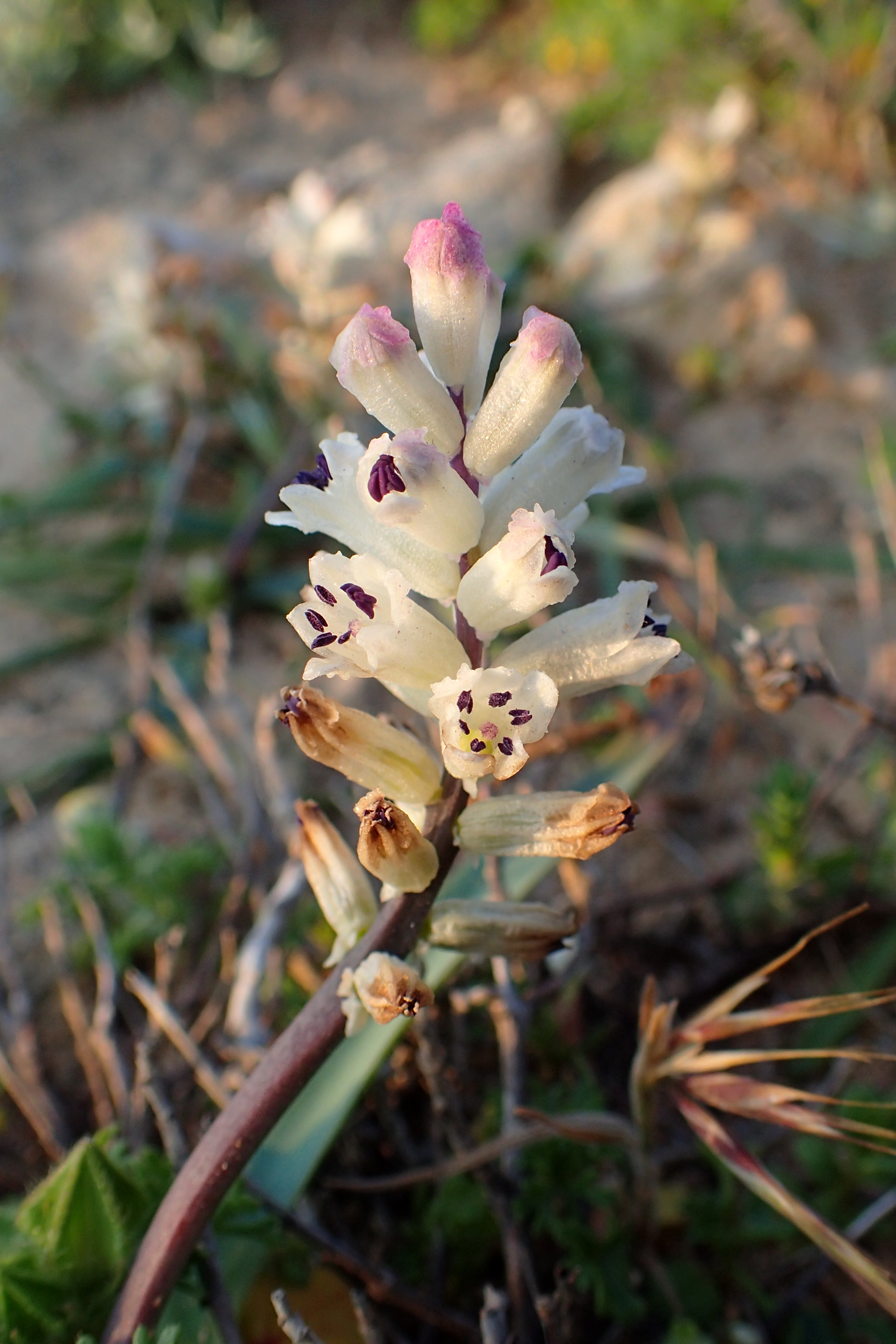
Bellevalia is a genus of approximately 81 species of perennial, bulb-forming flowering plants in the family Asparagaceae (subfamily Scilloideae, tribe Hyacintheae). The genus was first formally described in 1808 by the French botanist Philippe-Isidore Picot de Lapeyrouse and is named in honor of Pierre Richer de Belleval (1564–1632), the founder of the Montpellier botanical garden.
Plants in this genus are geophytes — they survive unfavorable seasons as underground bulbs covered by a papery membranous sheath (tunic). The leaves are basal, simple, and parallel-veined. From the center of the leaf rosette rises a smooth, cylindrical flower stem bearing a dense, grape-like raceme of numerous small flowers, each sitting in the axil of a tiny membranous bract. The flowers are hermaphroditic and built on a plan of three: six tepals, fused for one-third to one-half their length into a tube, give each flower a tubular, bell-shaped, or funnel-shaped silhouette. Flower color spans white, cream, and pale brown to the more striking blues and purples that make several species popular in cultivation. The fruit is a three-angled capsule with winged edges; seeds are nearly spherical and glossy.
The genus ranges across the Mediterranean Basin — North Africa, southern Europe, and Western Asia — and extends into Ukraine, southern European Russia, the Caucasus, and Central Asia as far east as Uzbekistan, Tajikistan, and Pakistan. Bellevalia is closely related to Muscari (grape hyacinths) and Hyacinthus, and a number of species were formerly placed in Hyacinthus. Some former members have since been transferred to the related genera Alrawia, Althenia, Hyacinthella, and Muscari.
Etymology
The genus name Bellevalia was coined by Philippe-Isidore Picot de Lapeyrouse in 1808 to honor the French botanist Pierre Richer de Belleval (1564–1632), who founded the botanical garden at Montpellier, one of the oldest in France.
Distribution
Bellevalia is distributed across the Mediterranean Basin, encompassing North Africa, southern Europe, and Western Asia. Its range extends further into Ukraine, southern European Russia, the Caucasus, and Central Asia east to Uzbekistan, Tajikistan, and Pakistan — reflecting an Old World temperate-to-semi-arid distribution centered on the eastern Mediterranean.
Taxonomy Notes
Bellevalia was described by Lapeyrouse in 1808 (published in J. Phys. Chim. Hist. Nat. Arts 67: 425) and is placed in tribe Hyacintheae, subfamily Scilloideae, family Asparagaceae. The synonym Strangweja Bertol. applies to the same genus. A homonymic Bellevalia Roem. & Schult. is an unrelated synonym of Richeria Vahl (Phyllanthaceae). Several species were historically included in Hyacinthus, and others have since been transferred to Alrawia, Althenia, Hyacinthella, and Muscari.










