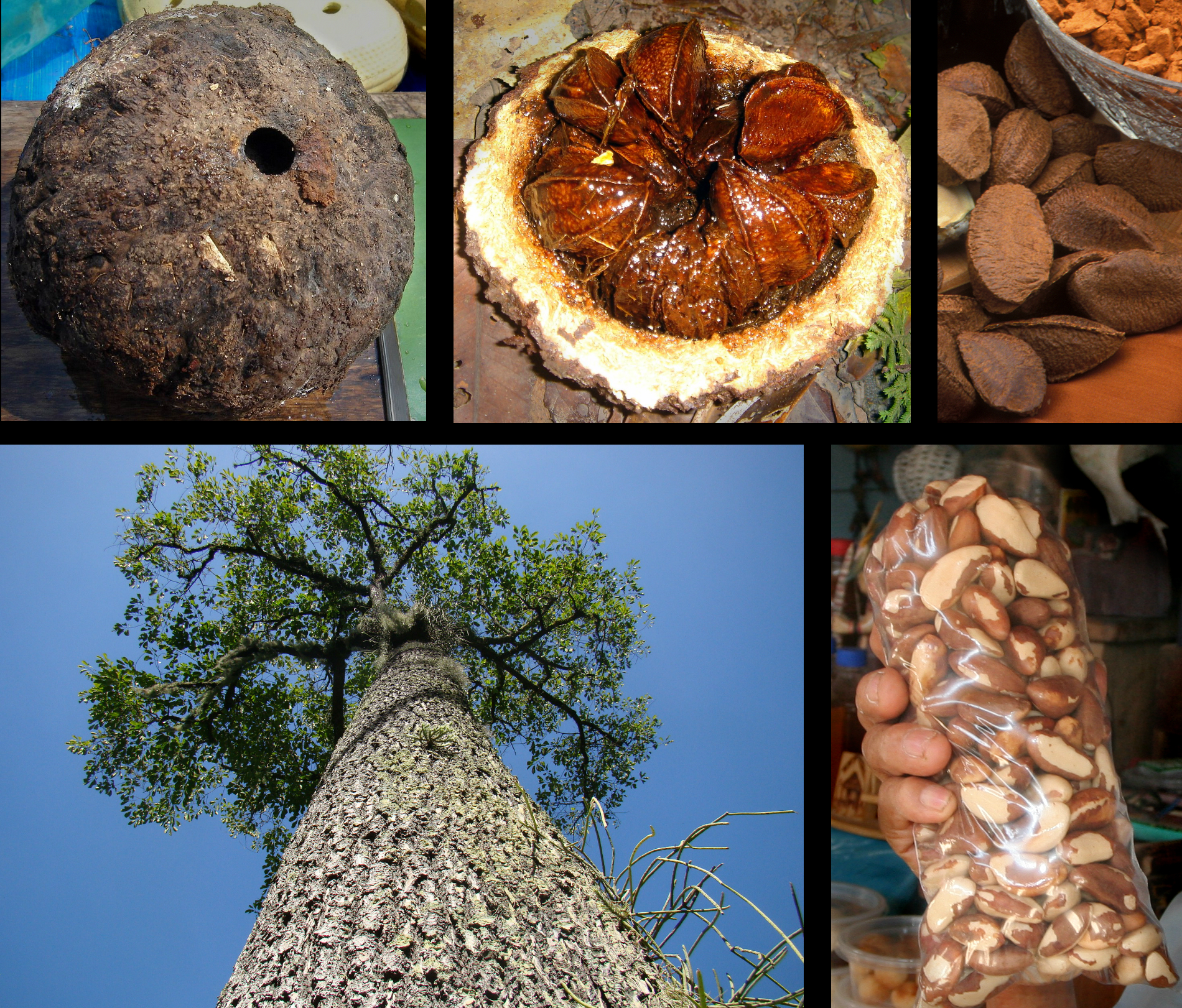
Bertholletia is a monotypic genus of flowering trees in the family Lecythidaceae, order Ericales — a diverse order that also includes blueberries, cranberries, tea, and persimmons. The genus contains a single species, Bertholletia excelsa, the Brazil nut tree, which ranks among the largest and longest-lived trees in the Amazon rainforest.
Brazil nut trees reach heights of up to 50 metres (160 feet), with straight trunks 1 to 2 metres in diameter that are typically branchless for much of their height before spreading into a large emergent crown above the surrounding canopy. The bark is grayish and smooth. Leaves are dry-season deciduous, alternate, oblong, 20–35 cm long, and 10–15 cm broad. Flowers are small, greenish-white, borne in panicles 5–10 cm long; each flower has a two-parted calyx, six unequal cream-coloured petals, and numerous stamens fused into a broad, hood-shaped mass. Trees may live for 500 years and can reach a thousand years of age.
The fruit is heavy and rigid, weighing up to 2 kg, and contains the commercially harvested seeds known as Brazil nuts. These seeds are nutritionally notable for their exceptionally high selenium content. The timber is also valued for its quality in carpentry, flooring, and heavy construction. In 2023, Brazil and Bolivia together produced 91% of the global supply of Brazil nuts.
Etymology
The genus name Bertholletia honours Claude Louis Berthollet (1748–1822), a prominent French chemist. The genus was described by the botanist Bonpland.
Distribution
Bertholletia excelsa is native to the Guianas, Venezuela, Brazil, eastern Colombia, eastern Peru, and eastern Bolivia. It occurs as scattered trees in large forests along the banks of the Amazon River, Rio Negro, Tapajós, and Orinoco rivers.
Ecology
The Brazil nut tree is an emergent species of the Amazon rainforest, rising above the surrounding canopy. It is strongly associated with intact, undisturbed forest — natural regeneration depends on specific pollinators and seed dispersers (notably large-bodied bees and agoutis). The heavy fruits fall from height and pose a genuine hazard to people and vehicles passing underneath.
Cultural Uses
Brazil nuts have long been harvested by indigenous peoples of the Amazon and remain a major commercial export of the region. The seeds are consumed raw or processed and are exceptional among nuts for their selenium concentration. The timber of the tree is prized for heavy construction, carpentry, and flooring. In 2023, Brazil and Bolivia together accounted for 91% of global Brazil nut production.
Conservation
Bertholletia excelsa is considered vulnerable in parts of its range due to historical overharvesting of seeds and forest clearance. The tree does not regenerate well outside intact forest, making deforestation a significant threat. Sustainable Brazil nut harvesting by forest communities is recognised as an economic incentive for forest conservation in Amazonia.
Taxonomy Notes
Bertholletia was described by Humboldt and Bonpland. It is placed in the family Lecythidaceae, order Ericales, class Magnoliopsida. The genus is monotypic, containing only Bertholletia excelsa Bonpl. GBIF records 1 accepted descendant taxon.










