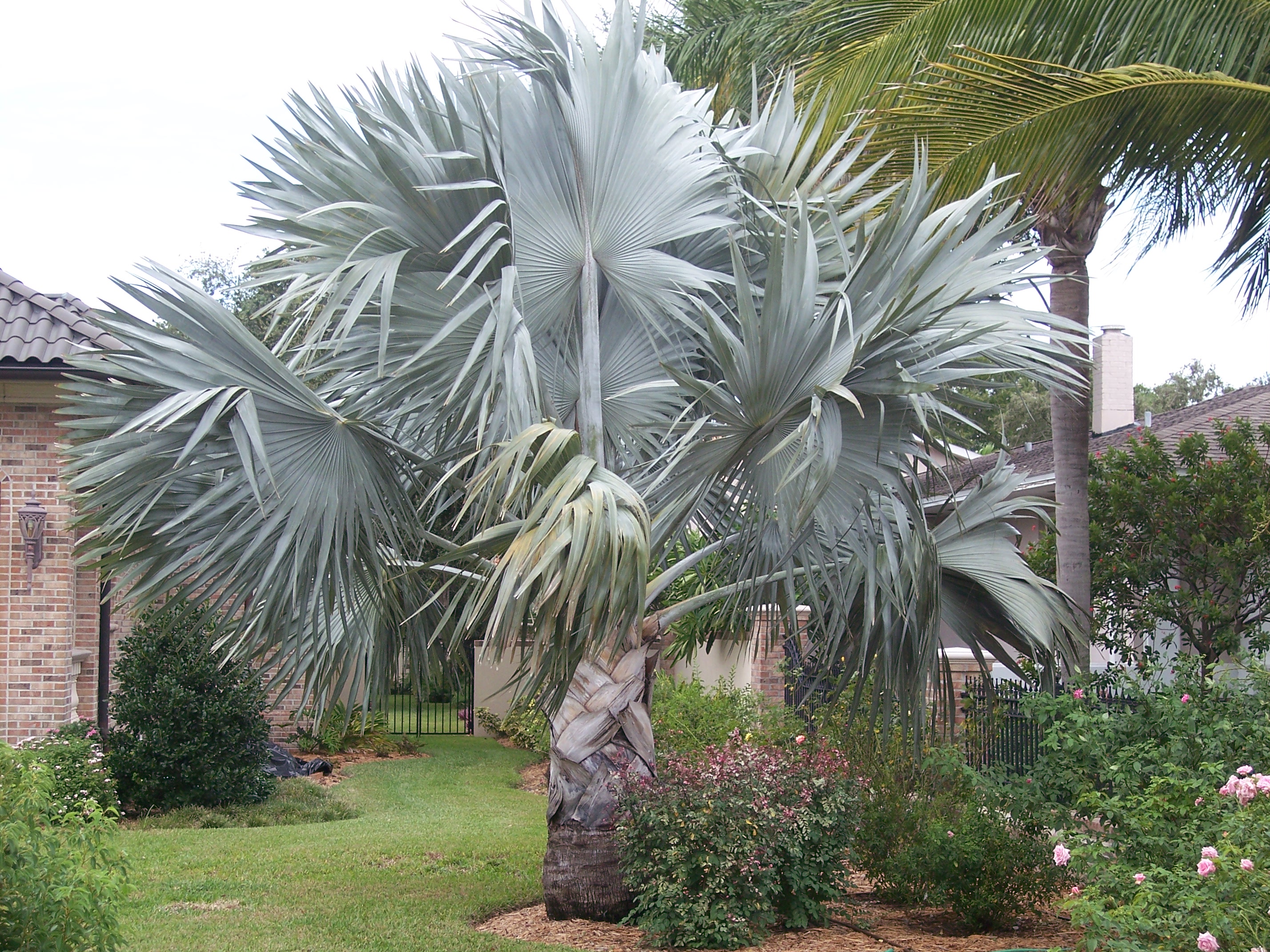
Bismarckia is a monotypic genus in the palm family Arecaceae, containing the single species Bismarckia nobilis. It is endemic to western and northern Madagascar, where it inhabits open savannas and grasslands on the central highlands, growing on lateritic soils from sea level up to 800 metres elevation.
The Bismarck palm is one of the most dramatically proportioned palms in cultivation. Solitary grey-to-tan trunks grow 30–45 cm in diameter, ringed with the scars of old leaf bases, and can reach 25 metres in their native habitat — though most cultivated specimens stay around 12 metres. The nearly circular leaves are costapalmate (an intermediate form between fan and feather palms), reaching over 3 metres in width and divided roughly a third of their length into more than 20 stiff, twice-split segments. Petioles measuring 2–3 m are coated in white wax and caducous cinnamon-coloured scales, and the full leaf crown spans approximately 7.5 metres wide by 6 metres tall. Plants are dioecious — male and female flowers are borne on separate individuals — with pendulous, interfoliar inflorescences of small brown flowers. Female plants bear brown ovoid drupes, each enclosing a single seed.
In Madagascar, B. nobilis is highly fire-resistant and shares its fire-managed savanna landscape with other hardy species such as Ravenala madagascariensis (the traveller’s palm) and Uapaca bojeri. Despite ongoing threats from agricultural conversion, increased fire frequency, and localized mining, the species is assessed as Least Concern on the IUCN Red List, with well over 10,000 mature individuals estimated in the wild.
Bismarckia nobilis is now widely grown as an ornamental throughout the tropics and subtropics — in Australia, Indonesia, the United Arab Emirates, and across the southern United States (Florida, Southern California, Texas, and Arizona). In horticulture, a common “silver” leaf-colour form and a rarer “green” form are informally recognized, though no subspecies or varieties are taxonomically accepted.
Etymology
The genus Bismarckia was named in honour of Otto von Bismarck, the first chancellor of the German Empire. The species epithet nobilis derives from Latin, meaning “noble.” In its native Madagascar, Bismarckia nobilis is known in Malagasy as satrana.
Distribution
Bismarckia nobilis is endemic to Madagascar, where it grows across the plains and plateaus of the central and northern highlands at elevations from sea level to approximately 800 metres. It favours open, fire-maintained savannas on lateritic soils, often becoming the most conspicuous tree in landscapes cleared by fire for agriculture.
Ecology
The Bismarck palm is highly adapted to fire-prone, seasonally dry savannas. It thrives on lateritic soils and co-occurs with other fire-tolerant species including Ravenala madagascariensis and Uapaca bojeri. It is strongly drought-tolerant, moderately tolerant of salt spray, and performs across a wide range of soil types, though it is susceptible to potassium deficiency.
Cultivation
Bismarckia nobilis is cultivated throughout the tropics and subtropics as a landscape palm. It is planted widely in Indonesia, Australia, the United Arab Emirates, and in the United States across Florida, parts of Southern California, southern Texas, and southern Arizona. The species tolerates drought well but grows fastest with high rainfall and plenty of space — mature crowns span up to 7.5 metres wide. Horticulturists informally distinguish a “silver” form (the most commonly grown) from a “green” form, with the green form sometimes considered less cold-hardy, though neither is formally recognised as a variety or subspecies.
Conservation
Bismarckia nobilis is assessed as Least Concern on the IUCN Red List (assessed December 2010, published 2021). The species is widespread in its native range with an estimated population exceeding 10,000 mature individuals. Identified threats include habitat loss from agricultural expansion, increasing frequency of human-set fires, and mining activities in parts of its range. Locally, leaves and pith are harvested for food and the timber is also exploited.










