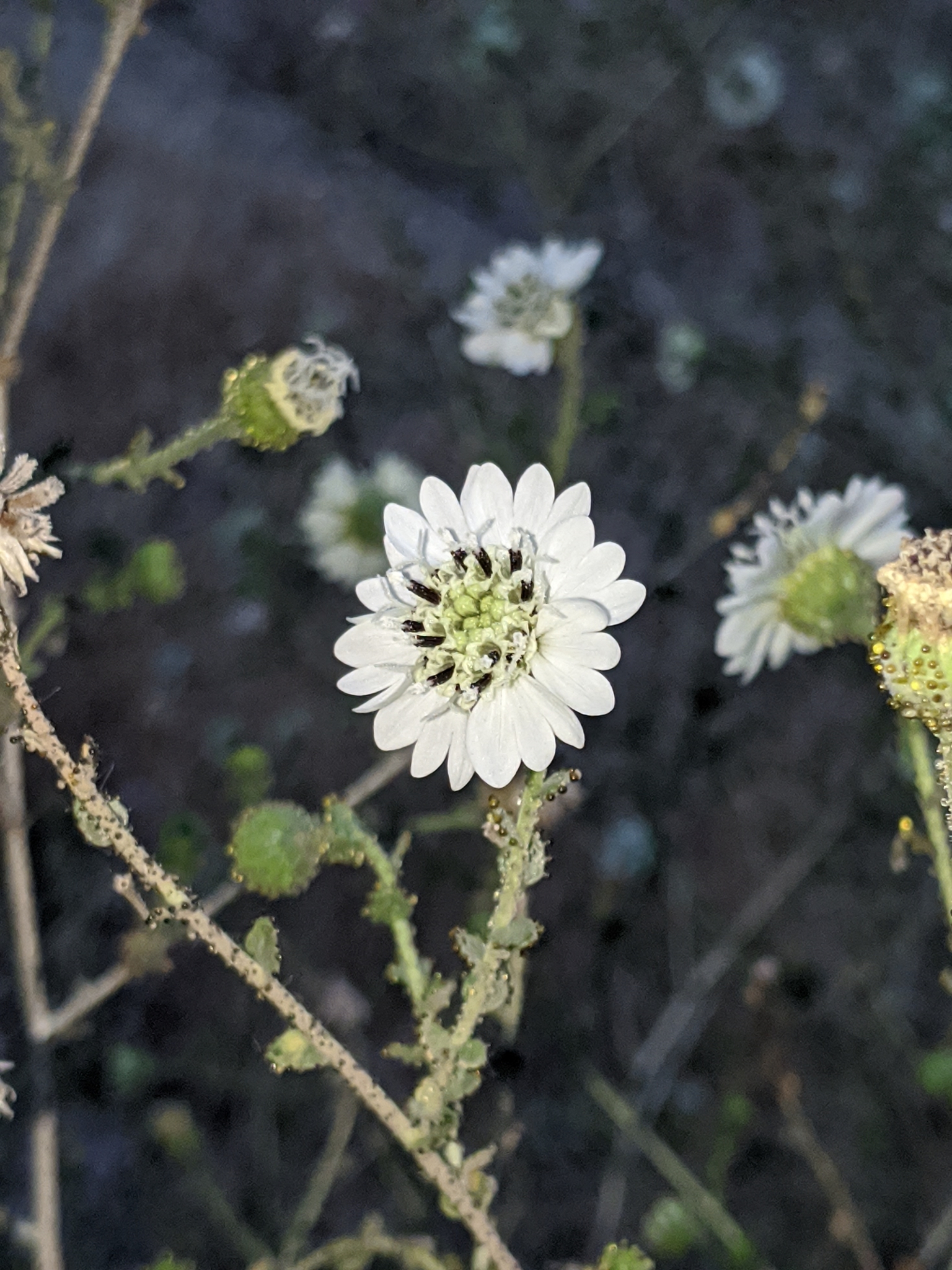
Blepharizonia is a small genus of two annual herbs in the family Asteraceae (order Asterales), endemic to California. They are commonly known as big tarweeds. The genus was established by Asa Gray and later revised by Edward Lee Greene.
Plants vary considerably in height, from as short as 10 centimetres (4 inches) to over 1.8 metres (6 feet). They are strongly scented and covered in hairy to bristly, often glandular herbage. Leaves near the base are arranged oppositely, while those along most of the stem are alternate; they are linear, lance-shaped, or narrowly spatula-shaped, sometimes with toothed margins. Flower heads are often borne in wide arrays or spikelike inflorescences, though B. laxa may bear solitary heads. The phyllaries are hairy and glandular, growing close to the ray florets and remaining attached to the fruits they bear. The deeply lobed ray florets are usually whitish, frequently with red or purple nerves on their undersides, and up to a centimetre or more in length. Disc florets are whitish or purplish with distinctive purple anthers. The fruit is a ribbed cypsela, sometimes bearing a pappus of scales.
The genus originally comprised a single species, B. plumosa, divided into two subspecies. Subsequent study revealed that the subspecies had low interfertility and rarely interbred even when growing side by side, were evolutionarily divergent, and differed morphologically and ecologically. One subspecies was consequently elevated to full species status and is now recognised as B. laxa. The two species have overlapping but distinct distributions within the San Joaquin Valley, eastern San Francisco Bay Area, and South Coast Ranges of California.
Distribution
Both species of Blepharizonia are endemic to California. Blepharizonia laxa occurs in the western San Joaquin Valley, eastern San Francisco Bay Area, and South Coast Ranges. Blepharizonia plumosa is found in the northwestern San Joaquin Valley, eastern San Francisco Bay Area, and south as far as San Luis Obispo County.
Taxonomy Notes
Blepharizonia was originally monotypic, containing only B. plumosa with two subspecies. Studies found the subspecies to have low interfertility, significant morphological and ecological distinctions, and evolutionary divergence, leading to one subspecies being elevated to full species status as B. laxa. The genus is placed in Asteraceae, tribe Madieae, and the authorship is attributed to (A.Gray) Greene.
Ecology
The two species differ in habitat character: B. laxa has yellow-green, more heavily glandular herbage and tends to produce solitary or wandlike-branching flower heads, while B. plumosa has gray-green, less glandular herbage with flower heads on arching branches. Both are annual herbs that occupy California's interior valleys and coast ranges.










