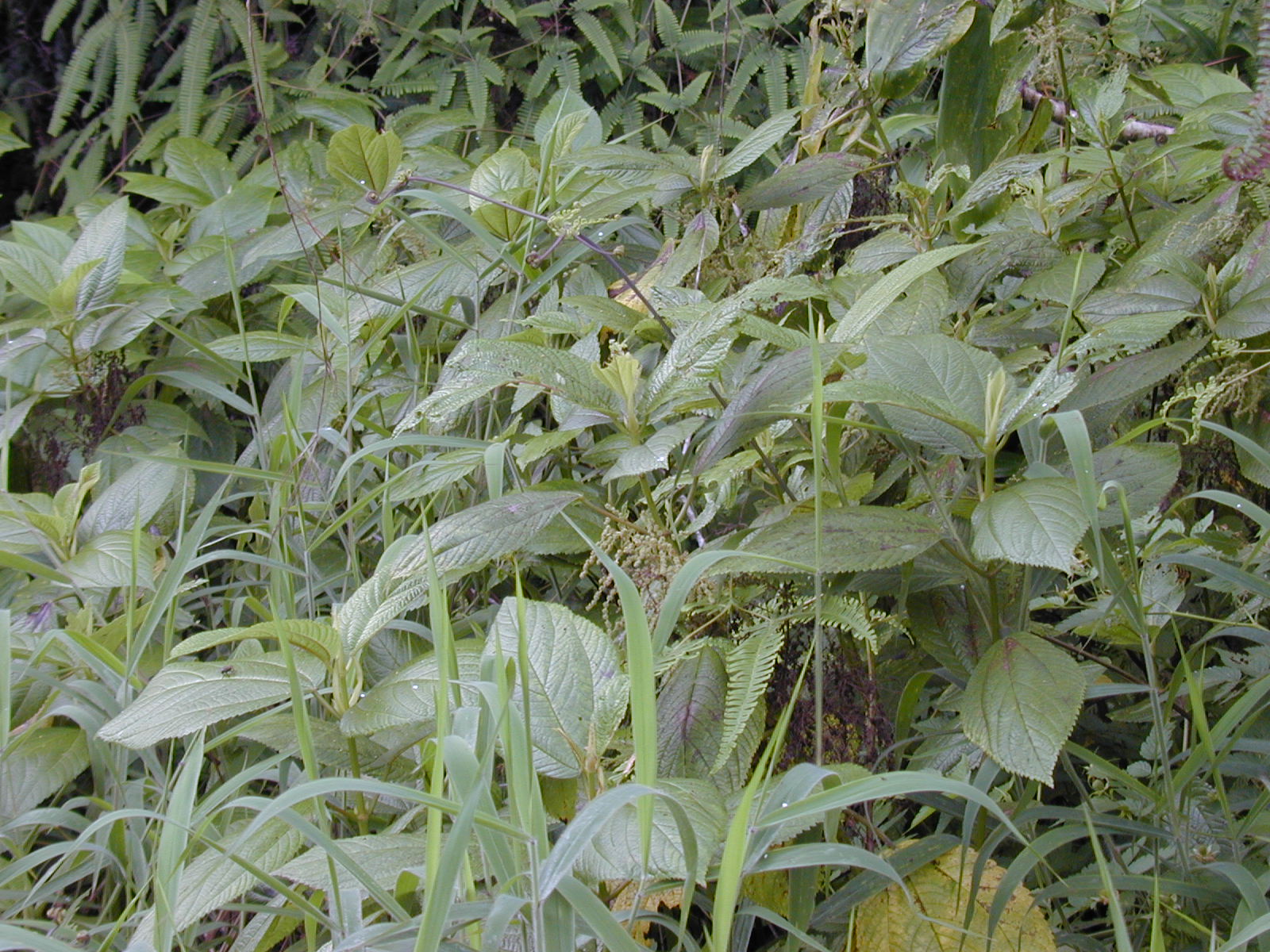
Boehmeria is a genus of approximately 47 species of flowering plants in the nettle family Urticaceae, placed in the order Rosales. The genus encompasses a morphologically varied group of herbaceous perennials, shrubs, and small trees distributed across tropical and subtropical regions of Asia, Africa, the Pacific, and the Americas. Of the accepted species, 33 are native to the Old World and 14 to the New World, with no species spanning both hemispheres.
Although closely related to the true stinging nettles of genus Urtica and similar in overall appearance, plants of Boehmeria are readily distinguished by the complete absence of stinging trichomes. This characteristic has given rise to the common name "false nettles" for many members of the group.
The genus includes one species of major economic importance: ramie (Boehmeria nivea), one of the oldest fibre crops in the world, cultivated for its exceptionally strong and fine bast fibres used in textiles. Several other species are grown as ornamental plants. Boehmeria species also serve as larval food plants for a number of Lepidoptera, including Bedellia boehmeriella, a moth that feeds exclusively on Boehmeria grandis.
The genus was named in honour of Georg Rudolf Boehmer (1723–1803), a German botanist and professor of medicine at Wittenberg who contributed extensively to botanical literature.
Etymology
The genus name Boehmeria honours Georg Rudolf Boehmer (1723–1803), a German botanist and professor at the University of Wittenberg. Members of the genus are commonly called "false nettles" because of their close resemblance to stinging nettles (genus Urtica), from which they are distinguished by the lack of stinging hairs.
Distribution
Boehmeria has a pantropical and warm-temperate distribution, with 33 species native to the Old World (including Asia, Africa, and Pacific islands) and 14 native to the New World (Central and South America, Caribbean). No species is native to both hemispheres. The genus reaches its greatest species diversity in tropical and subtropical Asia.
Ecology
Boehmeria species serve as larval host plants for several Lepidoptera. The moth Bedellia boehmeriella feeds exclusively on B. grandis, illustrating a degree of specialist herbivore dependence. More broadly, species in the genus occupy forest edges, disturbed habitats, stream banks, and secondary vegetation across their ranges.
Cultural Uses
Ramie (Boehmeria nivea) is one of the most important fibre plants in the genus and among the oldest textile crops known, used for thousands of years in Asia. Its bast fibres are notable for their exceptional strength, lustre, and resistance to bacterial degradation. Beyond ramie, several other Boehmeria species are cultivated as ornamental plants valued for their foliage.










