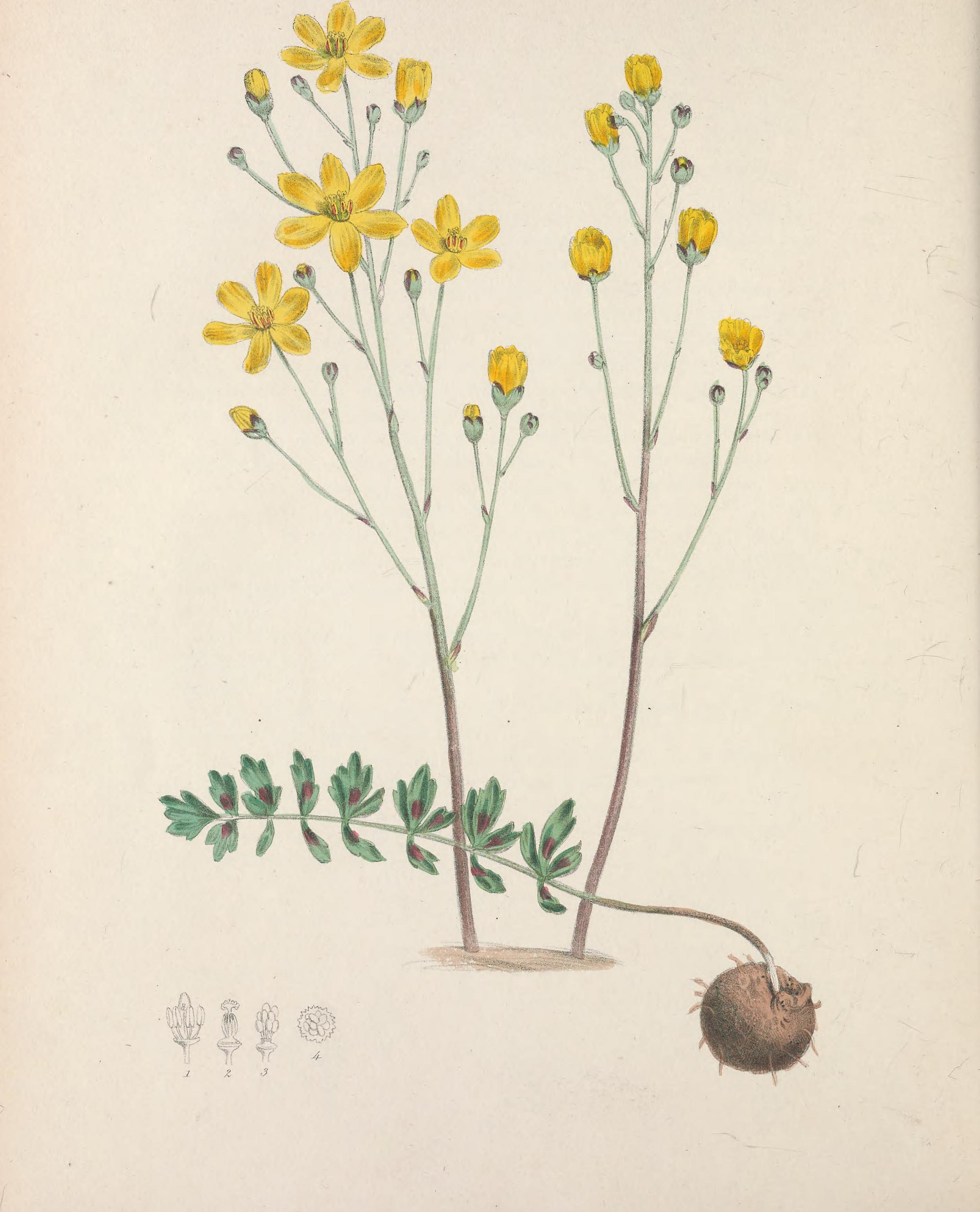
Bongardia is a very small genus of tuberous, herbaceous flowering plants in the family Berberidaceae (order Ranunculales). First formally described in 1831 by C.A. Meyer, it contains only two known species: Bongardia chrysogonum, native to North Africa, Greece, and the wider Middle East, and Bongardia margalla, a Pakistani endemic that was not recognised as a distinct species until 1996.
Plants in this genus are characterised by a large, rounded underground tuber and attractive pinnate leaves. The flowers are hermaphrodite, bearing both male and female organs. Both species are geophytes adapted to a pronounced seasonal rhythm: they grow on rocky mountain slopes and in cultivated fields, spending winter dormant beneath snow and enduring dry summers above ground. Leaves and roots are reported to be edible.
The genus was monotypic for most of its described history; the Pakistani populations were elevated to full species rank by Govaerts in 1996, giving the genus its current two-species composition.
Etymology
The genus name Bongardia honours Gustav Heinrich von Bongard (1786–1839), a German botanist who served as a professor at St. Petersburg Imperial University.
Distribution
Bongardia chrysogonum is distributed across North Africa, Greece, and the Middle East. Bongardia margalla is restricted to Pakistan. Both species favour rocky mountain slopes and cultivated fields within their ranges.
Ecology
Both species are adapted to a strongly seasonal climate: they grow in rocky mountain habitats and cultivated fields where winters are cold and snowy and summers are hot and dry. The plants die back in summer and overwinter as underground tubers.
Cultivation
Bongardia species require sandy, well-drained, porous soil in full sun. Year-round protection from excessive moisture is essential, with a period of hot, dry summer drought needed for the tubers to ripen properly. Propagation is from seed.










