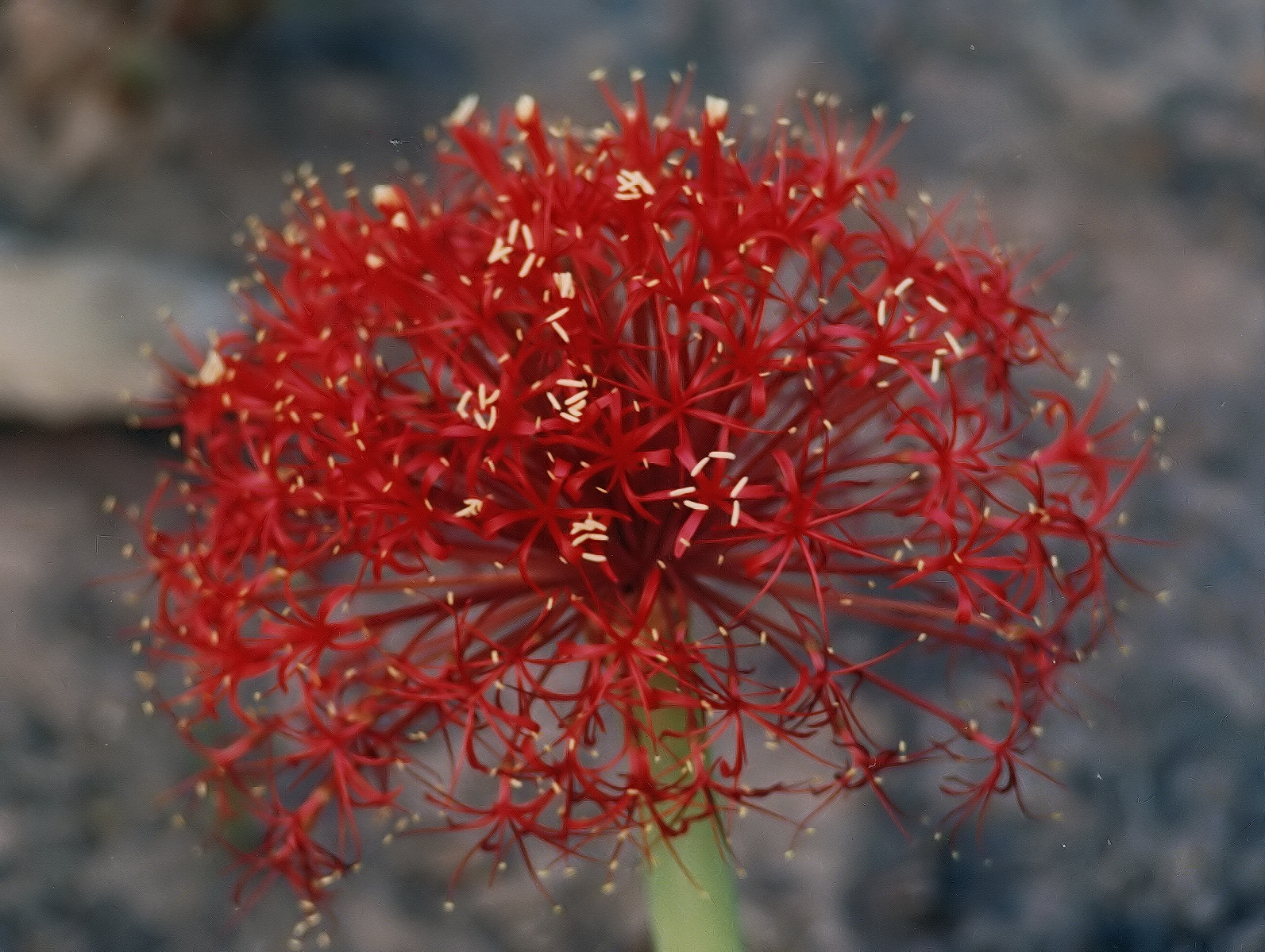
Boophone is a small genus of herbaceous, perennial, bulbous plants belonging to the family Amaryllidaceae (subfamily Amaryllidoideae), placed in the order Asparagales. The genus contains two confirmed species — Boophone disticha and Boophone haemanthoides — and is the sole member of subtribe Boophoninae within the tribe Amaryllideae. It is most closely related to Crossyne, a genus distinguished by its prostrate leaves.
Plants are drought tolerant but not cold-hardy, and the genus is notably toxic: all parts are highly poisonous to livestock, particularly cattle, a property that gives the genus its name. The large, deciduous bulbs produce strap-like leaves arranged in a distinctive fan pattern, and produce spherical umbels of pink to reddish flowers that dry on the plant and detach as a tumbleweed-like structure that disperses seeds by wind.
Boophone is distributed across sub-Saharan Africa, ranging from South Africa northward to Kenya and Uganda. Boophone disticha is the more widespread and better-known species, long used in southern African traditional medicine by the Zulu and other peoples, while Boophone haemanthoides is restricted to the Northern and Western Cape of South Africa.
Etymology
The genus name Boophone is derived from the Greek bous (ox) and phone (death), a direct reference to the plant's lethal toxicity to cattle. William Herbert originally used three different spellings — "Boophane" (1821), "Buphane," and "Buphone" (1825) — before Milne-Redhead standardised the spelling to "Boophone" in 1839. A formal proposal to conserve this name was published in 2001 and accepted in 2002.
Distribution
Boophone is distributed across sub-Saharan Africa, from South Africa northward through Zimbabwe and Zambia to Kenya and Uganda. The genus is drought tolerant but not cold-hardy, typically growing in open grasslands, bushveld, and rocky hillsides. Boophone haemanthoides has a more restricted range, confined to the Northern and Western Cape provinces of South Africa.
Cultural Uses
Boophone disticha has a long history of use in southern African traditional medicine. The Zulu people of South Africa use the plant to induce hallucinations for divinatory and ritual purposes, and it has also been employed in the treatment of various mental illnesses. The bulb and its alkaloids have been incorporated into traditional arrow poisons and used as medicinal dressings for skin lesions. Despite these applications, therapeutic use is limited by the plant's significant toxicity.
Taxonomy Notes
Boophone is the sole genus in subtribe Boophoninae, placed within tribe Amaryllideae of the family Amaryllidaceae. It is most closely related to Crossyne, which differs in having prostrate rather than erect leaves. The genus has had a complex nomenclatural history involving multiple original spellings by William Herbert (1821, 1825) before the current orthography was formally conserved in 2002. GBIF currently recognises 4 descendant taxa under the genus.










