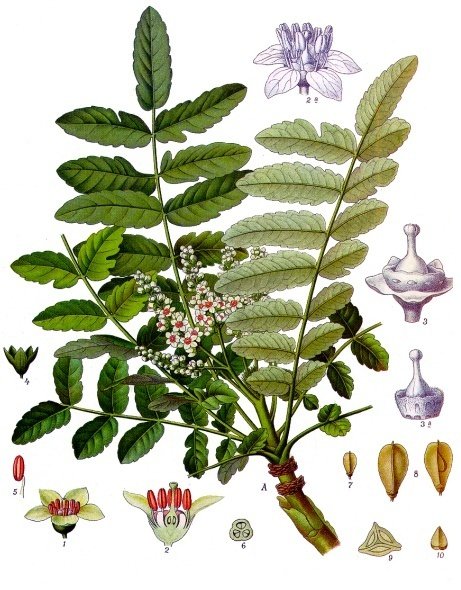
Boswellia is a genus of roughly 20 species of trees and shrubs in the family Burseraceae, order Sapindales, native to tropical regions of Africa and Asia. The genus is famous above all for yielding frankincense, the aromatic resin tapped from the bark of several species — most notably Boswellia sacra and B. frereana — and burned as incense for millennia across religious and cultural traditions worldwide. Boswellia papyrifera, found primarily in Ethiopia, Eritrea, and Sudan, supplies approximately two-thirds of global frankincense production.
Plants in the genus are moderate-sized and may be dioecious or hermaphroditic. The flowers carry four to five imbricate sepals and petals, stamens with nectar-secreting discs, and tricolporate pollen held in two-locule anthers. The ovary is superior, with two ovules per locule; the mature fruit is a drupe with one to five pits. Endosperm is typically absent in the embryo.
Species are distributed across arid and semi-arid tropical landscapes stretching from West Africa through the Horn of Africa to the Arabian Peninsula and the Indian subcontinent, with the highest species diversity concentrated in Africa and India. Notable range-restricted species include B. dioscoridis and B. ameero on the island of Socotra. Nearly all species are considered threatened by a combination of habitat loss, overgrazing, and chronic overtapping of resin — a practice driven by the fact that selling frankincense is often the sole source of income for communities in some of the world's most economically marginal regions.
Etymology
The genus name Boswellia honours John Boswell (1710–1780), a British botanist and — incidentally — uncle of the celebrated biographer James Boswell. The genus was formally published in Asiatic Researches (vol. 9, p. 379) in 1807.
Distribution
Boswellia species are native to the tropics of Africa and Asia, with the greatest species diversity in Africa and India. Their range spans Benin, Burkina Faso, Cameroon, Chad, Eritrea, Ethiopia, Ghana, India (including the western Himalayan foothills), Ivory Coast, Kenya, Mali, Niger, Nigeria, Oman, Senegal, Socotra, Somalia, Sudan, Tanzania, Togo, Uganda, and Yemen.
Ecology
Boswellia species grow in harsh, arid to semi-arid environments, often in regions affected by poverty and conflict. Their resin is one of the primary income sources for local communities, leading to chronic overtapping that weakens trees and reduces regeneration. Habitat loss further compounds pressure on populations; a 2019 study projected a 50% decline in B. papyrifera within two decades.
Conservation
Most Boswellia species are threatened by the combined pressures of overexploitation, habitat loss, and poor regeneration. The IUCN flagged B. sacra as "near threatened" as early as 1998. B. papyrifera, the dominant commercial frankincense source, faces a predicted 50% population reduction within two decades according to a 2019 study. Experts argue that the genus meets CITES criteria for protection, though it is not currently listed. Poverty in range countries makes sustainable harvesting difficult to enforce.
Cultural Uses
Boswellia resin — frankincense — has been traded and burned as incense for at least 5,000 years across Mesopotamian, Egyptian, Greek, Roman, Jewish, Christian, and Islamic religious traditions. It remains a globally traded commodity used in incense, perfumery, and traditional medicine. B. serrata resin (shallaki) has a long history in Ayurvedic medicine as an anti-inflammatory agent.

