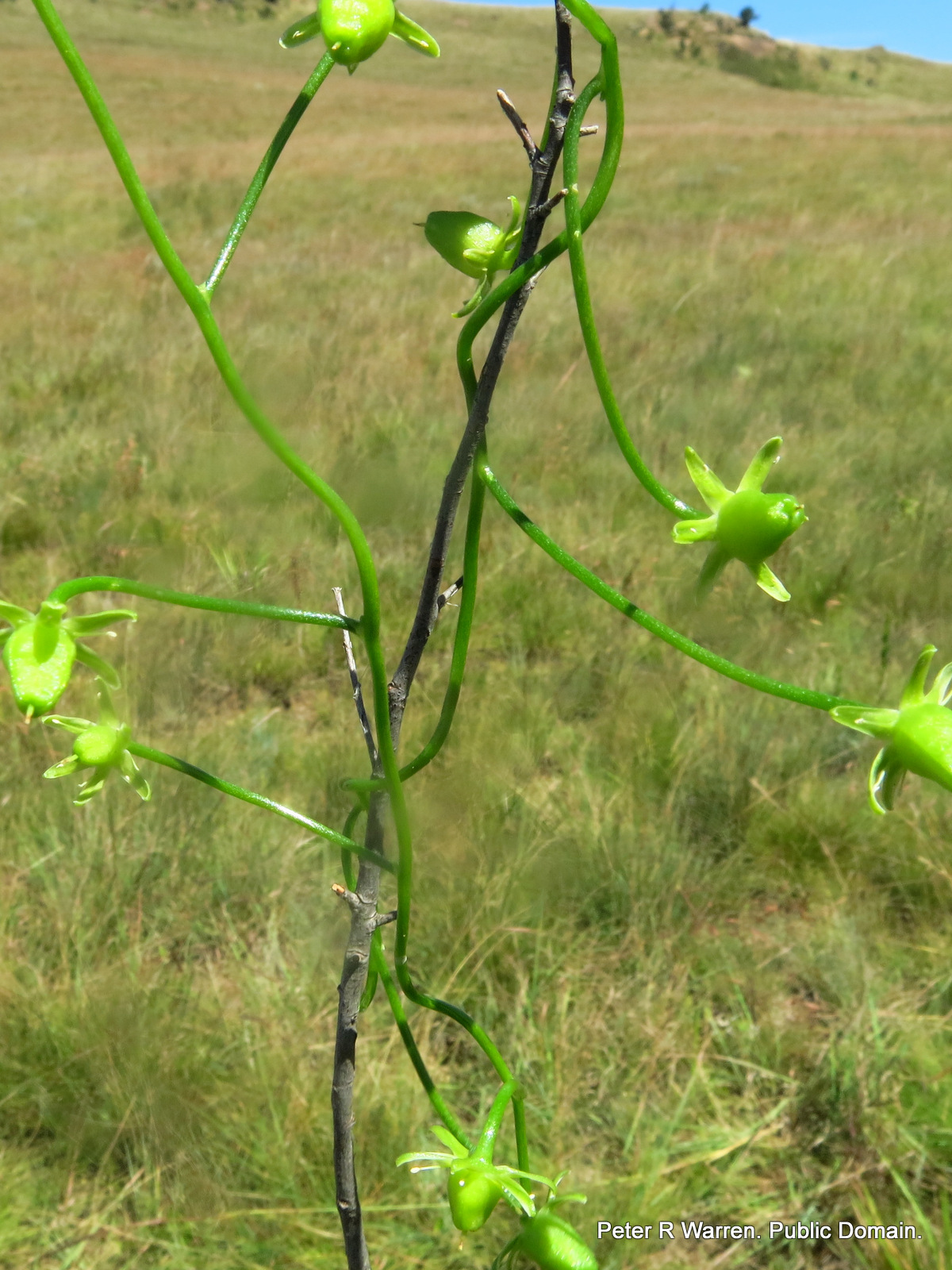
Bowiea is a monotypic genus of bulbous, perennial succulent plants in the family Asparagaceae (tribe Urgineeae, subfamily Scilloideae), comprising a single species, Bowiea volubilis, commonly known as climbing-onion or sea onion. The genus is placed sister to Drimia within the APG IV classification system, and was historically assigned to the family Hyacinthaceae before that family was subsumed into Asparagaceae.
The genus is native to eastern and southern Africa, ranging from Uganda and Kenya south through Tanzania to the Cape Province of South Africa. Plants grow at low to medium altitudes — along mountain ranges, in densely vegetated river valleys beneath shrub clumps, on boulders, and at the margins of the Karoo. They tolerate both wet and dry conditions and are adapted to summer-rainfall climates with annual precipitation of 200–800 mm.
Bowiea volubilis produces a large, exposed, green bulb from which twining, scrambling stems emerge. Two subspecies are recognized: B. volubilis subsp. volubilis, distributed from Cape Province to Kenya, and B. volubilis subsp. gariepensis, confined to cooler screes along the Orange River valley in Namibia and the northern Cape. The latter blooms in autumn and winter, while subsp. volubilis blooms in spring and summer.
The entire plant contains potent cardiac glycosides; bulb glycosides are reported to be approximately 30 times stronger than those of foxglove (Digitalis), and flower glycosides approximately 60 times stronger. Despite this extreme toxicity, Bowiea is the 14th most commonly sold medicinal plant in South Africa, used by Xhosa, Zulu, Mfengu, Mpondo, and Swazi peoples for a wide range of conditions. Its unusual appearance — a large green bulb bearing tangled, leafless, climbing stems — has also made it a curiosity in cultivation as a houseplant. Due to heavy harvesting from wild populations, the species has experienced significant population decline.
Etymology
The genus Bowiea was named in honour of James Bowie (c. 1789–1869), a nineteenth-century British plant collector who worked at the Royal Botanic Gardens, Kew, and collected extensively in southern Africa and Brazil. The specific epithet of the sole species, volubilis, derives from Latin volubilis, meaning "twisting" or "winding," a reference to the plant's climbing, twining stems.
Distribution
Bowiea is native to eastern and southern Africa, with a range extending from Uganda and Kenya south to the Cape Province of South Africa. Subsp. volubilis grows across this broad range in vegetated river valleys, on rocky hillsides, and under bushes at low to medium altitudes; subsp. gariepensis is restricted to cooler rocky screes along the Orange River valley in Namibia and the northern Cape.
Ecology
Plants grow in habitats ranging from mountain valley margins and boulder fields to bushy ravines (kloof) and open forests, typically in well-shaded spots. They are adapted to summer-rainfall regions with 200–800 mm of annual precipitation and tolerate both seasonal wet and dry conditions. After fruiting, aboveground parts die back and the plant enters dormancy. Flowers are pollinated by flies of the families Tachinidae and Muscidae and by wasps (Vespidae), attracted by an unpleasant floral scent.
Cultivation
Bowiea volubilis is described as very easy to grow and is occasionally cultivated as a houseplant for its unusual ornamental appearance — a large, exposed green bulb with twining leafless stems. Note: the entire plant is extremely toxic (cardiac glycosides); it should be handled with care and kept away from children and pets.
Conservation
Wild populations of Bowiea volubilis have been significantly reduced due to massive harvesting for the traditional medicinal plant trade, where it ranks as the 14th most commonly sold medicinal plant in South Africa.
Cultural Uses
Traditional healers across southern Africa have long used Bowiea bulbs medicinally, despite the plant's high toxicity. The Xhosa, Mfengu, and Mpondo peoples use decoctions as a laxative. Zulu people use fresh outer-scale water extracts for ascites, infertility, urinary tract infections, back pain, and muscle pains. Swazi people combine Bowiea with Boophane disticha bulbs to treat scabies. In the Western Cape, bulbs are applied topically for skin rashes, acne, cuts, burns, and insect bites; in KwaZulu-Natal, preparations are used to facilitate childbirth and treat headaches. The plant is also used to treat palpitations, eye irritation, hepatitis, and as an antiparasitic for infants.
Taxonomy Notes
Bowiea is a monotypic genus sister to Drimia within tribe Urgineeae, subfamily Scilloideae, family Asparagaceae (APG IV). GBIF currently lists it under Hyacinthaceae, which reflects an older circumscription — Hyacinthaceae is now treated as a synonym of Asparagaceae (or its subfamily Scilloideae). Historically the genus was placed in the tribe Bowieae Hutch. (Takhtajan 1997) and subfamily Urgineoideae (Takhtajan 2009). Species previously segregated in Schizobasis are now included in Drimia, the sister genus.










