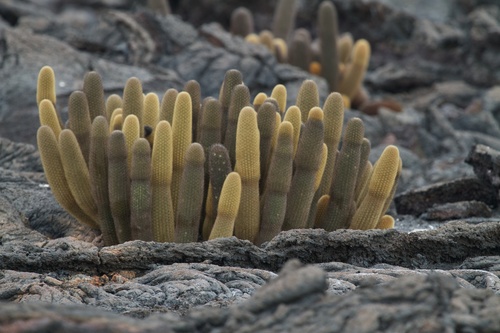
Brachycereus is a monotypic genus in the family Cactaceae (order Caryophyllales), containing a single species: Brachycereus nesioticus, commonly known as the lava cactus. It is endemic to the Galápagos Islands of Ecuador, where it is one of the first plants to colonize freshly formed lava fields.
The lava cactus is a leafless, clump-forming plant. Its cylindrical stems typically reach 50–60 cm (20–24 in) in height, and a single clump can spread up to 2 m (6 ft 7 in) across. Each stem bears 16–22 ribs and is initially yellow with green or brown tones. The numerous areoles carry up to 40 spines each, up to 5 cm long; the spines start yellowish but darken with age. Flowers are borne singly, narrowly funnel-shaped, up to 11 cm long, and open during the day — they are white to yellowish white on the inside. The fruit is a berry, red to brown in colour, covered with yellow spines and containing many black seeds.
The genus was established in 1920 by botanists Nathaniel Lord Britton and Joseph Nelson Rose, based on material first described in 1902 as Cereus nesioticus by Karl Moritz Schumann. In 1935, Curt Backeberg restricted the genus to its single Galápagos species, with the related Jasminocereus accommodating the other cactus previously placed alongside it.
Brachycereus nesioticus is listed as Least Concern on the IUCN Red List (downgraded from Vulnerable in 2013). Its entire range falls within the Galápagos National Park, a UNESCO Natural World Heritage Site, and collection or disturbance of the plant is strictly regulated by the Ecuadorian government. Trade in the species is controlled under CITES Appendix II.
Etymology
The genus name Brachycereus means "short cereus," combining the Greek brachys (short) with Cereus, the large columnar-cactus genus from which it was segregated. The species epithet nesioticus derives from the Ancient Greek νησιωτικός, meaning "of the islands," referencing its Galápagos range.
Distribution
Brachycereus nesioticus is endemic to the Galápagos Islands, recorded on Fernandina, Genovesa, Isabela, Pinta, Santa Cruz, Santiago, and several smaller islands including Bartolomé. It is a specialist of barren lava flows — both smooth pāhoehoe and rough ʻaʻā types — and is among the very first plant species to establish on newly solidified lava.
Ecology
The lava cactus occupies one of the most extreme microhabitats in the Galápagos: bare, nutrient-poor lava surfaces with little shade and intense solar radiation. Its role as a primary colonizer makes it ecologically significant in early succession on volcanic substrates. Daytime flower opening suggests pollination by diurnal visitors active in the open lava-field environment.
Conservation
Brachycereus nesioticus is assessed as Least Concern on the IUCN Red List (2013 assessment, downgraded from Vulnerable in 2000). The entire species range lies within the Galápagos National Park and Natural World Heritage Site, providing strong legal protection; the Ecuadorian government strictly controls all collecting or disturbance. International trade is regulated under CITES Appendix II.
Taxonomy Notes
The genus was erected in 1920 by Britton and Rose, who synonymized Cereus nesioticus (described by Schumann in 1902) and Cereus thouarsii under the name Brachycereus thouarsii. Curt Backeberg subsequently revised the circumscription in 1935, removing Cereus thouarsii to the related genus Jasminocereus and leaving Brachycereus as a monotypic genus containing only B. nesioticus. GBIF places the genus in family Cactaceae, order Caryophyllales, with one accepted descendant species.










