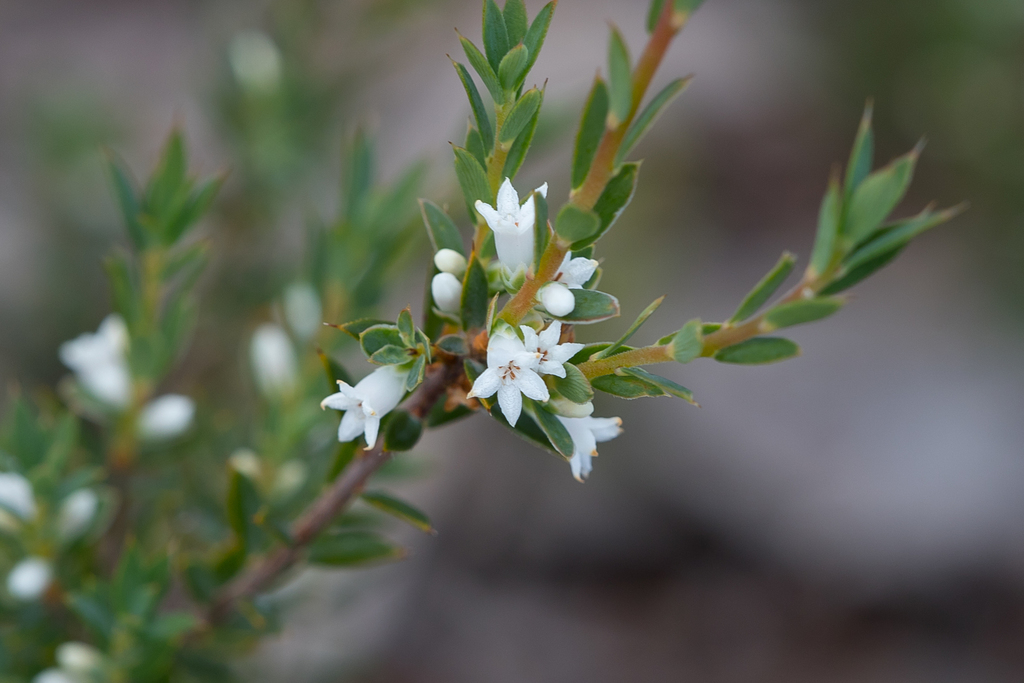
Brachyloma is a genus of approximately 16 species of flowering shrubs in the family Ericaceae (order Ericales), endemic to Australia. Plants in the genus are erect or spreading shrubs bearing simple, sessile or shortly petiolate leaves whose lower surfaces display more or less parallel or spreading veins. The flowers are bisexual and typically borne singly in the leaf axils; each flower has a bract at its base and bracteoles that grade in size toward the five sepals. The five petals are fused at the base to form a cylindrical to bell-shaped tube with erect to curved-back lobes — an arrangement that gives the genus a superficial resemblance to the unrelated genus Daphne, reflected in common names such as "daphne heath" applied to B. daphnoides. The fruit is a drupe with a hard endocarp.
The genus was formally described in 1845 by the German botanist Otto Wilhelm Sonder in Lehmann's Plantae Preissianae, with Brachyloma preissii as the type species. Species are distributed across all Australian states and the Australian Capital Territory, though the genus is absent from the Northern Territory. Well-known members include B. daphnoides (daphne heath), widespread across south-eastern mainland Australia, B. ciliatum (fringed brachyloma), found in Victoria and Tasmania, and B. ericoides, occurring in Victoria and South Australia.
Taxonomy Notes
Brachyloma was first formally described in 1845 by Otto Wilhelm Sonder in Lehmann's Plantae Preissianae. The type species is Brachyloma preissii Sond. The genus belongs to the family Ericaceae, order Ericales. As of September 2023, the Australian Plant Census recognises 16 accepted species, the majority centred in Western Australia.
Distribution
Brachyloma is endemic to Australia, with species recorded in all states — Western Australia, South Australia, Victoria, New South Wales, Queensland, and Tasmania — as well as the Australian Capital Territory. The genus is absent from the Northern Territory. Many species are restricted to Western Australia, while others such as B. daphnoides range more broadly across south-eastern mainland Australia.










