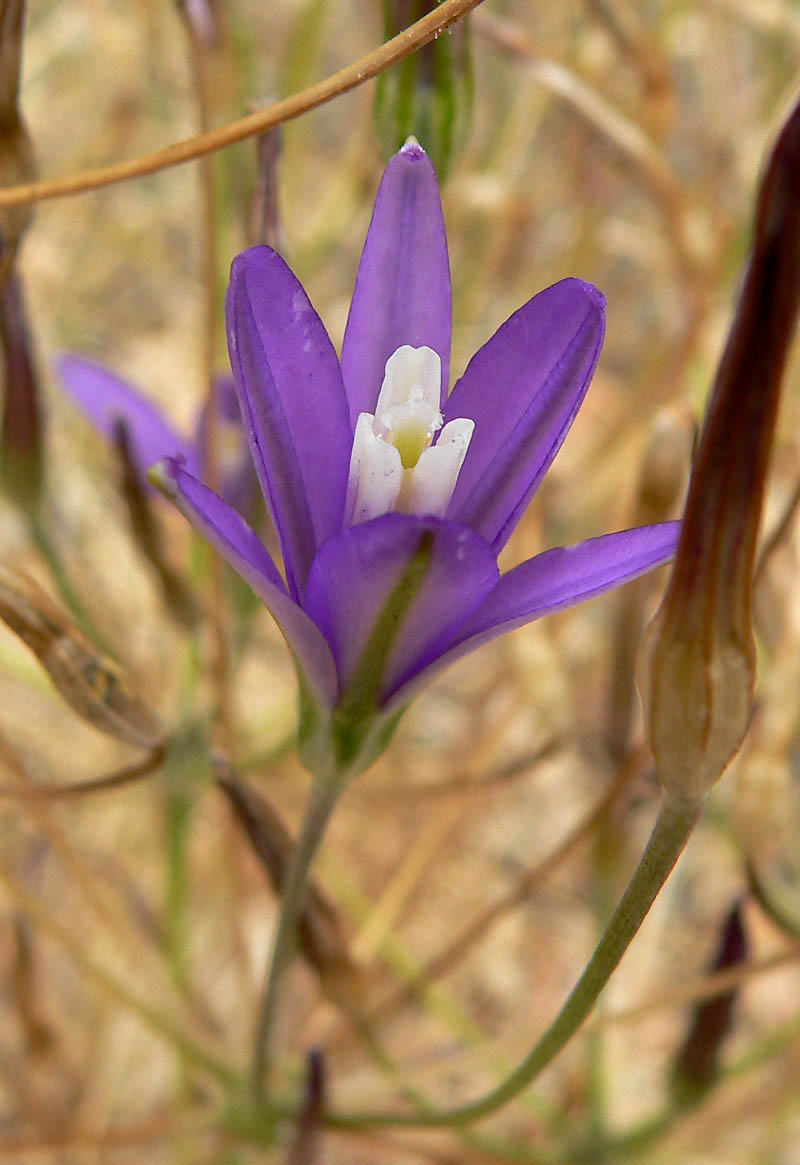
Brodiaea is a small genus of herbaceous perennial wildflowers in the family Asparagaceae (subfamily Brodiaeoideae), known commonly as cluster-lilies. The genus was established by the English botanist James Edward Smith in 1808 and named in honour of the Scottish botanist James Brodie. Worldwide, treatments recognise roughly fourteen to eighteen species, all native to the Pacific coast of North America, ranging from British Columbia south through California and into the Baja California Peninsula; the great majority occur in California itself.
Plants grow from a small underground corm and produce a few narrow, grass-like basal leaves that often wither before or during flowering. From the centre of the leaves rises a slender, leafless flowering stem — typically 30 to 50 cm tall — topped by a loose umbel of showy, star-shaped to broadly tubular flowers. Each bloom has six tepals fused at the base into a short tube, with the outer three narrower than the inner three; colours range across most of the violet-blue spectrum, with occasional pale lilac or white forms. A characteristic feature of the genus is the presence of three fertile stamens alternating with three sterile, often petal-like staminodes, a detail used by botanists to distinguish Brodiaea from its close relatives Dichelostemma and Triteleia.
Brodiaea species are mostly plants of open, seasonally dry habitats — grasslands, oak savannas, vernal-pool margins and rocky slopes — and many are adapted to serpentine and other chemically unusual soils. This substrate specialisation produces narrow local ranges and a notable number of rare or endangered taxa within the genus. Plants begin growth with autumn and winter rains, flower in late spring or early summer, and then go fully dormant through the dry season. The dormant corms have been used as food: California Indigenous peoples gathered and roasted them, eating them much like small potatoes.
In gardens Brodiaea are grown as easy summer-flowering bulbs in cool-summer Mediterranean and maritime climates, valued for their bright umbels of blue and purple flowers and for being deer-resistant and low-maintenance. They are typically rated for USDA zones 5–9, prefer full sun and well-drained soil, and tolerate summer drought once dormant; conversely, they resent wet, warm summers and tend to rot in regions with humid summer rainfall.
Etymology
The genus name Brodiaea was published by James Edward Smith in 1808 to honour the Scottish botanist James Brodie. Richard Salisbury had earlier circulated the name Hookera for the same plants, but Smith's name was conserved and Hookera was rejected. The common name "cluster-lily" reflects the umbel-like arrangement of several flowers atop each leafless stem.
Distribution
Brodiaea is restricted to the Pacific coast of North America. The northernmost species reach southern British Columbia, but the genus is overwhelmingly Californian: SEINet notes that eleven of the fourteen recognised species are confined to California, with the remainder extending into Oregon, Washington, and northern Baja California in Mexico.
Ecology
Most Brodiaea species inhabit open grasslands, oak savannas, vernal-pool margins and rocky outcrops with strongly seasonal Mediterranean climates. They grow during the cool wet season and flower as the surrounding vegetation dries out in late spring and early summer, then go fully dormant through the hot dry months. Polyploidy and edaphic specialisation — particularly to serpentine soils — are common in the genus and have produced a number of narrowly endemic, rare or endangered species.
Cultivation
Brodiaea are grown as cool-season summer-flowering bulbs and perform best in climates with mild, moist winters and dry summers. NCSU rates them for USDA zones 5a–9b in full sun, in well-drained soil that stays moist through winter and spring and dries out in summer; they tolerate clay or loam and are drought-resistant once dormant. Plants are low-maintenance and deer-resistant but resent humid, wet summers — the southeastern United States is considered difficult — and benefit from a couple of inches of winter mulch in cold areas. PFAF adds that B. coronaria prefers a rich sandy loam in a sheltered position and is hardy roughly to USDA zone 7. Suggested uses include sunny borders, small drift plantings, naturalised meadows, and as a long-lasting cut flower.
Propagation
Brodiaea is propagated either by seed or by division of dormant corm clumps. PFAF recommends sowing seed as soon as it is ripe — or in spring — in a cold frame, with germination in one to three months at around 15 °C. NCSU notes that dormant bulbs should be stored at roughly 21–25 °C (70–77 °F) in a dry location until planting. Mature clumps can be lifted in autumn after dormancy and split, with the smaller offsets potted on for a year before being planted into the garden.
Conservation
Several Brodiaea species are of conservation concern in their native range. SEINet attributes this to the combination of polyploidy and tight ecological specialisation to serpentine and other unique substrates, which produces narrow geographic ranges and high vulnerability to habitat loss.
Cultural uses
Indigenous peoples of California and the Pacific Northwest historically harvested Brodiaea corms as food. PFAF reports that the corms of B. coronaria can be eaten raw or cooked and are often baked or boiled like potatoes, becoming sweet when slowly roasted. SEINet similarly notes that Native Americans utilised the corms of certain species as food. In modern horticulture the genus is valued primarily as a hardy, deer-resistant cut flower and meadow bulb.
History
Smith formally established Brodiaea in a paper read before the Linnean Society of London in 1808 and published in the society's Transactions in 1810. The genus has since been subject to repeated taxonomic revision: it was at various points lumped with Hookera, treated as a single genus with three subgenera, split into three separate genera, and shuffled between the families Liliaceae, Themidaceae and Asparagaceae as molecular evidence accumulated.
Taxonomy
GBIF treats the accepted name as Brodiaea Sm., placed in Asparagaceae (order Asparagales), with 34 descendant taxa recorded. The World Checklist of Selected Plant Families currently accepts around 18 species; older Flora of North America-derived treatments referenced through SEINet recognise 14, eleven of them endemic to California. Modern molecular and anatomical work places Brodiaea close to Dichelostemma within subfamily Brodiaeoideae, with diagnostic species-level characters concentrated in the androecium (the three fertile stamens and three staminodes). Family placement still varies between sources, with some still using Themidaceae rather than Asparagaceae sensu lato.










