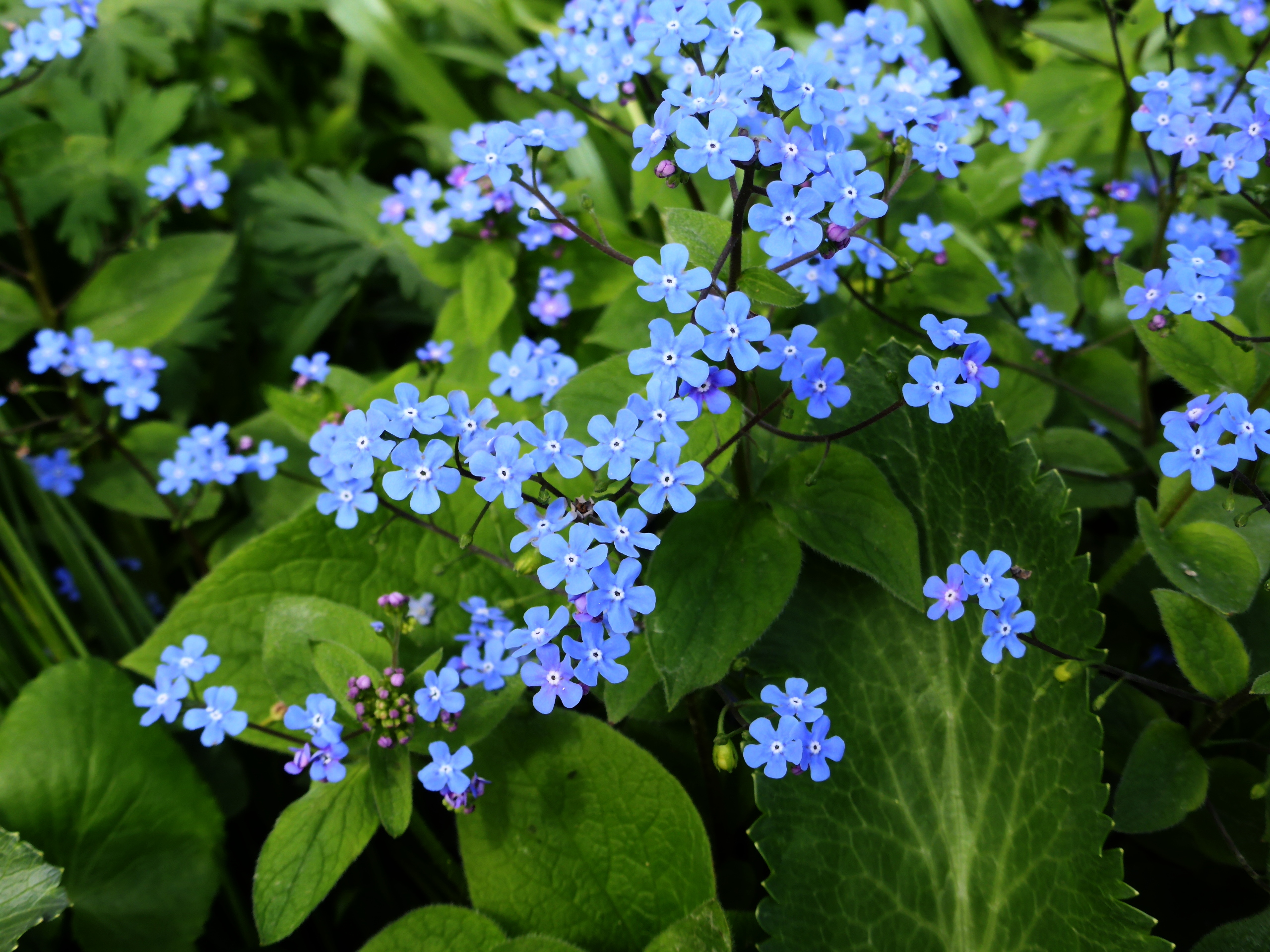
Brunnera is a small genus of rhizomatous perennial flowering plants in the family Boraginaceae (order Boraginales), comprising three accepted species native to the woodlands of Eastern Europe and Northwest Asia. Plants in this genus form low, spreading clumps of heart-shaped to ovate leaves that are covered in soft hairs, giving them a rough, textured feel. In spring they produce airy, branched sprays of small, vivid blue flowers that closely resemble forget-me-nots (Myosotis), a resemblance that has earned them the informal name "false forget-me-not."
The best-known member of the genus is Brunnera macrophylla, commonly called Siberian bugloss or large-leaved brunnera, which has become a popular ornamental groundcover in temperate gardens worldwide. It is particularly valued for its ability to thrive in dappled to deep shade, where few flowering perennials perform as reliably. Many cultivars of B. macrophylla have been selected for ornamental foliage, including forms with silver, cream, or white variegation that brightens shaded borders throughout the growing season.
The genus belongs to Boraginaceae, the borage family, placing it among other familiar blue-flowered plants such as borage (Borago), comfrey (Symphytum), and lungwort (Pulmonaria). The common name "bugloss" derives from the Greek for "ox tongue," a reference to the rough, tongue-like texture of the leaves.
Etymology
The genus name Brunnera honors Samuel Brunner (1790–1844), a Swiss botanist. The shared common name "bugloss" comes from the Greek for "ox tongue," most likely referring to the rough, hairy texture and elongated shape of the leaves.
Distribution
Brunnera species are native to woodlands of Eastern Europe and Northwest Asia. B. macrophylla originates from the Caucasus region, B. sibirica from Siberia and adjacent areas, and B. orientalis from Turkey and the eastern Mediterranean.
Cultivation
Brunnera species, especially B. macrophylla and its cultivars, are widely grown as shade-tolerant groundcovers in temperate gardens. They prefer moist, humus-rich, well-drained soil and perform best in dappled to full shade; prolonged sun can scorch the leaves. Numerous cultivars have been selected, many featuring silvery or variegated foliage that retains ornamental value well beyond the spring flowering period.










