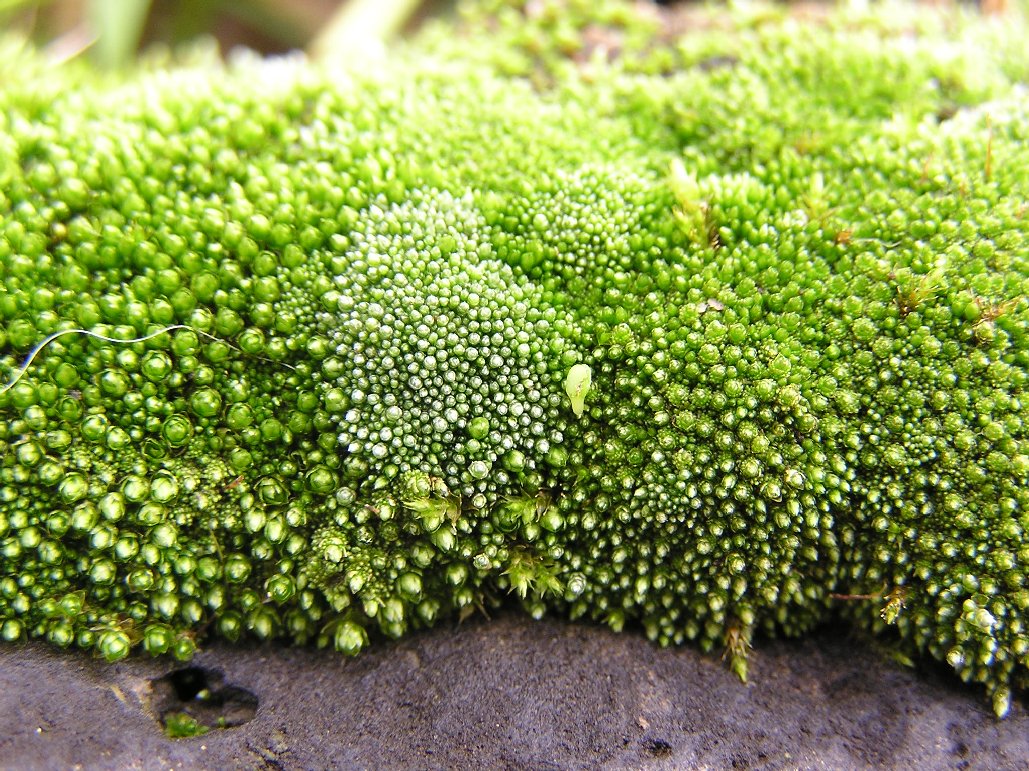
Bryum is a genus of mosses belonging to the family Bryaceae, within the order Bryales, class Bryopsida, and phylum Bryophyta. It is one of the true mosses (division Bryophyta), a group of non-vascular land plants that lack roots, flowers, and seeds, instead reproducing via spores.
Historically, Bryum was considered the largest genus of mosses, encompassing more than 1,000 described species. The genus was originally described by the botanist Johann Hedwig in 1801, with the name derived from the Greek word for moss. This broad circumscription persisted for two centuries, making Bryum a taxonomic catch-all for a highly morphologically diverse assemblage.
Bryum species are characterised by short laminal cells, short thick rounded stems, and cells that are distinctively narrowed at the leaf margins. These traits, along with patterns of asexual reproduction and coloration of the stem and leaf base, have traditionally been used to distinguish species within the genus.
A landmark 2005 reclassification by botanist John R. Spence revealed the genus to be polyphyletic — that is, composed of lineages that do not share a single common ancestor exclusive to the group. This work reinstated the genus Ptychostomum and established the new genera Leptostomopsis and Plagiobryoides. Subsequent molecular studies led to the further segregation of Gemmabryum, Imbribryum, and Rosulabryum. By 2013, DNA-based analyses had significantly reshaped the circumscription of both Bryum and the broader family Bryaceae. In its current, narrower sense, Bryum remains an accepted genus within Bryaceae, though far smaller than its former scope.
Etymology
The genus name Bryum is derived from the Greek word for moss. It was formally described by the German botanist Johann Hedwig in 1801.
Taxonomy Notes
Bryum was found to be polyphyletic through molecular studies, leading to a major reclassification by John R. Spence in 2005. That revision reinstated Ptychostomum and established the new genera Leptostomopsis and Plagiobryoides. Further DNA-based work around 2013 led to the additional segregation of Gemmabryum, Imbribryum, and Rosulabryum. In its current circumscription, Bryum sits within family Bryaceae, order Bryales, class Bryopsida, phylum Bryophyta.










