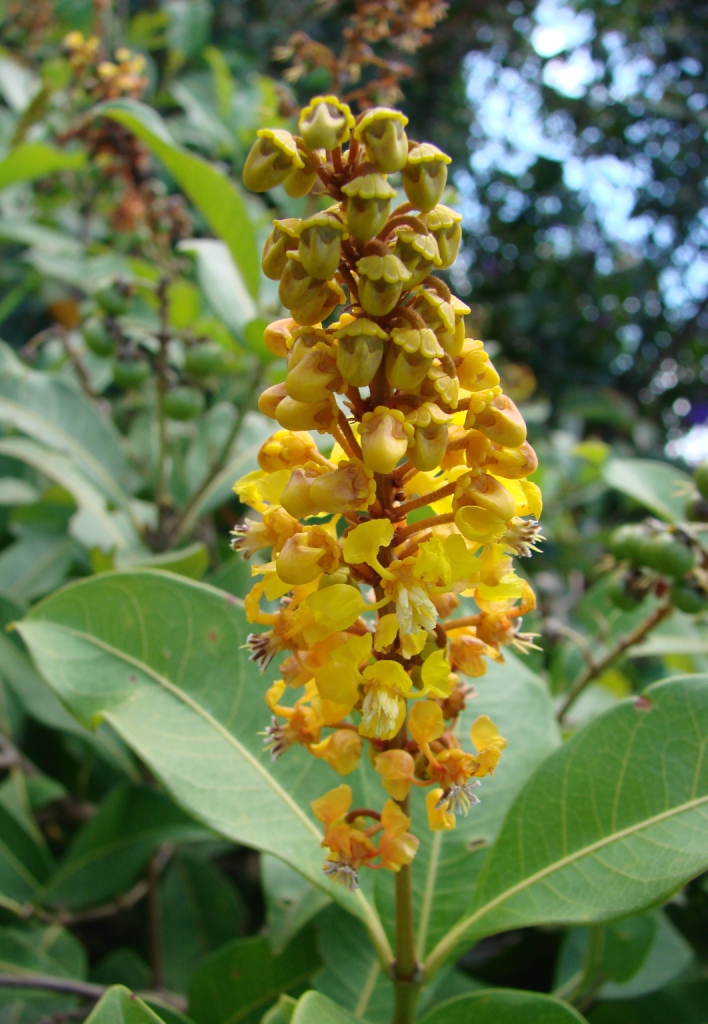
Byrsonima is a large genus of over 135 species of trees, shrubs, and subshrubs in the family Malpighiaceae (order Malpighiales), one of approximately 75 genera in this tropical family. The genus is distributed across the New World tropics and subtropics, ranging from southern Mexico, southeastern Florida, and the Caribbean south to southeastern Brazil.
Plants in this genus share a characteristic morphology: entire leaves, showy yellow flowers, and fleshy, drupe-like fruits. The common name "nance" (or "nanche" in Mexico) refers to these fruits, most famously those of Byrsonima crassifolia, which is an economically significant, if underutilized, crop throughout Latin America. Other widely used common names for the genus include locustberries and serrets (or serrettes).
A defining ecological feature of Byrsonima is its pollination system. The flowers produce floral oils rather than nectar, and pollination is almost exclusively carried out by oligolectic native bees — particularly species of Centris, Epicharis, and Tetrapedia — that are specialized to collect these oils. This tight plant–pollinator relationship makes the genus an important component of New World tropical and savanna ecosystems. Beyond pollinators, the genus supports other wildlife: the fruits are a significant food source for animals such as the golden conure (Guaruba guarouba), while the leaves are consumed by the American moth-butterflies (Hedylidae).
Several species have cultural and ecological significance beyond their fruits. Byrsonima spicata (maricao) is the floral emblem and namesake tree of Maricao, Puerto Rico, where it figures on the city's coat of arms. Byrsonima crassifolia plantings in the dry savannas of Oaxaca, Mexico, have been studied as potential substitute habitat for the critically endangered Tehuantepec jackrabbit (Lepus flavigularis).
Etymology
Members of the genus are commonly known as locustberries — a name that may also refer specifically to Byrsonima coccolobifolia or Byrsonima lucida — as well as serrets or serrettes. The fruit-derived name "nance" or "nanche" is widely used in Latin America for Byrsonima crassifolia in particular.
Distribution
Byrsonima is native to the New World tropics and subtropics, extending from southern Mexico, southeastern Florida, and the Caribbean south to southeastern Brazil. The genus reaches its greatest diversity in South America and is frequently associated with savanna and dry tropical habitats across this range.
Ecology
Byrsonima flowers produce floral oils rather than nectar, and are primarily pollinated by oil-collecting oligolectic native bees of the genera Centris, Epicharis, and Tetrapedia. The fleshy fruits are an important dietary resource for wildlife, including the golden conure (Guaruba guarouba). Leaves of the genus are consumed by American moth-butterflies (Hedylidae). Plantings of B. crassifolia in the dry savannas of Oaxaca have been evaluated as potential surrogate habitat for the endangered Tehuantepec jackrabbit (Lepus flavigularis).
Cultural Uses
The fruits of Byrsonima crassifolia, known as nance or nanche, are edible and represent an underutilized crop of some commercial importance in Latin America. Byrsonima spicata (maricao) serves as the floral emblem and namesake tree of Maricao, Puerto Rico, where it figures on the city's coat of arms.










