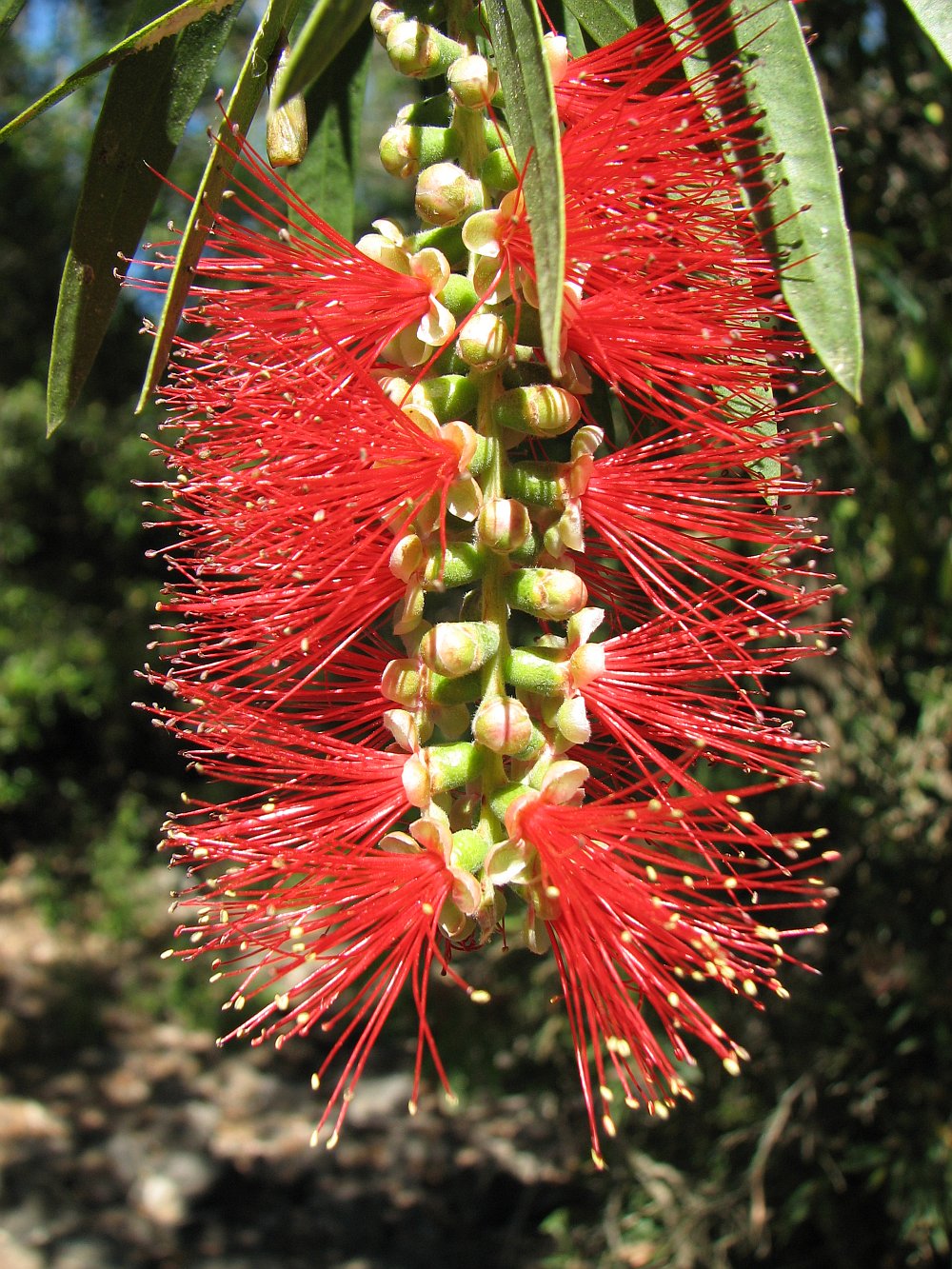
Callistemon is a genus of shrubs in the family Myrtaceae (order Myrtales), first formally described by the Scottish botanist Robert Brown in 1814. The genus is endemic to Australia, with roughly 50 species concentrated along the east coast and in Tasmania, and several in the south-west of Western Australia.
The plants are best known for their striking cylindrical flower spikes, which resemble a traditional bottle brush — densely packed with long, colourful stamens, typically red or crimson, that give the genus its common name, bottlebrush. It is the prominent, elongated, free stamens that distinguish callistemons from their close relatives: Callistemon is named from the Greek kallos (beauty) and stemon (stamen).
Most callistemon species grow in moist, temperate conditions and thrive along watercourses and in seasonally wet soils, though at least some species tolerate drought. Beyond Australia, callistemons are widely cultivated as ornamentals in warm-temperate and subtropical gardens around the world, and have naturalised in scattered locations outside their native range.
The taxonomic boundaries of Callistemon have been contested for over 150 years. Ferdinand von Mueller noted as early as 1864 that the distinction between Callistemon and Melaleuca was "entirely artificial." Molecular phylogenetic work by Lyndley Craven in 2006 and 2009 led to the transfer of most callistemon species into Melaleuca, on the grounds that Callistemon as traditionally circumscribed is paraphyletic. In 2012, Frank Udovicic and Roger Spencer challenged this, arguing the DNA evidence was insufficient to justify the merger and reinstating several species back to Callistemon. The two positions are not yet universally reconciled: the Queensland Herbarium and the New South Wales Herbarium, for instance, differ in the names they accept.
Etymology
The genus name Callistemon combines the Greek words kallos (beauty) and stemon (stamen), a reference to the plant's long, showy, free-standing stamens that define the characteristic bottlebrush flower spike. The genus was first formally named by Robert Brown in 1814.
Distribution
Callistemon is entirely endemic to Australia, with the majority of species occurring in the more temperate regions along the east coast. Two species are native to Tasmania, and several occur in the south-west of Western Australia. Outside their native range, callistemons are widely cultivated as ornamentals in warm climates and have naturalised in scattered locations around the world.
Cultivation
Callistemon species are popular ornamental shrubs in warm-temperate and subtropical gardens worldwide, valued for their vivid bottlebrush flower spikes that attract nectar-feeding birds. Most species favour moist conditions and respond well to regular watering when grown in gardens; however, at least some species are drought-resistant and tolerate drier landscapes. They are used in ornamental landscaping beyond Australia wherever frost is not severe.
Taxonomy Notes
The relationship between Callistemon and Melaleuca has been debated since at least the 1860s. Robert Brown established Callistemon in 1814 to accommodate species of Metrosideros with Melaleuca-like inflorescences and distinct, elongated free stamens; George Bentham noted its gradual transition into Melaleuca in Flora Australiensis. In 2006–2009, Lyndley Craven used DNA evidence to transfer the overwhelming majority of callistemons into Melaleuca, retaining only four taxa (including Callistemon genofluvialis and Callistemon forresterae) outside that genus, treating them as hybrids. In 2012, Udovicic and Spencer countered that this reclassification was premature and reinstated a number of species — including Callistemon wimmerensis — to Callistemon. The taxonomy remains actively contested and acceptance varies by institution.

