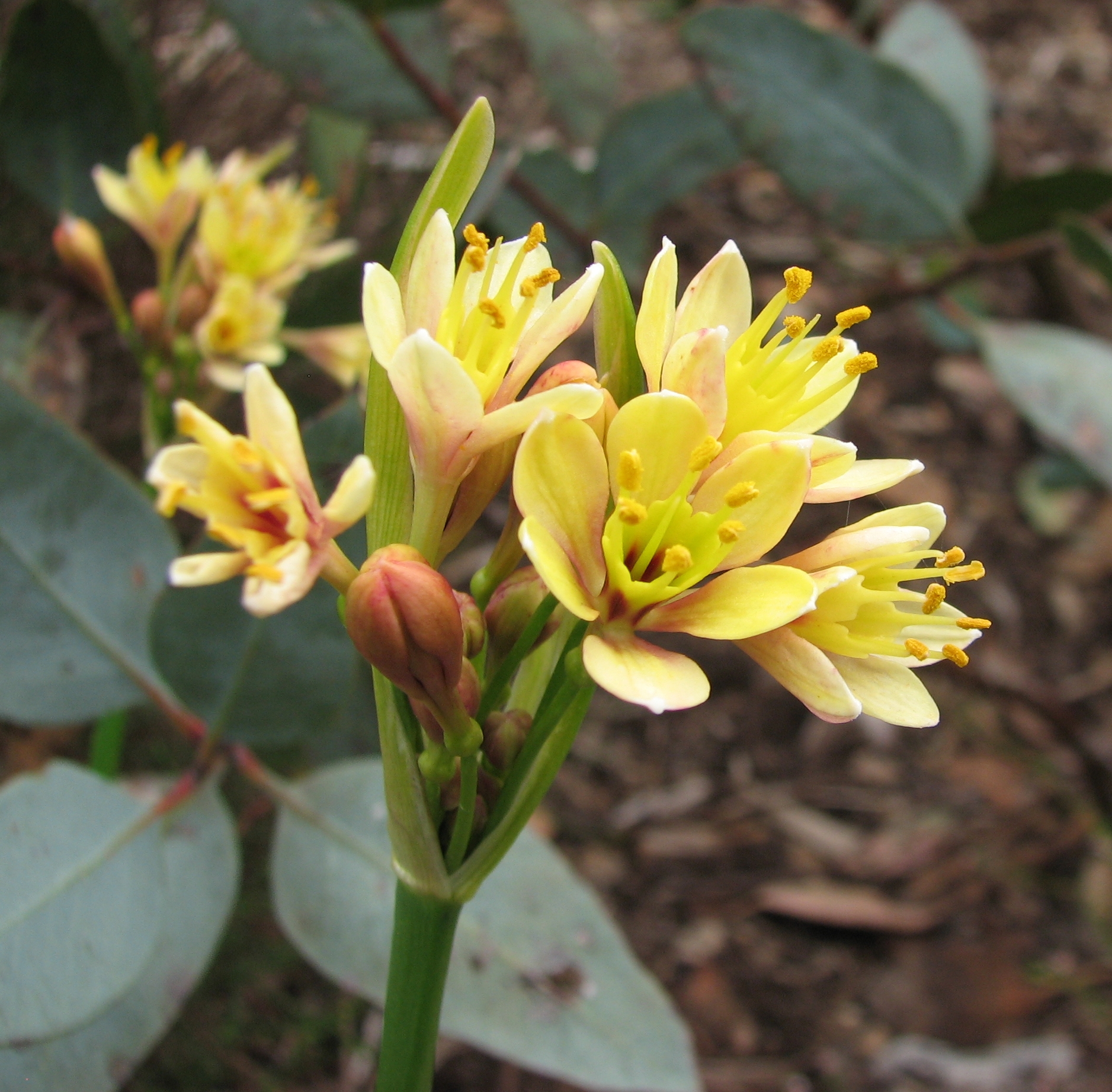
Calostemma is a small genus of herbaceous, perennial, bulb-forming plants in the amaryllis family (Amaryllidaceae, subfamily Amaryllidoideae), placed in the order Asparagales. It was described by Robert Brown and published in his Prodromus Florae Novae Hollandiae in 1810. The genus is endemic to Australia, where its species — commonly known as Wilcannia lilies — grow in arid regions with summer rainfall, ranging from central Queensland through New South Wales and South Australia to south-eastern Australia.
Plants arise from a tunicated bulb and typically flower before or during leaf emergence, so blooming often occurs from an apparently leafless bulb. The narrow, strap-like, shining-green leaves are basal and elongate to 25–30 cm, usually developing fully only after flowering. The umbellate, scapose inflorescence carries several actinomorphic, pedicellate flowers enclosed by 2–3 narrow-ovate spathes. The funnel-shaped perianth is six-lobed, in shades of purplish-red or yellow, sometimes with a paler tube; six stamens are inserted at the throat of the tube, their lower filaments expanded and fused into a corona, with yellow, versatile anthers. The inferior, globose ovary is one-chambered with two ovules and ripens into a roughly globose capsule that ruptures as the smooth, green "seed" enlarges — these propagules are understood to be bulbils rather than true seeds, a feature shared with the related genus Proiphys.
Sources place two to four species in the genus depending on treatment: Calostemma purpureum and Calostemma luteum are broadly recognised, with Calostemma abdicatum and Calostemma cunninghamii also accepted in some taxonomic databases. Because of their large, showy, funnel-shaped flowers, Calostemma species are cultivated as ornamental bulbs.
Distribution
Calostemma is endemic to Australia, where its species grow in arid regions with summer rainfall. Depending on species, the range spans central Queensland, New South Wales, South Australia, and south-eastern/south-central Australia; Calostemma purpureum is the species recorded in New South Wales.
Ecology
Members of the genus typically flower from an apparently leafless bulb, with the strap-like leaves elongating mainly after flowering — an adaptation associated with their arid, summer-rainfall habitat. The rounded capsules rupture as the enlarging propagules mature; these are understood to be bulbils rather than true seeds, as in the related genus Proiphys.
Cultivation
Because of their large, showy, funnel-shaped flowers, Calostemma species are grown as ornamental bulbs.
Taxonomy Notes
The genus was described by Robert Brown and published in Prodromus Florae Novae Hollandiae (1810). It sits in family Amaryllidaceae, subfamily Amaryllidoideae, order Asparagales. Species counts vary by source: Wikipedia lists three species (C. abdicatum, C. luteum, C. purpureum), while the GBIF backbone additionally accepts C. cunninghamii.










